Avtron 4950
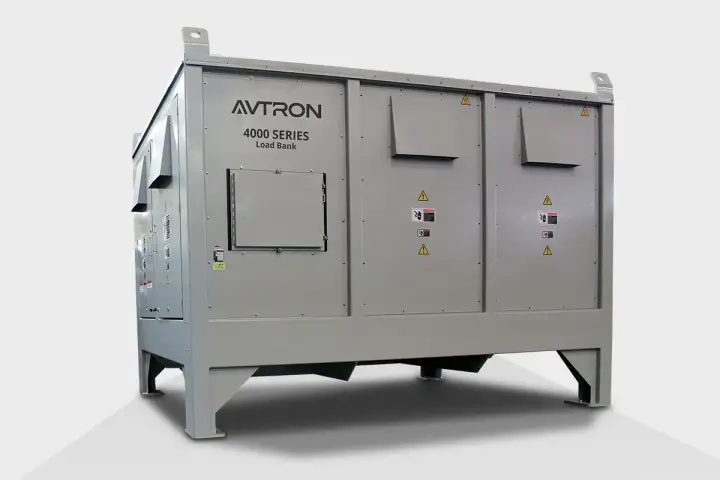
Permanent outdoor resistive load bank rated in kW to 5,000 kW, 50 kW steps at 400, 480 or 600 V, 66,000 CFM
Avtron 4950 is one of 16 load banks tracked in the SecondWatt catalogue, each with specifications, lead times and indicative secondary-market pricing.
Avtron 4950 permanent resistive load bank, 2,500 to 5,000 kW at 400/480/600 V with 50 kW steps. Specifications, capacity conflict and inspection points.
The Avtron 4950 is the top of the 4000 Series, a permanently installed outdoor resistive load bank rated in kilowatts at unity power factor. It is not a kVA product. Load resolution is 50 kW, airflow is roughly 66,000 CFM through direct-coupled TEFC or TEAO fans, and hot air discharges vertically away from personnel. Avtron publishes three different capacity figures for this model. The product page markets 2,500 to 5,000 kW. The pub 5522 rev D data sheet tabulates only 3,000, 3,500 and 4,000 kW, and the 4000 Series brochure says 3,000 to 4,000 kW. Distributor SteadyPower lists a fourth set, 2,500 through 4,000 kW. The 4950 is a low-voltage machine. Published voltages stop at 600 V, so a 5,000 kW build at 480 V is a connection of roughly 6,014 A, which is a bus duct or parallel feeder problem rather than a cable problem. Buyers connecting at 4,160 V or above need the 9000 Series instead. One dimensional caveat matters at purchase. The data sheet gives a single dimension set of 166.25 by 100.00 by 141.00 in and a single weight of 9,600 lb against three separate ratings, so require a job-specific outline drawing before pouring a pad.
Why it matters
At the top of its published range the 4950 puts 5,000 kW of controllable real load on a bus with no live IT equipment at risk. Its 50 kW step resolves 1.0 percent of full scale, which suits generator exercise and is far too coarse for UPS step testing where the containerised 8400 resolves 1 kW. Being resistive, it exercises the engine and the cooling path but not the alternator excitation the way a lagging load does.
Who buys it
Facilities that own standby or prime generation they must exercise on a schedule and have decided a permanent fixed asset beats calling a rental crew several times a year. Data centres, hospitals, water treatment plants and utility peaking sites are the standing customer set. The 4950 specifically is bought when a single connection point of 2.5 MW and up needs testing, since the 4900 covers 1,000 to 2,500 kW below it.
Role in the data center
A permanently installed plant asset rather than a commissioning tool. It sits on the generator paralleling bus or a dedicated switchgear section and exercises engines at real load on a monthly or annual cycle without waiting for a rental unit. Avtron does not name the 4950 in either March 2026 data centre brochure, reaching instead for containers and portables, so treat this as a recurring maintenance duty rather than a headline commissioning product.
Key specifications
| Rated capacity, product page | 2,500 to 5,000 kW resistive at unity pf |
|---|---|
| Rated capacity, data sheet standard builds | 3,000 / 3,500 / 4,000 kW resistive at unity pf |
| Rated capacity, 4000 Series brochure | 3,000 to 4,000 kW resistive at unity pf |
| Load step resolution | 50 kW |
| Load steps at 5,000 kW | 100 steps (5,000 / 50) |
| Load tolerance | -0, +5 percent |
| Voltage | 400 / 480 / 600 V three phase |
| Line current at 5,000 kW, 480 V | 6,014 A (computed, 5,000,000 / (1.732 x 480)) |
| Frequency | 60 Hz per product page |
| Airflow | approximately 66,000 CFM |
| Length | 166.25 in (4223 mm) |
| Width | 100.00 in (2540 mm) |
| Height | 141.00 in (3581 mm) |
| Weight | 9,600 lb (4,354 kg) |
| Enclosure material | Aluminized steel to ASTM A463 gray ANSI 61 powder coat |
| Ambient range | -20 to 120 deg F (-28 to 50 deg C) |
| Warranty | 24 months parts and labor |
Technical summary
Capacity: 2,500 to 5,000 kW resistive per the product page; 3,000, 3,500 and 4,000 kW standard per the data sheet. Rating unit: kW at unity power factor, not kVA. Load step resolution: 50 kW, giving 100 steps at 5,000 kW and 60 steps at 3,000 kW. Load tolerance: -0, +5 percent. Voltage: 400, 480 or 600 V three phase, low voltage only. Frequency: 60 Hz on the product page; the series brochure lists 50, 60 and 50/60 Hz. Airflow: approximately 66,000 CFM, direct-coupled TEFC or TEAO fan motors, vertical discharge. Dimensions: 166.25 x 100.00 x 141.00 in (4223 x 2540 x 3581 mm). Weight: 9,600 lb (4,354 kg). Enclosure: heavy gauge aluminized steel to ASTM A463, gray ANSI 61 powder coat 2.8 +/- 0.4 mils. Ambient: -20 deg F to 120 deg F (-28 deg C to 50 deg C), permanent outdoor installation. Warranty: 24 months parts and labor.
Major variations
Capacity is the live variable and Avtron publishes three conflicting ranges: 2,500 to 5,000 kW on the product page, 3,000, 3,500 and 4,000 kW standard on the pub 5522 rev D data sheet, and 3,000 to 4,000 kW in the 4000 Series brochure. Distributor SteadyPower lists a fourth set at 2,500 through 4,000 kW. The brochure footnote explains the spread, since ratings outside the standard set are engineered to order. Control builds are the other variation: manual 19 inch rack panel, NEMA 4 enclosed control, automatic control, digital metering, SIGMA 2, or pilot relay control. Voltage is ordered as 400, 480 or 600 V.
Configurations and options
Six published control options span a manual rack panel through SIGMA 2, and multiple units network under the SIGMA platform with Modbus support. Avtron publishes a three-part specification document for 4000 Series vertical discharge units, pub 5701, for an engineer writing a Division 26 section. A standing aluminized steel construction document covers the corrosion package across the 4000 and 7000 Series.
Compatibility and dependencies
Low voltage only at 400, 480 or 600 V, so a medium-voltage connection needs the 9000 Series instead. At 5,000 kW and 480 V the tie is roughly 6,014 A, which normally means bus duct or parallel feeders rather than a cable set. Vertical upward discharge requires clear overhead space, so any canopy, pipe rack or adjacent structure built after installation becomes a constraint. The 4950 is compatible with switchgear and building management systems and networks with other banks under SIGMA. Confirm frequency against the nameplate, since the product page publishes 60 Hz while the series brochure lists 50 and 50/60 Hz.
Pricing and availability
Comparable secondary-market band: 49.78–70.54 $ per kW. Trend: stable No price series exists for this model. One structural finding does apply at this size: used dollars per kW does not fall with scale the way new dollars per kW does, so the used band observed for small banks overlaps New OEM pricing for 1,500 to 3,000 kW units. A buyer shopping a 2 MW machine can find used asks above new list, which is a genuine market inefficiency. Lead time, new: The 4950 does not appear on Avtron's stock list, whose 24 line items are all 2,000 kW and below, and SteadyPower publishes no lead time for it. The only published numeric new-equipment lead time in this category is a 3 to 4 week quick-ship on four 4800 Series builds, which belongs to that series and must not be carried across.. Lead time, used or refurbished: No used 4950 listed as of August 2026.. Warranty, new: 24 months parts and labor, per the pub 5522 rev D data sheet.. Warranty, used: No used 4950 listed as of August 2026; confirm any remaining OEM warranty with the seller..
Lifecycle and maintenance
Avtron publishes no MTBF, design life or maintenance interval table for the 4950. The pub 5522 rev D data sheet publishes a 24 month parts and labor warranty and nothing further on service life. What is published: the unit is built for continuous full-load outdoor operation, rated -20 deg F to 120 deg F, in ASTM A463 aluminized steel with a 2.8 +/- 0.4 mil powder coat. Wear runs contactors first, then fan motors and bearings, then controls, with the resistive elements last because they have no moving parts and no firmware. Avtron sells model-specific spares kits as a standing product line, which signals that consumables are expected. A 4,000 kW run held four hours draws 16,000 kWh from the plant, discharged vertically outdoors, so the clearance question is overhead structure rather than a coolant loop.
Thermal and emissions profile
No on-site combustion and no direct emissions. Rated 2,500–5,000 kW and permanently installed outdoors, it rejects the full applied load as heat to atmosphere through vertical discharge. At the top of that range the thermal plume is comparable to a large air-cooled chiller plant, so clearance from intakes and adjacent equipment is the governing constraint. Emissions during a test are those of the generator or bus source under test.
Common failure points
- Load contactors — One or more 50 kW steps fails to pick up, or applied load reads low by an exact multiple of 50 kW
- Resistive elements — Phase currents unbalanced at a fixed step, or total load short of rating beyond the -0, +5 percent tolerance
- Cooling fan motor or bearing — Airflow loss, over-temperature trip, or motor current drifting up over successive tests
- Over-temperature interlock — Nuisance trips at high ambient, or an interlock that never trips because it has been bypassed
- Enclosure corrosion — Rust blooms at seams and the base frame, powder coat lifting from fastener heads
- Control system obsolescence — Hand-held or PC software will not talk to the bank, or the unit cannot be networked with newer SIGMA 2 banks
- Terminal and conduit entry water ingress — Tracking marks, corrosion or insulation resistance falling at the incoming terminals only
Inspection checklist
Element bank integrity: megger each of the 3 phases to ground with the contactors open, and compare all 3 readings against each other before comparing to any absolute limit. Load step count: confirm the unit switches the number of steps its rating implies: 60 steps at 3,000 kW, 80 at 4,000 kW, 100 at 5,000 kW, all at the published 50 kW step. Step accuracy: apply each step and verify measured load lands inside the published -0, +5 percent tolerance. Nameplate voltage: confirm 400 V, 480 V or 600 V matches your bus; a 600 V bank on a 480 V bus delivers roughly 64 percent of rating because resistive power scales with voltage squared. Frequency: the product page publishes 60 Hz only while the series brochure lists 50 and 50/60 Hz, so read the nameplate rather than the catalogue.
Procurement channels
New through Avtron and its distributors. SteadyPower is the only distributor publishing dollar list prices for Avtron resistive banks as of August 2026, and it publishes none for any stationary, medium-voltage, liquid-cooled or resistive-reactive unit including this one. Global Power Supply and Curtis Power Solutions both carry the stationary line without prices. The used channel is thin at this size. Used load bank listings are concentrated under 250 kW and none exceeds 750 kW as of August 2026, so large permanent banks appear to leave service with the building rather than into resale. Avtron states it does not rent its own equipment and refers buyers to rental companies.
Regional notes
The product page publishes 60 Hz at 400, 480 or 600 V, which covers North American practice, while the 4000 Series brochure lists 50, 60 and 50/60 Hz across the series. No NRTL listing file number is published for the 4950. Confirm frequency and listing on the nameplate for any project outside North America.