NVIDIA B200 SXM6 180GB
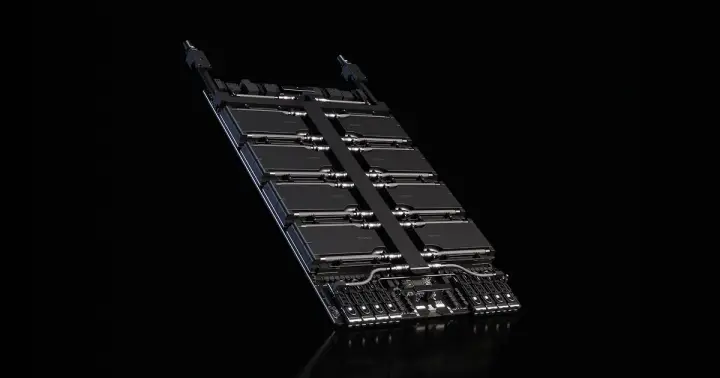
1,000 W Blackwell accelerator whose 8-GPU node draws 14.3 kW and racks four-deep at 57.2 kW
NVIDIA B200 SXM6 180GB is one of 24 data center GPUs tracked in the SecondWatt catalogue, each with specifications, lead times and indicative secondary-market pricing.
NVIDIA B200 SXM6 180GB specs and verified power: 1,000 W per GPU, 14.3 kW per 8-GPU DGX B200 node, 57.2 kW per rack at four nodes, plus observed pricing.
The B200 SXM6 180GB is the volume Blackwell training accelerator, and it is not a card. It carries 180 GB of HBM3E at 7.7 TB/s and rates at configurable up to 1,000 W, mounted only on an 8-GPU HGX B200 baseboard or inside an NVIDIA DGX B200. Two of the three sellers publishing a baseboard price state it cannot be bought except inside a complete server. So there is no legitimate per-GPU transaction price for this part, and every per-GPU figure in circulation is a division. The facility number is not the 1,000 W. NVIDIA rates a DGX B200 at 14.3 kW maximum in 10 rack units, so the eight GPUs are 56 percent of node power. Four of those nodes fill a 48U rack at 32 GPUs and draw about 57.2 kW against a 63 kW supply ceiling. A widely repeated figure of 120 kW for B200 is a GB200 NVL72 rack number from a November 2024 explainer, wrong on product class and wrong on GPU count, and it overstates this rack by 2.1 times. Air cooling is shipping at 1,000 W and liquid is optional rather than mandatory, with separate NVIDIA baseboard part numbers ending 00A0-000 for air and 00A1-000 for liquid. Direct-to-chip liquid becomes mandatory only at 1,200 W, which is the Grace-paired GB200 rack part and a different product. Transient behaviour here is measured rather than modelled, with Stanford telemetry recording one B200 falling from 1,000 W to 50 W.
Why it matters
This is the Blackwell part that fits a retrofit. At about 57.2 kW for 32 GPUs it sits below the 100 kW threshold that forces a facility rebuild, and it ships in air-cooled chassis at 1,000 W a GPU. It is also the part most often mispriced on power, because the 120 kW GB200 rack figure gets attached to it and doubles the electrical plan.
Who buys it
Neoclouds and hyperscale training operators building 32-to-256-GPU scalable units, enterprises replacing 8-GPU H100 nodes inside an existing 60 kW rack envelope, and colocation tenants whose halls already carry 60 kW a rack. Also inference operators who want a single-node 1.4 TB NVLink domain without committing to a liquid-cooled rack and a coolant distribution unit.
Role in the data center
Training and fine-tuning first, high-throughput inference second, landing in the 57 to 63 kW per rack density band at 32 GPUs air-cooled. A 4U direct-to-chip liquid build takes the same footprint to 96 GPUs and 96 kW of GPU alone.
Power envelope
- Per accelerator
- 1,000 W — Verified: Maximum configurable board power, manufacturer specification. source
- Per 8-accelerator node
- 14.3 kW electrical — Verified: NVIDIA DGX B200 published maximum system power — 14.3 kW against 8 kW of accelerator (1.79x). Sizing from accelerator watts alone under-provisions the building. source
- Per rack
- ~57 kW — Derived: 4 nodes per rack at the published node power, bound by the 10U chassis height in a 42U rack (power alone would allow 9). State your own budget and rack height and the count changes.
- Cooling class
- DLC strongly preferred — Derived: Per-accelerator power at or above 1000 W. Air-cooled OEM systems exist at this level, at reduced rack density and higher airflow; liquid cooling is the practical choice above roughly 40 kW per rack. Configuration decides, not the accelerator alone.
- Accelerators per IT MW
- ~559 — Derived: 1 MW IT load / (14.3 kW per 8-accelerator NVIDIA DGX B200 node). IT load only — excludes cooling and distribution losses.
Node figures are published OEM system ratings; rack counts are arithmetic against a stated rack budget and move with your own cooling design. Assumption set version 2026-09-11a.
Key specifications
| GPU memory | 180 GB HBM3E |
|---|---|
| Memory bandwidth per GPU | 7.7 TB/s |
| Total fast memory, 8-GPU HGX B200 | 1.4 TB |
| Max thermal design power, configurable | up to 1,000 W |
| Per-GPU ceiling with reduced power cabling | 800 W |
| Node maximum power, 8-GPU DGX B200 | 14.3 kW |
| Node height | 10 RU |
| Rack power, four nodes and 32 GPUs air-cooled | 57.2 kW |
| Heat rejection, 8-GPU node | 48,794 BTU/hr |
| Airflow, 8-GPU node | 1,550 CFM |
| Inlet air temperature range | 10 to 35 degrees C |
| NVLink bandwidth per GPU | 1.8 TB/s |
| NVLink domain size on an HGX baseboard | 8 GPUs |
| Host interface | PCIe Gen5, 128 GB/s |
| FP4 throughput across 8 GPUs, sparse and dense | 144 and 72 PFLOPS |
| Measured single-GPU transient floor | 1,000 down to 50 W |
Technical summary
Architecture: Blackwell, two dies on TSMC 4NP, 208 billion transistors, 10 TB/s die-to-die. Form factor: SXM6 on an 8-GPU HGX B200 baseboard or a DGX B200, not a PCIe card. Memory: 180 GB HBM3E at 7.7 TB/s per GPU, 1.4 TB and 62 TB/s across eight. Max TDP: configurable up to 1,000 W, and 800 W with fewer power cables connected. Node power: 14.3 kW maximum for an 8-GPU DGX B200 in 10 rack units. Rack power: about 57.2 kW at four nodes and 32 GPUs, 63 kW supply ceiling. Interconnect: fifth-generation NVLink 1.8 TB/s per GPU, 14.4 TB/s across an 8-GPU domain. Host link: PCIe Gen5 at 128 GB/s, plus 8 ConnectX-7 at up to 400 Gb/s in a DGX B200. Throughput: 144 PFLOPS FP4 sparse and 72 PFLOPS dense across eight, vendor figures. Cooling: air and liquid baseboards both ship under separate NVIDIA part numbers.
Major variations
B100 was announced as the 700 W rung of the same die pair, quoted at 14 PFLOPS FP4 against B200 at 18 PFLOPS at 1,000 W and 20 PFLOPS at 1,200 W. NVIDIA named B100 in its March 2024 AWS partnership release; what shipped in May 2025 was P6-B200, 8 GPUs and 1,440 GB. No HGX B100 SKU, datasheet row, lifecycle entry or cloud offer exists as of September 2026, so treat B100 as announced and superseded, not sourceable. The same silicon in a GB200 superchip is different: 186 GB HBM3E at 8 TB/s, up to 1,200 W, liquid-cooled only, inside a GB200 NVL72 or NVL4. Blackwell Ultra is the next step up at 1,100 W on an HGX B300 baseboard. Two B200 baseboard variants exist: air-cooled passive 935-26287-00A0-000 and liquid-cooled 935-26287-00A1-000, plus Lenovo-labelled 27A0-000 and 27A1-000. Loose SXM6 modules appear in resale under 699-2G525 numbers, every one found with a QS or TS sample suffix.
Configurations and options
Air-cooled 8U and 10U chassis at four nodes and 32 GPUs a rack, and 4U direct-to-chip liquid chassis at up to 96 GPUs a rack. DGX B200 is the NVIDIA-built reference at 10 rack units with six 3.3 kW supplies at 5+1. Supermicro air nodes carry six 5,250 W supplies at 3+3, which is 15.75 kW of non-redundant capacity a node.
Compatibility and dependencies
Host platform is an 8-GPU HGX B200 baseboard in an OEM chassis or an NVIDIA DGX B200, so there is no single-GPU path, and two of three resellers state the baseboard cannot be ordered on its own. Qualified hosts include Intel Xeon Platinum 8570 in a DGX B200 and dual Xeon 6 or AMD EPYC 9005 and 9004 in 4U and 8U chassis. Interconnect is fifth-generation NVLink at 1.8 TB/s per GPU and 14.4 TB/s across a domain of 8, with host link PCIe Gen5 at 128 GB/s. Power and cooling drive the rest of the design. A DGX B200 needs 200 to 240 V AC and six 3.3 kW supplies at 5+1, which is 16.5 kW of non-redundant capacity a node and 66 kW across four, so provision the feed against 63 to 66 kW rather than the 57.2 kW draw. Air-cooled reference clusters use 208 V 60 A three-phase in 48U enclosures. Plan alongside liquid cooling, busway for the 60 kW-plus feed, PDUs and racks.
Pricing and availability
Published price range: $335,487.20 - $372,994.00 per 8-GPU HGX B200 baseboard, new, which is $41,935.90 - $46,624.25 per GPU on a divisor of eight; two of three sellers state the baseboard cannot be bought except inside a complete server, so the per-GPU figure is a division and not a transaction price. Evidence: integrator analysis · new condition · Eight-GPU HGX B200 baseboard, divided by eight · observed Jul 2026. Comparable secondary-market band: 400000–500000 $ per accelerator (baseboard price on a divisor of 8) (Jul 2026). Trend: stable No five-year series exists and none can, because B200 reached general cloud availability on 15 May 2025. The observable trend through 2026 is allocation-constrained and flat rather than depreciating, with a July 2026 integrator analysis recording loose-GPU street quotes of 45,000 to 50,000 dollars against a list band of 30,000 to 40,000. The A100 and H100 curves elsewhere in this category are the only real depreciation evidence in the category, and they are not this part price. Lead time, new: 8 to 16 weeks for buyers with an existing OEM relationship, improved from 12 to 24 weeks in Q4 2025; 30-plus weeks for non-priority buyers on broker data. Every baseboard listing checked on 10 September 2026 was out of stock, pre-order or contact for pricing.. Lead time, used or refurbished: No established secondary channel.. Warranty, new: 3 years with 120 days advance replacement on a new baseboard, quoted as overnight replacement for 120 days and two weeks afterwards.. Warranty, used: Treat a used board as out of warranty unless the seller produces a written transfer. The advance-replacement window is a 120-day clock from original sale rather than a 3-year one..
Lifecycle and maintenance
NVIDIA publishes no MTBF or service-life figure for any data center accelerator, and B200 is current rather than deprecated in NVIDIA's enterprise software support lineup. What is bounded is the operating envelope, with a DGX B200 documented for a 10 to 35 degree C inlet, 1,550 CFM and 48,794 BTU/hr of heat. New baseboards carry a 3-year warranty with 120-day advance replacement, so the useful clock on a used board is the 120 days rather than the 3 years. Service life in this category is set by economics rather than wear, and no depreciation curve exists yet because the oldest generally available B200 capacity dates to 15 May 2025.
Common failure points
- HBM3E memory stack — Correctable ECC counts climb, then uncorrectable errors and retired pages, and training jobs abort mid-run
- SXM6 module on a non-serviceable baseboard — One accelerator drops from enumeration and total memory reads short of 1,440 GB
- Under-provisioned rack feed after a Hopper swap — Breaker trips at load, or a rack that cannot be filled to four nodes
- Power cabling below the platform specification — No fault is raised and measured throughput lands short of the datasheet
- Baseboard-to-chassis cooling mismatch — Board will not mount, or mounts and overheats under sustained load
- Synchronised power swings across a training cluster — Upstream voltage disturbance and generator stress that no single node reports
- Qualification or test-sample module in production — Passes basic diagnostics then behaves unpredictably under sustained load with no support path
Inspection checklist
HBM row-remapping history: run nvidia-smi -q -d ECC on all 8 modules and record retired page counts, because HBM3E is not repairable and a rising remap count sets the remaining life of the whole baseboard. Uncorrectable ECC event log: pull volatile and aggregate counters, and treat any non-zero uncorrectable count on a board sold as tested as grounds to reject or reprice. Hours in service: request accumulated power-on hours per module; volume B200 shipment began mid-2025, so a board claiming under 4,000 hours in September 2026 is plausible and one claiming 30,000 is not. Thermal-throttle counts: read the clock-throttle reason counters, since sustained thermal throttling on an air-cooled 1,000 W board points at a chassis airflow fault rather than a GPU fault.
Procurement channels
New through OEMs and integrators only, as a line item inside a configured server rather than as a component. Named sellers with published baseboard prices on 10 September 2026 were Exxact, Turbo Max GPU and Ahead-IT, and none had stock. Wiredzone lists the same part number with email for price.
Regional notes
Blackwell is in the BIS 3A090/4A090 control set per guidance of 31 May 2026, which classifies rather than names models. No export-compliant variant is published; B30A appears only in trade reporting. BIS guidance of 31 May 2026 turns on the counterparty: a licence is required for any entity headquartered in Country Group D:5 or Macau, or with an ultimate parent there, from every destination outside the US, regardless of location. 91 FR 1684 of 15 January 2026 gates case-by-case China and Macau review at both total processing performance under 21,000 and DRAM bandwidth under 6,500 GB/s. B200's 7,700 GB/s is 18 percent above the gate, so presumption of denial holds; no Blackwell TPP figure.