FuelCell Energy SureSource 4000, 3.7 MW (discontinued)
Manufacturer: FuelCell Energy
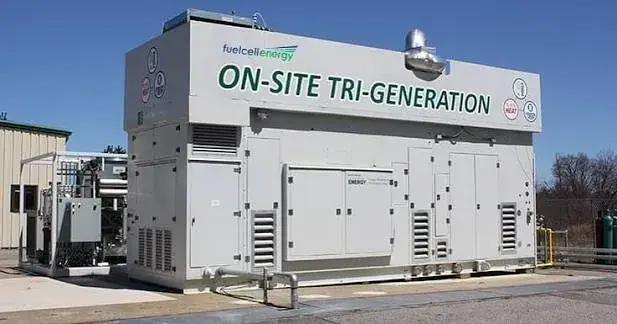
FuelCell Energy's discontinued 3.7 MW high-efficiency carbonate plant, with roughly three units ever built
This model is part of SecondWatt’s fuel cell research catalogue. Specifications and price observations are included where supported by sources. Equipment availability and commercial terms require confirmation.
FuelCell Energy SureSource 4000 dossier: 3.7 MW rather than 4 MW, roughly 60% electrical efficiency, discontinued status, known fleet and inspection guidance.
The SureSource 4000 is a discontinued 3.7 MW combined heat and power carbonate plant, and the name overstates the rating. It was never a 4 MW machine: the Connecticut Siting Council petition for the Danbury installation describes a 3.7 megawatt combined heat and power fuel cell facility, and the Groton Naval Submarine Base installation is two SureSource 4000 plants with a total output of 7.4 MW, which is 3.7 MW each.
The distinguishing specification is efficiency. FuelCell Energy described the Triangle Street plant as achieving approximately 60 percent electrical efficiency when it began commercial operation in April 2020, which is materially above the 50% published for the current 1.25 and 2.5 MW systems and is the highest figure the manufacturer has published for a carbonate product.
It is gone from the catalogue. The current carbonate platform page lists only the 1500 and 3000 systems, the Block System range runs 1.25, 2.5 and 12.5 MW, and no 4000-series product appears in the March 2026 corporate presentation or any Block System material. No formal discontinuation notice was ever published. The total known installed population is roughly three units and 11.1 MW across Danbury and Groton, which is far too small to support a secondary market.
Why it matters
The SureSource 4000 is no longer offered. With roughly three units built, no successor at its 3.7 MW rating and no formal discontinuation notice, its approximately 60% electrical efficiency figure still circulates as if the product were current, and a buyer at this rating is directed by FuelCell Energy to the 2.5 MW or 12.5 MW Block Systems instead.
Who buys it
Only the operators of the existing Danbury and Groton installations, who need service and module exchange rather than new equipment. There is no buyer profile beyond that fleet, and any prospective purchaser at this rating is directed to the 2.5 MW or 12.5 MW Block Systems instead.
Role in the data center
None current. The installed units serve a municipal site and a naval base as baseload combined heat and power rather than data center supply. No unit has been offered new since the platform left the catalogue.
Key specifications
| Rated output | 3,700 kW |
|---|---|
| Rating corroboration | 2 units totalling 7.4 MW at Groton |
| Electrical efficiency | approximately 60 % |
| Technology | Molten carbonate, internally reforming |
| Production status | Discontinued; absent from the current platform page |
| Successor at this rating | None; nearest are the 2.5 MW and 12.5 MW Blocks |
| Danbury commercial operation | 2020-04-21 |
| Known installed population | about 3 units, 11.1 MW |
| Module design life | 5-year target cell design life (legacy) |
| System design life | 25 to 30 years |
| Product warranty | 15 months after shipment or 12 months after acceptance |
| Datasheet availability | No public datasheet was ever published |
Technical summary
Rated output: 3,700 kW, not 4,000 as the name implies. Electrical efficiency: approximately 60%, the highest FuelCell Energy has published for carbonate. Technology: molten carbonate, internally reforming, roughly 650 degrees C class. Configuration: combined heat and power. Production status: discontinued with no successor at 3.7 MW; no formal notice published. Known installed base: about 3 units and 11.1 MW total. Danbury, Connecticut: 1 unit, commercial operation from 2020-04-21, manufacturer-owned. Groton Naval Submarine Base: 2 units totalling 7.4 MW. Module design life: 5-year target cell design life on legacy modules. System design life: 25 to 30 years, so balance of plant far outlives the stacks.
Major variations
No variants are documented. The platform appears only in the two known installations, one at Danbury and two at Groton, both configured for combined heat and power. The two Groton units total 7.4 MW at 3.7 MW each, and the Danbury unit brings the known population to roughly three units and 11.1 MW. No successor product exists at this rating.
Compatibility and dependencies
Both known installations are combined heat and power sites, so the plant depends on a host thermal load to reach its published efficiency. Service depends entirely on FuelCell Energy under a long-term service agreement, and with roughly three units built there is no independent parts or service channel. Balance of plant carries a 25 to 30 year design life against a 5-year target cell design life, so stack exchange is the recurring dependency across the asset life.
Pricing and availability
Trend: rising Lead time, new: Not offered. Lead time, used or refurbished: No used or refurbished unit listed as of August 2026.
Lifecycle and maintenance
Carbonate systems are designed around a 25 to 30 year system life with stack modules replaced inside it, at a 5-year target cell design life on legacy modules and 7 years on current production. The manufacturer publishes a 10% to 15% decrease in power and efficiency across the life of a module, and the legacy 3000 datasheet expressed the same thing as an efficiency band falling from 49% to 44% LHV. Balance of plant therefore outlives three to five module generations, which is why value concentrates in module age rather than plant age. Long-term service agreements run up to 20 years and include module exchange, and the agreement permits a new or a used replacement module.
Thermal and emissions profile
Fuel cells generate without combustion, and that is the whole regulatory argument for siting them where an engine or a turbine cannot be permitted. California's distributed generation certification regulation sets 0.07 lb/MWh NOx, 0.10 CO and 0.02 VOC for fossil-fuelled distributed generation, and current products certify far below it, at 0.003 lb/MWh NOx for Bloom, 0.01 for FuelCell Energy and 0.02 for HyAxiom. Sacramento's 2024 best available control technology determination classifies those limits as achieved in practice and allows a combined heat and power credit of one MWh per 3.4 million Btu of recovered heat. Carbon dioxide is not eliminated: a natural gas fuel cell emits 679 to 1,006 lb/MWh electric-only, falling to 496 to 567 with full heat recovery.
Common failure points
- Stack module end of life — Modules carry a 5-year legacy or 7-year current target cell design life and then need a maker exchange
- Electrolyte loss — Molten carbonate is lost over long exposure through volatilization of alkali chlorides
- Service agreement transferability — Without a transferable agreement the asset cannot be exchanged, serviced or warranted by anyone
- Sulfur and halide contamination — Testing at 5 ppm H2S produced rapid power loss, and organic sulfides and halides remain unsolved
- Second-life modules — The maker may fit a new or used replacement module, so a refurbished plant can hold aged stacks
- Long start-up — A cold unit is not a same-day restart and no published start duration exists
Inspection checklist
Module install date and hours: legacy modules carry a 5-year and current production a 7-year target cell design life. Nameplate generation: a 1.4 MW or 2.8 MW plate is legacy; the same lines sell new today at 1,250 kW and 2,500 kW. Service agreement: confirm a transferable long-term agreement exists and that the maker will novate it, or the asset cannot be serviced at all. Used replacement modules: the maker reserves the right to fit a new or used module, so a refurbished plant may hold second-life stacks. Efficiency band: the legacy 3000 datasheet published 49% falling to 44% LHV; assume the lower end on a late-cycle stack. Power walk-down: the maker publishes a 10% to 15% decrease in power and efficiency across the life of a stack module. Fuel history: obtain the gas analysis record, because chloride and sulfur exposure are cumulative and irreversible.
Procurement channels
None. The platform is not offered new, no dealer stocks it, and the only route to service on an existing unit is the manufacturer's long-term service agreement. The known population is roughly three units across two Connecticut sites, which is far too small to support any secondary channel.
Regional notes
Both known installations are in Connecticut, at Danbury and at the Groton Naval Submarine Base, reflecting the manufacturer's home-state procurement base. Neither site is a data center, and both are configured for combined heat and power.