Ballard Power Systems FCgen-LCS liquid-cooled stack, 93 kW gross direct current
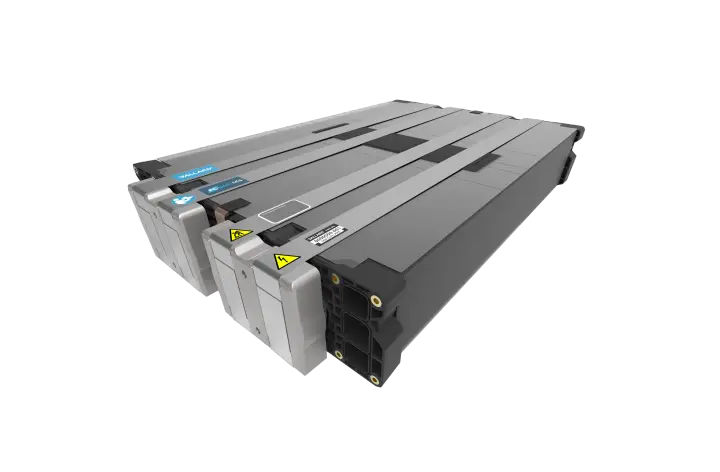
Ballard's heavy-duty liquid-cooled stack, 93 kW of bare direct current hardware rather than a genset
This model is part of SecondWatt’s fuel cell research catalogue. Specifications and price observations are included where supported by sources. Equipment availability and commercial terms require confirmation.
Ballard FCgen-LCS dossier: 93 kW gross direct current at 500 A and 187 V, why it is a stack and not a genset, plus fuel purity and inspection notes.
FCgen-LCS is a fuel cell stack, not a generating set, and that distinction governs how it should be bought. Ballard's own taxonomy separates fuel cell modules, FCmove and FCwave, from fuel cell stacks, the FCgen family. The datasheet publishes a direct current operating point of 93 kW at 500 A and 187 V, with no inverter, no enclosure, no air handling, no hydrogen train and no controls. A buyer acquires between 10.2 and 26.7 kg of hardware depending on cell count, to a maximum of 311 cells.
The stack is current production and it sits inside Ballard's own FCwave module, which the stationary power page describes as powered by the FCgen-LCS heavy-duty liquid-cooled stack. Ballard reports revenue from stationary stacks sold separately, so a standalone purchase is a real channel rather than an inference. What changed in 2026 is the layer above it: Ballard acquired GeoPura on 23 June 2026 for 275 million pounds upfront against an enterprise value of 301.1 million, adding containerised gensets with alternating current output at 250 kW and 500 kW.
Two published inconsistencies matter at valuation. The FCwave page claims modules typically last up to 25,000 hours while the FCwave datasheet states above 15,000 hours for that module, and the 15 MW stationary order of June 2026 describes FCmove-HD+ as 100 kW each against a 120 kW datasheet rating. Ballard publishes no stack life, no degradation rate, no certification list and no warranty for FCgen-LCS itself.
Why it matters
Rating basis is the first thing to check. A 93 kW figure quoted without the words stack gross direct current invites comparison against a 100 kW alternating current genset, and the two are not the same purchase by a wide margin. Stationary revenue was 8.1 million dollars in 2025 against 99.4 million total, so this channel is small and thinly documented.
Who buys it
System integrators and genset builders who supply their own balance of plant. The stack is a component sold into hydrogen genset programmes, marine shore power and backup power modules, and Ballard booked 15 MW of stationary demand in June 2026 as 150 modules rated 100 kW each. A data center operator is not the buyer for this part number; the buyer is the company assembling the machine that a data center operator would then purchase.
Role in the data center
Component only. The data center relevance is indirect, through the hydrogen gensets integrators build around it and through the GeoPura containerised units now inside the group. The stack itself has no inverter, enclosure, controls or hydrogen train.
Key specifications
| Rated power | 93 gross direct current kW |
|---|---|
| Current at rated power | 500 A |
| Voltage at rated power | 187 V DC |
| Power density | 4.3 kW/L |
| Maximum cell count | 311 cells |
| Fuel specification | SAE J2719; ISO 14687:2019 Grade D |
| Ambient operating range | minus 30 to plus 80 degrees C |
| Minimum start-up temperature | minus 30 degrees C |
| Maximum coolant temperature | 86 degrees C |
| Coolant medium | fuel cell grade glycol |
| Dimensions | 443 W x 110 H x 131 to 601 L mm |
| Mass | 10.2 to 26.7 with cell count kg |
| Parent module | FCwave, 200 kW, lifetime above 15,000 hours |
| Stack life |
Technical summary
Technology: proton exchange membrane, liquid-cooled stack, direct current only. Rated point: 93 kW gross at 500 A and 187 V direct current. Power density: 4.3 kW per litre. Cell count: up to 311 cells, with the rated point footnoted to the 311-cell build. Fuel: SAE J2719 and ISO 14687:2019 Grade D hydrogen. Ambient operating range: minus 30 to plus 80 degrees C. Minimum start-up temperature: minus 30 degrees C. Coolant: fuel cell grade glycol, inlet 2 to 85 degrees C, maximum 86 degrees C. Dimensions: 443 mm wide, 110 mm high, 131 to 601 mm long with cell count. Mass: 10.2 to 26.7 kg with cell count.
Major variations
One catalogued liquid-cooled heavy-duty stack whose length and mass scale with cell count, from 131 mm and 10.2 kg to 601 mm and 26.7 kg. The siblings in the FCgen family are FCgen-HPS, a liquid-cooled propulsion stack, and FCgen-1020ACS, an air-cooled low-power stack rated 41.1 W per cell at 660 mV and 65.3 A.
Configurations and options
Sold bare as a stack, or as the core of Ballard's FCwave module at 200 kW with 53% peak efficiency, operating voltage of 350 to 720 V without a converter, CANbus and Modbus TCP/IP controls and DNV marine type approval. The alternating current products in the group are the GeoPura units acquired in June 2026: HPU1 at 250 kW with a 250 kWh battery, and HPU2 at 500 kW in a 20 ft container.
Compatibility and dependencies
A stack is not a system: the buyer supplies the inverter, enclosure, air handling, hydrogen train and controls around it. Hydrogen must meet SAE J2719 and ISO 14687:2019 Grade D, and coolant must be fuel cell grade glycol at 2 to 85 degrees C inlet, since automotive coolant destroys a stack. The stack is 443 mm wide and 110 mm high with length from 131 to 601 mm and mass from 10.2 to 26.7 kg by cell count, to a maximum of 311 cells. Ambient range is minus 30 to plus 80 degrees C.
Pricing and availability
Trend: rising No price series exists for this part number. The only order-of-magnitude anchor from the manufacturer's own reporting is 99.4 million dollars of 2025 revenue against 77 MW shipped in 785 modules, which works out near 1,291 dollars per kW blended across service, engineering and all markets. Treat that as an upper-bound indicator rather than a selling price. Lead time, used or refurbished: No used or refurbished unit listed as of August 2026.
Lifecycle and maintenance
Proton exchange membrane products are rated in operating hours rather than years, and the published figures are module-level: above 15,000 hours on Ballard's FCwave and above 25,000 on FCmove-HD+, against a family claim of up to 25,000. A unit in continuous duty is consumed in under three years while a telecom standby unit running a few hundred hours a year is barely touched, so runtime hours rather than calendar age govern valuation. The DOE durability targets for the technology are 5,000 hours with cycling and 5,000 start-up and shutdown cycles. Ballard publishes no stack rebuild, membrane assembly replacement or refurbishment pricing.
Thermal and emissions profile
A fuel cell stack produces no emissions on its own; the emissions profile belongs to the complete system it is built into and to the fuel that system consumes. On pure hydrogen a proton exchange membrane stack produces only water, and the containerised gensets built around these stacks recover up to 50 litres of pure water an hour as a by-product. The governing installation standard for any complete stationary system is NFPA 853, whose 2025 edition is current, with NFPA 2 applying once gaseous hydrogen is stored or piped on site. Metal-supported solid oxide stacks add a materials story rather than an emissions one, at more than 85% steel and described by their developer as highly recyclable.
Common failure points
- Catalyst poisoning — Carbon monoxide, sulfur and ammonia poison the membrane assembly invisibly and irreversibly
- Runtime consumption — Module lifetimes run 15,000 to 25,000 hours, so continuous duty consumes a unit in under three years
- Water management and freeze — Freeze and thaw damage is the failure mode most sensitive to storage conditions
- Coolant contamination — Fuel cell grade glycol and deionised water are specified, and automotive coolant destroys a stack
- Balance of plant — Compressor, humidifier, recirculation and power electronics carry the cost rather than the stack
- Parts continuity — Consecutive cost reduction programmes have narrowed Ballard's catalogued part list
Inspection checklist
Stack or system: a bare stack has no inverter, enclosure, air handling or hydrogen train; FCgen-LCS is 10.2 to 26.7 kg of DC hardware. Rating basis: confirm stack gross DC against system net AC; the FCgen-LCS rated point is 93 kW at 500 A and 187 V DC. Runtime hours: published module lifetimes run above 15,000 hours on FCwave and above 25,000 on FCmove-HD+. Start and stop cycles: the DOE durability target for start-up and shutdown is 5,000 cycles. Hydrogen grade: datasheets cite ISO 14687:2019 Grade D, a standard withdrawn on 2025-02-12 and replaced by the 2025 edition. Fuel supply history: poisoning by carbon monoxide, sulfur and ammonia is cumulative and irreversible across 100% of the catalyst area. Freeze exposure: confirm the unit was purged and stored above its minimum start temperature; FCwave cannot start below 0 degrees C.
Procurement channels
New from the manufacturer or through its integrator programme. Auction platforms are actively misleading here, because the phrase fuel cell returns racing fuel tanks and gas cartridges rather than electrochemical hardware.
Regional notes
Manufactured in Burnaby, British Columbia, with additional facilities in Hobro, Denmark and Bend, Oregon. The stack datasheet lists no certification marks; module-level marks exist instead, with FCgen-1020ACS certified to CAN/CSA-C22.2 No. 62282-2 and FCwave holding DNV marine type approval.