Ceres Power Ceres Endura metal-supported stack platform, licensed technology
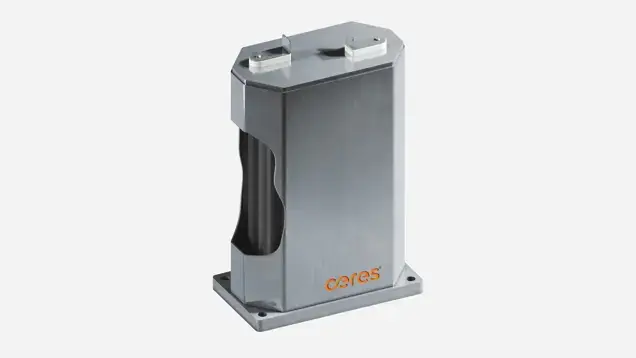
The licensed metal-supported stack behind Doosan, Delta and Weichai systems, rebranded Ceres Endura
This model is part of SecondWatt’s fuel cell research catalogue. Specifications and price observations are included where supported by sources. Equipment availability and commercial terms require confirmation.
Ceres Power dossier: the metal-supported solid oxide stack licensed to Doosan, Delta and Weichai, with published specs, five-year stack life and buyer notes.
Ceres does not manufacture equipment. It licenses a metal-supported solid oxide cell and stack platform to partners who build the products, and its own catalogue lists Cell, Stack, Factory, Power Module, Power System, Stack Array Module and Electrolyser Module as packages of designs, expertise and intellectual property rights. Two points apply: the SteelCell name has been retired in practice, replaced by Ceres Endura at launch on 15 April 2026, and the platform is not purchasable hardware.
What can be bought today carries the technology under another badge. Doosan Fuel Cell began factory production of Ceres-based stacks and power systems in July 2025 at a combined 50 MW of electrical power per year, and its catalogued system is the S300 NG at 300 kW and 64% electrical efficiency. Delta Electronics has committed roughly 170 million pounds to a factory site targeting pilot production at the end of 2026, and Weichai Power signed a manufacturing licence on 5 November 2025.
The platform figures Ceres publishes are a 36 W fuel cell, a 450 to 630 degrees C operating window, a 100 kW power module, a 500 kW power system above 65% electrical efficiency, above 90% total efficiency with heat recovery, a 5% per second ramp rate and a five-year stack life. Ceres does not state whether the 65% figure is lower or higher heating value, or gross direct current against net alternating current, and that ambiguity should travel with any quotation.
Why it matters
The same stack shows up under four badges, and a buyer needs to know it is one technology. Ceres puts the solid oxide power market at 22 GW per annum by 2030 with 49% of that data center demand, and Bosch divested its 17.4% holding in October 2025 after discontinuing its own solid oxide work. Both facts belong beside any partner quotation.
Who buys it
Nobody buys hardware from Ceres. The purchasers are licensees who buy manufacturing rights, and end customers buy finished systems from Doosan Fuel Cell today and from Delta Electronics and Weichai Power as their plants come online. For a data center developer the practical entry point is the Doosan S300 NG at 300 kW, or a Delta system once the Centrica partnership reaches deployment in the United Kingdom and Europe.
Role in the data center
Prime and behind-the-meter generation through licensee systems. Ceres cites a 114 GW pipeline of on-site gas capacity and notes that California-certified solid oxide units can bypass local air district permit-to-operate requirements.
Key specifications
| Cell output | 36 fuel cell; 75 electrolyser cell W |
|---|---|
| Operating temperature | 450 to 630 degrees C |
| Power module rating | 100 kW |
| Power system rating | 500 kW |
| Electrical efficiency | above 65 on natural gas, basis not stated % |
| Total efficiency with heat recovery | above 90 % |
| Power ramp rate | 5 per second % |
| Stack life | 5 years |
| Stack material content | above 85 steel % |
| Carbon dioxide against open cycle gas turbine | 25 lower % |
| Licensee production capacity | 50 per year at Doosan Fuel Cell MW |
| Purchasable equivalent system | Doosan S300 NG, 300 kW, 64% electrical efficiency |
| Degradation rate |
Technical summary
Technology: metal-supported solid oxide, reversible between power and electrolysis Cell output: 36 W per fuel cell; 75 W per electrolyser cell Operating temperature: 450 to 630 degrees C at the cell Power module: 100 kW; power system 500 kW Electrical efficiency: above 65% on natural gas, basis not stated Total efficiency: above 90% with combined heat and power Fuel: natural gas rated, compatible with biogas, ammonia and methanol Load response: 5% per second power ramp rate, with cycling and vibration duty stated Stack life: five years, with performance held across the product lifetime Materials: above 85% steel, ferritic steel supports with a ceria electrolyte Purchasable equivalent: Doosan S300 NG at 300 kW and 64% electrical efficiency
Major variations
The licensed catalogue runs Cell, Stack, Stack Array Module, Power Module at 100 kW, Power System at 500 kW and Electrolyser Module, all built on one reversible platform. Partner implementations differ: Doosan sells the S300 NG at 300 kW in a 10.6 by 2.2 by 2.8 metre package, while Delta and Weichai designs have not been published.
Configurations and options
Natural gas is the rated fuel, with biogas, ammonia and methanol listed as compatible. The electrolysis configuration runs the same stack in reverse and is quoted around 30% more efficient than low-temperature electrolysis at a referenced 37 kWh per kg. Combined heat and power raises total efficiency above 90%.
Pricing and availability
Trend: up Lead time, new: Months rather than years, per the manufacturer; no committed figure published. Lead time, used or refurbished: No used or refurbished unit listed as of August 2026.
Lifecycle and maintenance
Ceres publishes a five-year stack life for the Endura platform, with performance stated as maintained across the product lifetime rather than derated on a published curve. No degradation rate is published: the 2025 annual report describes work to understand and model lifetime degradation mechanisms without giving figures. Because the licensor does not build systems, the service obligation, the spare stack supply and the warranty all sit with the licensee that assembled the machine, and they differ by partner. The manufacturing cost trajectory is disclosed in relative terms only, at half the cost of the 2020 stack design and a target of capital cost comparable to conventional generation by 2030.
Thermal and emissions profile
A fuel cell stack produces no emissions on its own; the emissions profile belongs to the complete system it is built into and to the fuel that system consumes. On pure hydrogen a proton exchange membrane stack produces only water, and the containerised gensets built around these stacks recover up to 50 litres of pure water an hour as a by-product. The governing installation standard for any complete stationary system is NFPA 853, whose 2025 edition is current, with NFPA 2 applying once gaseous hydrogen is stored or piped on site. Metal-supported solid oxide stacks add a materials story rather than an emissions one, at more than 85% steel and described by their developer as highly recyclable.
Common failure points
- Stack degradation — Cumulative electrical efficiency falls from 65% toward 53% LHV across module life
- Title reversion on replaced modules — Every swapped fuel cell module reverts to the maker by contract, so a used unit may be missing its stacks
- Thermal cycling — High-temperature ceramic stacks tolerate a limited number of shutdowns and no maker publishes an allowance
- Sulfur and siloxane contamination — Sulfur deactivates catalysts and siloxanes deposit silica across anode surfaces
- Certification lapse — A California siting certification issued to the maker expires on a schedule the buyer does not control
- Service dependency — Third-party service is contractually barred on financed fleets and only the maker supplies stacks
Inspection checklist
Chain of title — establish whether the seller holds title or a project company does; Bloom contracts carry a right of first refusal at section 3.6 Repurchase right — get a written waiver; the contractual repurchase value is the greater of fair market value or 100% of purchase price reduced annually Module inventory — confirm which fuel cell modules are physically present; replaced modules revert to the maker under section 4.04 Measured heat rate — test against the 7,550 Btu/kWh minimum efficiency level in Bloom's own contracts and the 5,811-7,127 datasheet band Efficiency band — published cumulative efficiency runs 65% down to 53% LHV, so a mid-life unit is not a 65% machine Module age — Bloom reports a median recorded module life of 4.9 years and a maximum of 7.7 across more than 20,000 modules Thermal cycle count — the DOE lists limited shutdowns as an explicit challenge for stacks running at 500-1,000 degrees C, and no maker publishes an allowance Fuel quality history — total sulfurs above 5,000 ppbV average or H2S above 1,000 ppbV average exceed the published natural gas limit Siloxane exposure — 10 ppm of D5 caused total solid oxide failure in 30 hours at 1,000 degrees C in the Argonne fuel quality work Ammonia and halogens — the natural gas specification limits are 40 ppmV ammonia and 0.28 micrograms per cubic metre halogens Regulatory status — confirm a live CARB executive order covers the exact model; DG-044 for the ES-5 lapsed on 2026-03-27 Service entitlement — get a written service quotation first; third-party service is barred at section 10.01 of the standard agreement Operating data — request the remote monitoring history, which the maker holds under a 5 to 20 year service term Site scope — gas polishing media, wastewater and permitting sit outside maker scope, and cleanup ran about 1.8 cents per kWh in the Argonne 300 kW case Removal and rigging — a 325 kW unit runs 28,745 lb across 29 ft 5 in, so verify crane access and transport width
Procurement channels
Through a licensee, not through Ceres. Doosan Fuel Cell is in production, Delta Electronics targets pilot production at the end of 2026 and Weichai Power holds a licence signed in November 2025. No used, refurbished or surplus unit carrying this technology was listed on any public channel as of August 2026.
Regional notes
United Kingdom licensor with manufacturing partners in South Korea, Taiwan, China, Japan and India. Route to market in Europe runs through Centrica, which signed a strategic partnership in March 2026 and an infrastructure partnership with Delta Electronics in April 2026 aimed at data centers.