FuelCell Energy 1.25 MW Block System (formerly SureSource 1500)
Manufacturer: FuelCell Energy
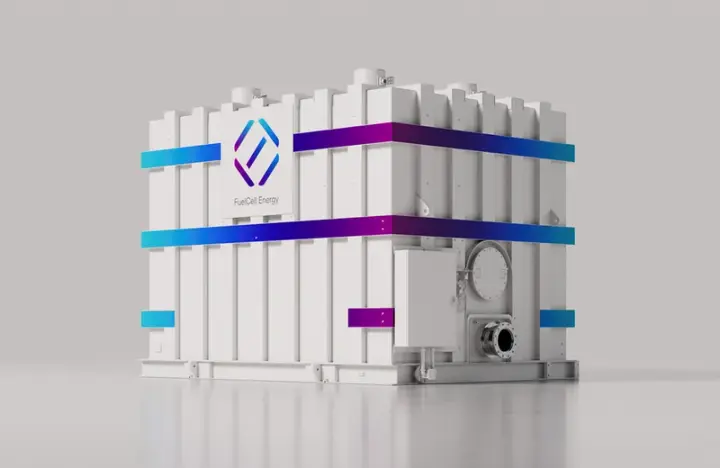
FuelCell Energy's 1.25 MW carbonate system, renamed from SureSource 1500 and restated down from 1.4 MW
This model is part of SecondWatt’s fuel cell research catalogue. Specifications and price observations are included where supported by sources. Equipment availability and commercial terms require confirmation.
FuelCell Energy 1.25 MW Block System dossier: the SureSource 1500 rename and rating restatement, carbonate specs, carbon capture, and inspection guidance.
The SureSource brand is retired. FuelCell Energy's current product is the 1.25 MW Block System, still labelled the 1500 fuel cell system on FuelCell Energy's platform page, and the manufacturer's own product page no longer uses the SureSource name. The rating changed with the name: the historical SureSource 1500 was a 1.4 MW plant, and the current system is rated 1,250 kW. That is a 10.7% restatement with no published explanation, and the identical 10.7% appears on the 3000 line.
The consequence for a listing is precise. Installed hardware from roughly 2015 to 2024 physically carries a 1.4 MW nameplate, while the same product line sold new today is marketed at 1,250 kW. A listing that says 1.4 MW SureSource 1500 is not necessarily misdescribed; it is a legacy nameplate, and it should not be corrected downward without inspecting the plate.
Current published specifications, dated September 2025: 1,250 kW at 480 VAC and 60 Hz, 50% electrical efficiency LHV and 85% total with heat recovery, 3.1 MMBtu/h of heat on natural gas, fuel input of 9.5 MMBtu/h at 9,250 SCFH, natural gas or 0 to 100% biogas or blends up to 50% hydrogen, NOx and CO at 0.01 lb/MWh, a 58 by 42 by 20 foot envelope, 62 dBA at 30 feet and 3.9 gpm of water in against 2 gpm discharged. The molten carbonate architecture reforms methane internally at roughly 650 degrees C, which is why there is no external reformer to inspect.
Why it matters
Molten carbonate is the only commercial stationary fuel cell technology with inherent carbon capture: carbon dioxide from an external exhaust stream is fed to the cathode and transferred to the anode where it becomes far easier to separate, and the process adds power rather than consuming it. FuelCell Energy reports above 90% capture efficiency in laboratory testing. No solid oxide or phosphoric acid product offers an equivalent.
Who buys it
Universities, hospitals, wastewater and industrial sites that need baseload power with usable heat and full biogas capability, plus utilities procuring distributed generation under long-term power purchase agreements. Named microgrid references include the University of Bridgeport at 1.4 MW supplying roughly 80% of campus power and Santa Rita Jail paired with solar and battery storage.
Role in the data center
Baseload on-site generation with recoverable heat for absorption cooling, deployed as the constituent module of larger blocks rather than as a standalone data hall supply. Interconnection is at 480 VAC and 60 Hz.
Key specifications
| Rated output | 1,250 kW net AC |
|---|---|
| Legacy nameplate | 1,400 (SureSource 1500) kW |
| Voltage and frequency | 480 VAC / 60 Hz |
| Electrical efficiency | 50 % LHV |
| Total CHP efficiency | 85 % LHV |
| Heat output | 3.1 natural gas / 3.3 biogas MMBtu/h |
| Fuel input | 9.5 MMBtu/h (9,250 SCFH natural gas) |
| Hydrogen blend range | 0-50 % |
| NOx and CO | 0.01 lb/MWh |
| CO2 | 886 electric-only, 554 with full heat recovery lb/MWh |
| Dimensions | 58 x 42 x 20 ft (17.7 x 12.8 x 6.1 m) |
| Water | 3.9 consumption / 2 discharge gpm |
| Module design life | 7-year target cell design life on current production, 5 on legacy |
| System design life | 25 to 30 years |
| Rated net output, FuelCell Energy 1500 (current sheet) | 1250 kW |
Technical summary
Rated output: 1,250 kW net AC at 480 VAC, 60 Hz. Legacy nameplate: 1,400 kW as SureSource 1500 on hardware built through roughly 2024. Electrical efficiency: 50% LHV; total 85% LHV with heat recovery. Heat output: 3.1 MMBtu/h on natural gas; 3.3 MMBtu/h on biogas. Fuel input: 9.5 MMBtu/h, 9,250 SCFH natural gas or 15,640 SCFH biogas. Fuel flexibility: natural gas, 0-100% biogas, and blends up to 50% hydrogen. Emissions: NOx and CO 0.01 lb/MWh; SOx and PM10 negligible; CO2 886 lb/MWh electric-only. Dimensions: 58 ft x 42 ft x 20 ft (17.7 x 12.8 x 6.1 m); 62 dBA at 30 ft. Water: 3.9 gpm consumption against 2 gpm discharge; ambient minus 20 to 120 degrees F. Standards: ANSI/CSA FC-1, NFPA 70, UL 1741, IEEE 1547, California Rule 21, CARB 2007 and 2013.
Major variations
One carbonate module of about 1.25 MW built from four stacks is the unit of manufacture. Two modules make a 2.5 MW system and ten make the 12.5 MW Block, all on shared balance of plant. Configurations run on natural gas, biogas or a hydrogen blend, with or without heat recovery. The current 1.25 MW rating replaced a 1.4 MW legacy nameplate, a 10.7% restatement.
Configurations and options
Fuel is the main configuration choice: natural gas, 0 to 100% biogas, or blends up to 50% hydrogen, each changing the fuel-input figure and the heat output. Heat recovery is optional and is what lifts total efficiency from 50% to 85% LHV, delivering 3.1 MMBtu/h on natural gas or 3.3 on biogas. Carbon capture is offered as a separate platform on the same carbonate architecture, and units combine into 2.5 MW systems and 12.5 MW Blocks on shared balance of plant.
Compatibility and dependencies
Interconnection is at 480 VAC and 60 Hz under UL 1741, IEEE 1547 and California Rule 21. The plant needs a 58 by 42 by 20 foot envelope and a water connection: 3.9 gpm of consumption against 2 gpm of discharge, which is a utility dependency the solid oxide products do not have. Gas supply must deliver 9.5 MMBtu/h, about 9,250 SCFH of natural gas or 15,640 SCFH of biogas. Ambient range is minus 20 to 120 degrees F and noise is 62 dBA at 30 feet.
Pricing and availability
Trend: rising Lead time, new: Initial 30 MW delivery began inside the year of contract signature on the Fit Energy agreement. Lead time, used or refurbished: No used or refurbished unit listed as of August 2026.
Supply, delivery and overhaul
- Manufacturer-wide delivery estimate: 3 months
Lifecycle and maintenance
Carbonate systems are designed around a 25 to 30 year system life with stack modules replaced inside it, at a 5-year target cell design life on legacy modules and 7 years on current production. The manufacturer publishes a 10% to 15% decrease in power and efficiency across the life of a module, and the legacy 3000 datasheet expressed the same thing as an efficiency band falling from 49% to 44% LHV. Balance of plant therefore outlives three to five module generations, which is why value concentrates in module age rather than plant age. Long-term service agreements run up to 20 years and include module exchange, and the agreement permits a new or a used replacement module.
Thermal and emissions profile
Fuel cells generate without combustion, and that is the whole regulatory argument for siting them where an engine or a turbine cannot be permitted. California's distributed generation certification regulation sets 0.07 lb/MWh NOx, 0.10 CO and 0.02 VOC for fossil-fuelled distributed generation, and current products certify far below it, at 0.003 lb/MWh NOx for Bloom, 0.01 for FuelCell Energy and 0.02 for HyAxiom. Sacramento's 2024 best available control technology determination classifies those limits as achieved in practice and allows a combined heat and power credit of one MWh per 3.4 million Btu of recovered heat. Carbon dioxide is not eliminated: a natural gas fuel cell emits 679 to 1,006 lb/MWh electric-only, falling to 496 to 567 with full heat recovery.
Common failure points
- Stack module end of life — Modules carry a 5-year legacy or 7-year current target cell design life and then need a maker exchange
- Electrolyte loss — Molten carbonate is lost over long exposure through volatilization of alkali chlorides
- Service agreement transferability — Without a transferable agreement the asset cannot be exchanged, serviced or warranted by anyone
- Sulfur and halide contamination — Testing at 5 ppm H2S produced rapid power loss, and organic sulfides and halides remain unsolved
- Second-life modules — The maker may fit a new or used replacement module, so a refurbished plant can hold aged stacks
- Long start-up — A cold unit is not a same-day restart and no published start duration exists
Inspection checklist
Module install date and hours: legacy modules carry a 5-year and current production a 7-year target cell design life. Nameplate generation: a 1.4 MW or 2.8 MW plate is legacy; the same lines sell new today at 1,250 kW and 2,500 kW. Service agreement: confirm a transferable long-term agreement exists and that the maker will novate it, or the asset cannot be serviced at all. Used replacement modules: the maker reserves the right to fit a new or used module, so a refurbished plant may hold second-life stacks. Efficiency band: the legacy 3000 datasheet published 49% falling to 44% LHV; assume the lower end on a late-cycle stack. Power walk-down: the maker publishes a 10% to 15% decrease in power and efficiency across the life of a stack module. Fuel history: obtain the gas analysis record, because chloride and sulfur exposure are cumulative and irreversible.
Procurement channels
Direct from FuelCell Energy, predominantly as generation under a long-term power purchase agreement rather than as equipment. The one transferable form is the project company: FuelCell Energy sold the Trinity College 1.4 MW project to OnSite Partners with a 15-year service agreement attached.
Regional notes
North American 480 VAC and 60 Hz product certified to ANSI/CSA FC-1 with CARB 2007 and 2013 compliance. Air permits and interconnection are site-level and do not travel with the equipment even though the product certification does.