HyAxiom / Doosan Fuel Cell PureCell Model 400, hydrogen configuration
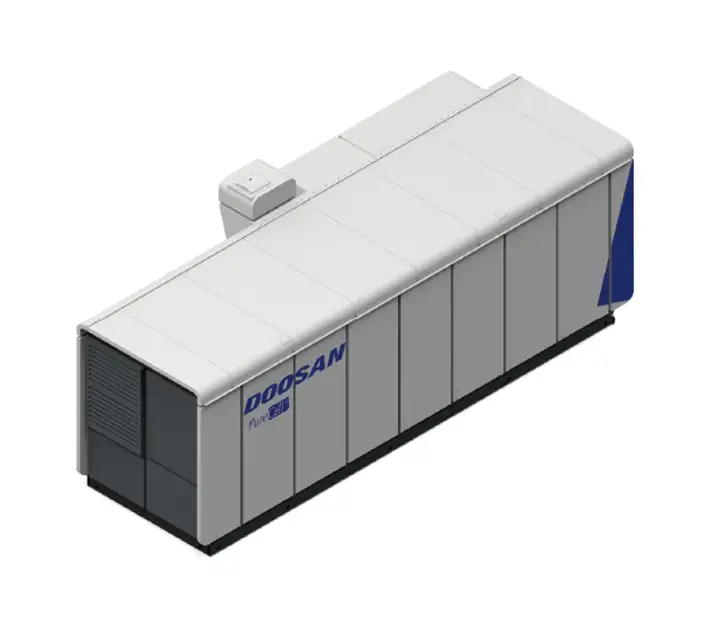
The hydrogen build of the PureCell platform, which drops the reformer and gains about six efficiency points
This model is part of SecondWatt’s fuel cell research catalogue. Specifications and price observations are included where supported by sources. Equipment availability and commercial terms require confirmation.
HyAxiom PureCell Model 400 hydrogen dossier: 460 kW phosphoric acid at 50% efficiency, zero point-of-generation emissions and a 10-year stack life.
The hydrogen configuration is the same phosphoric acid platform with the fuel processing system removed. On natural gas that system comprises desulfurisation plus steam methane reforming; on pure hydrogen it comes out entirely, and HyAxiom states the modular assembly means removal can be accomplished in a matter of days. The consequences are measurable: electrical efficiency rises from about 44% to roughly 50%, load following improves from 10 to about 20 kW per second, make-up water is no longer required, and the power module drops from 57,000 to 60,000 lb down to 49,428 lb.
Output is 460 kW at year 1 falling to 420 kW at year 10, an 8.7% power fade across the stack life, with average lifetime efficiency of 48.3% plus or minus 1.3 against a 50% nameplate. Heat output is 352 kW or 1.20 MMBtu/h to 121 degrees C, equivalent to up to 75 refrigeration tons through absorption chilling in year one. Emissions at the point of generation are zero for carbon dioxide, NOx, SOx, carbon monoxide and volatile organic compounds.
Two published figures conflict and a buyer must resolve them before committing. The datasheet states a minimum hydrogen purity of 99.9%, while HyAxiom's current web page states the system can operate with purity as low as 80%. The overhaul scope also differs from the natural gas build: hydrogen needs only the stack overhaul at 10 years, with no fuel processing system overhaul at all, which is the single largest lifecycle cost difference between the two configurations.
Why it matters
The reformer is roughly 20% of system cost and carries its own overhaul, so removing it changes both the capital and the lifecycle equation. Against that, the buyer takes on an NFPA 2 hydrogen storage and piping scope with its own separation distances, which the equipment price does not include. A hydrogen build and a natural gas build of the same machine are therefore not interchangeable assets.
Who buys it
Korean utility and industrial buyers operating under the hydrogen portfolio standard, where a 40 MW long-term service agreement with UH Power runs to 2046, and North American sites with a committed hydrogen supply. The hydrogen build is a shipping product rather than a roadmap item, which is unusual in this category.
Role in the data center
Zero-emission on-site generation where a hydrogen supply exists, with recoverable heat suitable for absorption chilling rather than direct data hall cooling. Year-one heat output supports up to 75 refrigeration tons.
Key specifications
| Rated output, year 1 | 460 (532 kVA at 0.865 power factor) kW |
|---|---|
| Output, year 10 (derated) | 420 kW (year 10) |
| Power fade over stack life | 8.7 % |
| Electrical efficiency | 50 nameplate; 48.3 plus or minus 1.3 average lifetime % LHV |
| Heat output | 352 kW (1.20 MMBtu/h) to 121 degrees C |
| Absorption chilling equivalent | up to 75 refrigeration tons, year 1 |
| Emissions | Zero CO2, NOx, SOx, CO and VOC at the point of generation |
| Hydrogen purity, datasheet | 99.9 minimum % |
| Fuel supply pressure | 5 plus or minus 0.25 bar gauge |
| Power module weight | 49,428 (22,420 kg) lb |
| Load following | about 20 kW per second against 10 on natural gas |
| Cell stack life | 10 years |
| Certification | FC 1-2021, with UL 1741 SB and IEEE 1547 compliance |
| Overhaul scope | Stack overhaul at 10 years only; no fuel processing system overhaul |
| Rated net output, year 1 | 460 kW |
Technical summary
Rated output: 460 kW at year 1 (532 kVA at 0.865 power factor) falling to 420 kW at year 10. Electrical efficiency: 50% LHV nameplate; average lifetime 48.3% plus or minus 1.3. Peak overall efficiency: 90% on the datasheet; the Korean page publishes 85% total. Heat: 352 kW (1.20 MMBtu/h) to 121 degrees C; up to 75 refrigeration tons via absorption chilling. Emissions: zero CO2, NOx, SOx, CO and volatile organic compounds at the point of generation. Hydrogen purity: 99.9% minimum on the datasheet against as low as 80% on the current web page. Fuel supply: 5 bar gauge plus or minus 0.25; particle size below 1 micron. Power module: 29 ft 4 in x 8 ft 7 in x 10 ft 0 in at 49,428 lb, about 8,000 to 10,500 lb lighter than the gas build. Load following: about 20 kW per second against 10 on natural gas; no make-up water required. Certification: FC 1-2021 North American standard, with UL 1741 SB and IEEE 1547 compliance noted.
Major variations
Three fuel configurations share the platform: pure hydrogen, natural gas, and a blend mode running natural gas with up to 30% hydrogen that retains the full fuel processing system at above 44% electrical efficiency. Conversion between them is a fuel processing system change measured in days. The hydrogen build needs only a stack overhaul at 10 years.
Configurations and options
Three fuel builds share the platform: pure hydrogen, natural gas, and a blend mode running natural gas with up to 30% hydrogen that keeps the full fuel processing system at above 44% electrical efficiency. The hydrogen build deletes the desulfurisation and steam methane reforming train entirely, which is what raises efficiency to 50% LHV, improves load following to about 20 kW per second and removes the make-up water requirement. Heat recovery delivers 352 kW to 121 degrees C.
Compatibility and dependencies
Hydrogen must be supplied at 5 bar gauge plus or minus 0.25 with particle size below 1 micron, and the purity requirement is unresolved between two manufacturer documents: the datasheet states 99.9% minimum while the current web page states operation down to 80%. A US installation adds an NFPA 2 hydrogen storage and piping scope with its own separation distances. The power module is 29 ft 4 in by 8 ft 7 in by 10 ft 0 in at 49,428 lb, and no make-up water is required.
Pricing and availability
Trend: rising Lead time, used or refurbished: No used or refurbished unit listed as of August 2026.
Supply, delivery and overhaul
- cell stack overhaul: 10 years (20-year product life)
Lifecycle and maintenance
Phosphoric acid systems carry the longest commercial track record in the category, at a 10-year cell stack life against a 20-year product life. The manufacturer publishes power fade from 460 kW at year 1 to 420 kW at year 10, an 8.7% loss, with average lifetime efficiency of 48.3% plus or minus 1.3 against a 50% nameplate on the hydrogen build. The natural gas build adds a fuel processing system, roughly 20% of system cost, that carries its own overhaul, while the hydrogen build removes it and needs only the stack overhaul at 10 years. Doosan is running a funded in-place stack replacement programme across units installed 2020 to 2022, which is a warranty obligation performed by the maker rather than a merchant refurbishment market.
Thermal and emissions profile
A hydrogen fuel cell emits no carbon dioxide, NOx, SOx, carbon monoxide or volatile organic compounds at the point of generation, which is the cleanest emissions profile available in on-site power. The regulatory burden moves to the fuel instead. Natural gas builds are governed by NFPA 853, the standard for the installation of stationary fuel cell power systems, whose 2025 edition is current, while storing or piping gaseous hydrogen on site adds NFPA 2, the hydrogen technologies code, with its own separation distances and storage scope. That hydrogen scope is a site cost the equipment price does not include, and it is why a hydrogen build and a natural gas build of the same machine are not interchangeable assets.
Common failure points
- Phosphoric acid loss — Acid evaporates from the matrix at operating conditions and is carried out in the exhaust
- Cell stack end of life — A 10-year cell stack life dominates residual value and only the maker supplies replacements
- Steady-state decay — Platinum sintering and carbon support corrosion progress against field data out to 60,000 hours
- Start-stop decay — Carbon and catalyst corrosion occur on both shutdown and startup, separate from steady-state decay
- Ammonia contamination — Ammonia induces performance loss and even failure where gas nitrogen exceeds 1% by volume
- Cooler plugging — Fouling of the in-stack cooling circuit is a named failure mechanism
Inspection checklist
Serial number and generation: a Gen 2 unit is 440 kW at about 41% LHV while the current build is 460 kW at 43.5-44.4%. Cell stack install date and hours: the platform carries a 10-year cell stack life and only the maker supplies replacements. Power fade: the maker publishes 460 kW at year 1 falling to 420 kW at year 10, an 8.7% loss over the stack life. Field utilization: one Korean operator reported utilization falling from 91.9% in year 1 to 76.5% by year 4. Acid inventory: phosphoric acid evaporates from the matrix and leaves in the exhaust; DOE measured it after 43,000 hours of operation. Steady-state decay: platinum sintering and carbon support corrosion, modelled against field data out to 60,000 hours. Start-stop decay: carbon and catalyst corrosion occur on both shutdown and startup, a mechanism distinct from steady-state decay.
Procurement channels
New units through HyAxiom in North America and Doosan Fuel Cell in Korea. No used hydrogen-build PureCell appears on any public channel as of August 2026, and the two used listings that do exist are both natural gas machines. Conversion between fuel configurations is a fuel processing system change measured in days rather than a separate procurement.
Regional notes
Hydrogen at scale on this platform is a Korean phenomenon rather than a North American one, anchored by a 40 MW long-term service agreement with UH Power running to 2046 at 72.93 million USD. Any US installation adds an NFPA 2 hydrogen storage and piping scope.