HyAxiom / Doosan Fuel Cell PureCell Model 400, natural gas configuration
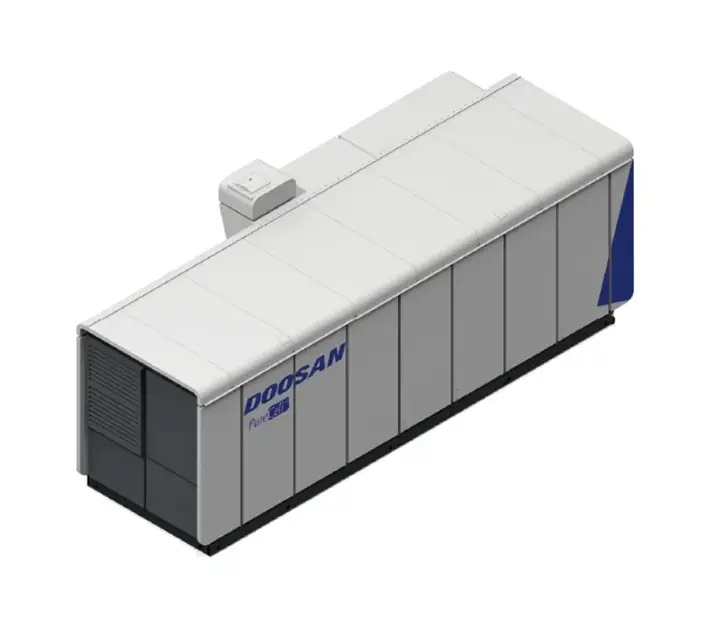
The UTC-lineage phosphoric acid platform, rated 460 kW rather than 400, with a 10-year cell stack life
This model is part of SecondWatt’s fuel cell research catalogue. Specifications and price observations are included where supported by sources. Equipment availability and commercial terms require confirmation.
HyAxiom PureCell Model 400 natural gas dossier: 460 kW phosphoric acid, 90% total efficiency, 10-year stack life, generation gaps and inspection notes.
The PureCell Model 400 is a phosphoric acid fuel cell with the longest commercial lineage in stationary fuel cells: UTC Power, then ClearEdge Power, then Doosan Fuel Cell America out of bankruptcy in July 2014 for 32.4 million USD, renamed HyAxiom in early 2022. Two entities operate it today. Doosan Fuel Cell Co., Ltd. manufactures at Iksan in Korea, and HyAxiom is the North American commercial and service entity whose name appears on current US datasheets.
The 400 in the name is a family designation, not a rating. The current US datasheet publishes 460 kW and 532 kVA at characteristic power with an eco mode at 440 kW and 517 kVA, at 480 VAC and 60 Hz, 43.5% or 44.4% electrical efficiency LHV and a peak 90% overall efficiency. The Korean product page gives 440 kW at 43% electrical and 47% heat. A Gen 2 unit from 2016 is a different machine again at 440 kW maximum, 400 kW baseload and roughly 41% LHV, so the nameplate tells a buyer which generation they are looking at.
Heat is the commercial argument. The unit delivers 1.30 MMBtu/h of high-grade heat to 250 degrees F and 1.68 MMBtu/h of low-grade heat to 140 degrees F, consumes no water up to 86 degrees F ambient, holds below 65 dBA at 33 feet, and reaches 90% total efficiency where a thermal host exists. Certification is ANSI/CSA FC1-2014 and UL 1741 SA, with the hydrogen build certified to FC 1-2021.
Why it matters
This is the one platform in the category where a real refurbishment programme is documented and funded, and it is instructive precisely because it is not a market. Doosan booked roughly 30 billion won of quality-response cost for phosphoric acid stack replacement in a single quarter of 2026, expanding from Group B to Group C units installed 2020 to 2022. That work is a warranty obligation performed in place by the maker, and no third-party re-stacker exists.
Who buys it
Sites with a year-round thermal load that can use 90% total efficiency: hospitals, universities, district energy and food processing, alongside the Korean utility fleet built under the hydrogen portfolio standard. Two used listings exist on North American dealer sites, both natural gas builds and both unpriced, which is the entire visible secondary market for this platform.
Role in the data center
Combined heat and power for facilities with a year-round thermal load, and increasingly a data center block component through the 10 MW phosphoric acid power block announced in January 2026. Heat is delivered at 250 degrees F high grade and 140 degrees F low grade.
Key specifications
| Rated output | 460 / 532 characteristic; 440 / 517 eco kW/kVA |
|---|---|
| Voltage and frequency | 480 VAC / 60 Hz |
| Electrical efficiency | 43.5 / 44.4 % LHV |
| Peak overall efficiency | 90 % LHV |
| Gas consumption | 4.00 / 3.75 MMBtu/h (3,902 / 3,657 SCFH) |
| High-grade heat | 1.30 MMBtu/h to 250 degrees F |
| NOx | 0.02 lb/MWh |
| CO2 | 1,006 electric-only, 496 with full heat recovery lb/MWh |
| Power module dimensions | 29 ft 4 in x 8 ft 7 in x 10 ft 0 in |
| Noise | below 65 at 33 ft dBA |
| Water consumption | None up to 86 degrees F ambient |
| Cell stack life | 10 years |
| Certification | ANSI/CSA FC1-2014 and UL 1741 SA |
| Korean market rating | 440 kW at 43% electrical and 47% heat, 90% total |
| Rated net output, year 1 (characteristic power) | 460 kW |
Technical summary
Rated output: 460 kW and 532 kVA characteristic; 440 kW and 517 kVA in eco mode, at 480 VAC 60 Hz. Electrical efficiency: 43.5% or 44.4% LHV; peak overall efficiency 90% LHV. Gas consumption: 4.00 or 3.75 MMBtu/h higher heating value, 3,902 or 3,657 SCFH. Heat: 1.30 MMBtu/h high grade to 250 degrees F; 1.68 MMBtu/h low grade to 140 degrees F. Emissions: NOx 0.02, CO 0.01, VOC 0.01 lb/MWh; SOx and particulates negligible. CO2: 1,006 lb/MWh electric-only, 567 with high-grade heat recovery, 496 with full recovery. Power module: 29 ft 4 in x 8 ft 7 in x 10 ft 0 in; cooling module 15 ft 11 in x 7 ft 10 in x 6 ft. Environment: minus 20 to 104 degrees F, 0 to 95% humidity; below 65 dBA at 33 ft; no water use. Cell stack life: 10 years; product life 20 years. Certification: ANSI/CSA FC1-2014 and UL 1741 SA.
Major variations
One platform with three fuel configurations: natural gas, hydrogen, and LPG with natural gas dual fuel. Generations differ materially, from a Gen 2 build at 440 kW and roughly 41% LHV to the current 460 kW at 43.5 to 44.4%, and a trailer-mounted mobile form factor also exists. The Korean product page rates the same platform at 440 kW and 43% electrical.
Configurations and options
The order choices are fuel and operating mode. Fuel configurations are natural gas, hydrogen, or LPG with natural gas dual fuel, and the machine runs characteristic mode at 460 kW and 532 kVA or eco mode at 440 kW and 517 kVA, with gas consumption of 4.00 or 3.75 MMBtu/h respectively. Heat recovery is available at two grades, 1.30 MMBtu/h to 250 degrees F and 1.68 MMBtu/h to 140 degrees F. A trailer-mounted mobile form factor also exists.
Compatibility and dependencies
Output is 460 kW and 532 kVA at 480 VAC and 60 Hz, certified to ANSI/CSA FC1-2014 and UL 1741 SA. The installation is two modules, a power module at 29 ft 4 in by 8 ft 7 in by 10 ft 0 in and a cooling module at 15 ft 11 in by 7 ft 10 in by 6 ft, so the pad must carry both plus service clearance. Heat is delivered at 250 degrees F high grade and 140 degrees F low grade, which only pays back where a year-round thermal host exists. No water is used up to 86 degrees F ambient.
Pricing and availability
Trend: rising Lead time, new: About 18 months from construction start to commissioning on the 39.6 MW Incheon project. Lead time, used or refurbished: 2-8 weeks where dealer stock exists, both known listings unpriced.
Supply, delivery and overhaul
- Delivery time: 12 months (PAFC)
- cell stack and fuel processing system (FPS) overhaul: 10 years (20-year product life)
Lifecycle and maintenance
Phosphoric acid systems carry the longest commercial track record in the category, at a 10-year cell stack life against a 20-year product life. The manufacturer publishes power fade from 460 kW at year 1 to 420 kW at year 10, an 8.7% loss, with average lifetime efficiency of 48.3% plus or minus 1.3 against a 50% nameplate on the hydrogen build. The natural gas build adds a fuel processing system, roughly 20% of system cost, that carries its own overhaul, while the hydrogen build removes it and needs only the stack overhaul at 10 years. Doosan is running a funded in-place stack replacement programme across units installed 2020 to 2022, which is a warranty obligation performed by the maker rather than a merchant refurbishment market.
Thermal and emissions profile
Fuel cells generate without combustion, and that is the whole regulatory argument for siting them where an engine or a turbine cannot be permitted. California's distributed generation certification regulation sets 0.07 lb/MWh NOx, 0.10 CO and 0.02 VOC for fossil-fuelled distributed generation, and current products certify far below it, at 0.003 lb/MWh NOx for Bloom, 0.01 for FuelCell Energy and 0.02 for HyAxiom. Sacramento's 2024 best available control technology determination classifies those limits as achieved in practice and allows a combined heat and power credit of one MWh per 3.4 million Btu of recovered heat. Carbon dioxide is not eliminated: a natural gas fuel cell emits 679 to 1,006 lb/MWh electric-only, falling to 496 to 567 with full heat recovery.
Common failure points
- Phosphoric acid loss — Acid evaporates from the matrix at operating conditions and is carried out in the exhaust
- Cell stack end of life — A 10-year cell stack life dominates residual value and only the maker supplies replacements
- Steady-state decay — Platinum sintering and carbon support corrosion progress against field data out to 60,000 hours
- Start-stop decay — Carbon and catalyst corrosion occur on both shutdown and startup, separate from steady-state decay
- Ammonia contamination — Ammonia induces performance loss and even failure where gas nitrogen exceeds 1% by volume
- Cooler plugging — Fouling of the in-stack cooling circuit is a named failure mechanism
Inspection checklist
Serial number and generation: a Gen 2 unit is 440 kW at about 41% LHV while the current build is 460 kW at 43.5-44.4%. Cell stack install date and hours: the platform carries a 10-year cell stack life and only the maker supplies replacements. Power fade: the maker publishes 460 kW at year 1 falling to 420 kW at year 10, an 8.7% loss over the stack life. Field utilization: one Korean operator reported utilization falling from 91.9% in year 1 to 76.5% by year 4. Acid inventory: phosphoric acid evaporates from the matrix and leaves in the exhaust; DOE measured it after 43,000 hours of operation. Steady-state decay: platinum sintering and carbon support corrosion, modelled against field data out to 60,000 hours. Start-stop decay: carbon and catalyst corrosion occur on both shutdown and startup, a mechanism distinct from steady-state decay.
Procurement channels
New units through HyAxiom in North America and Doosan Fuel Cell in Korea. Two used listings are public, at Machinery Marketing International through Surplus Record and at Aaron Equipment, both quote-only. Note a marketplace taxonomy error to watch for: one listing indexes the manufacturer as Daewoo Doosan, which is not a real brand for this product.
Regional notes
Ratings differ by market: the US datasheet gives 460 kW at 43.5% LHV while the Korean product page gives 440 kW at 43%. Korea is the home market, where the hydrogen portfolio standard drove a national fleet past 1 GW, though the 2026 auction volume was cut 28.4% to about 125 MW.