Bloom Energy Energy Server 5 (ES5-EAXAAC), 250 kW
Manufacturer: Bloom Energy
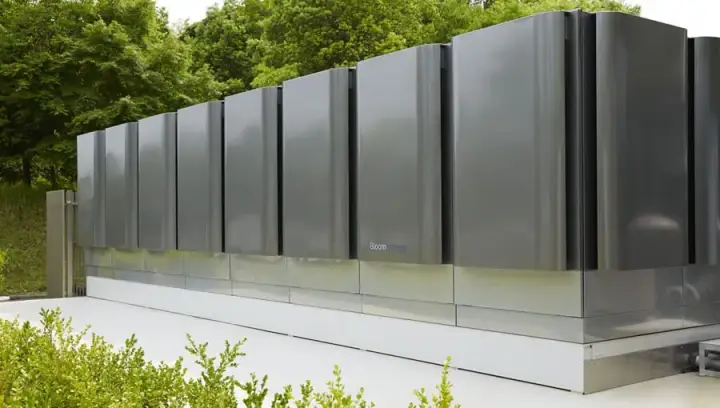
Bloom's 250 kW Energy Server 5, superseded by the ES6 platform after its natural gas certification lapsed in March 2026
This model is part of SecondWatt’s fuel cell research catalogue. Specifications and price observations are included where supported by sources. Equipment availability and commercial terms require confirmation.
Bloom Energy Server 5 dossier: 250 kW solid oxide, 65 to 53% efficiency band, lapsed CARB certification, transfer risk and a used-unit inspection checklist.
The ES5-EAXAAC is a 250 kW net AC solid oxide server, documented as DOC-1013935 Rev A and filed with the Connecticut Siting Council. Electrical efficiency is published as a 65% to 53% LHV cumulative band with a heat rate of 5,811 to 7,127 Btu/kWh, and the unit weighs 13.6 tons in a 14 ft 4 in by 8 ft 8 in footprint or a 28 ft 8 in linear arrangement.
Production status is superseded. The natural gas CARB certification for the ES-5 family, Executive Order DG-044, expired on 27 March 2026, and the digester gas and landfill gas certifications DG-050 and DG-051 expire on 7 September 2026. The current equivalent at this rating is ES6-2500 on the Energy Server 6.5 platform. Note that CARB certifies the family at its 300 kW maximum, which is why the CARB record reads 300 kW ES-5 while Bloom's own spec sheets document 200 kW and 250 kW builds.
For a California siting decision that lapsed certification matters more than the hardware condition. A used ES5 cannot be sited under a certification that has expired, and the certification belongs to Bloom rather than to the owner, so the buyer cannot renew it. That is a category-specific transfer risk with no analogue in generators or switchgear.
Why it matters
This is where the category's regulatory transfer risk becomes concrete. A certification issued to a manufacturer, expiring on a published schedule, is a condition of siting that travels with neither the equipment nor the owner. DG-044 lapsed on 27 March 2026, so any California listing for an ES-5 has to be checked against the live executive order list before a price is agreed.
Who buys it
Owners of installed Energy Server 5 fleets managing service and replacement, and sites that standardised on the platform between roughly 2015 and 2023. New buyers are routed to the ES6 platform, where ES6-2500 covers the same 250 kW rating and ES6-2495 sits at 249.5 kW.
Role in the data center
Primary on-site generation in arrays for data halls and campuses of the 2015 to 2023 build era, operating grid parallel under California Rule 21 and IEEE 1547. The lapsed CARB certification restricts California siting rather than continued operation.
Key specifications
| Rated output | 250 kW net AC |
|---|---|
| Model number | ES5-EAXAAC (DOC-1013935 Rev A) |
| Electrical efficiency | 65-53 cumulative LHV % |
| Heat rate | 5,811-7,127 Btu/kWh |
| NOx | 0.0017 lb/MWh |
| CO | 0.034 lb/MWh |
| CO2, natural gas | 679-833 lb/MWh |
| Dimensions | 14 ft 4 in x 8 ft 8 in x 6 ft 9 in (28 ft 8 in linear) |
| Weight | 13.6 tons |
| Noise | below 70 at 6 ft dBA |
| Certification lapse | CARB DG-044 natural gas certification expired 2026-03-27 |
| Current equivalent | ES6-2500 on the Energy Server 6.5 platform |
| Sibling 300 kW variant | ES5-YA8AAN at 15.8 tons, same efficiency and emissions |
Technical summary
Rated output: 250 kW net AC nameplate and base load. Model number: ES5-EAXAAC, document DOC-1013935 Rev A. Electrical efficiency: 65-53% LHV net AC cumulative. Heat rate: 5,811-7,127 Btu/kWh. Fuel: natural gas and directed biogas. Emissions: NOx 0.0017, CO 0.034, VOC 0.0159 lb/MWh; CO2 679-833 lb/MWh. Dimensions: 14 ft 4 in x 8 ft 8 in x 6 ft 9 in, or 28 ft 8 in x 4 ft 4 in x 7 ft 2 in linear. Weight: 13.6 tons; noise below 70 dBA at 6 ft. Certification: UL Listed, ANSI/CSA FC1-2014, California Rule 21, IEEE 1547, CARB 2007. Family: ES5 spans 200, 250 and 300 kW; the 300 kW ES5-YA8AAN weighs 15.8 tons.
Major variations
The ES5 family spans 200, 250 and 300 kW with a 210 kW nameplate variant, all sharing the same efficiency band, heat rate and emissions. CARB certifies the family at its 300 kW maximum under a single executive order. Bloom's own spec sheets document the 200 kW and 250 kW builds, and the 300 kW ES5-YA8AAN weighs 15.8 tons against 13.6 for this one.
Configurations and options
The order choices are rating and fuel: 200, 250 or 300 kW within the ES5 family, on natural gas or directed biogas, with separate CARB executive orders covering each fuel. Footprint is selectable between a compact 14 ft 4 in by 8 ft 8 in block and a 28 ft 8 in linear arrangement of the same area, which is the decision that follows the site rather than the machine.
Compatibility and dependencies
Output is grid parallel under California Rule 21 and IEEE 1547 with UL Listing and ANSI/CSA FC1-2014. The unit occupies 14 ft 4 in by 8 ft 8 in by 6 ft 9 in, or a 28 ft 8 in by 4 ft 4 in linear arrangement of the same footprint, at 13.6 tons, so pad design and rigging follow the chosen array geometry. Noise sits below 70 dBA at 6 feet. Service and module replacement depend on Bloom, so site access for the manufacturer is a standing requirement rather than an option.
Pricing and availability
Trend: rising Lead time, new: Superseded; new orders route to the ES6 platform. Lead time, used or refurbished: No used or refurbished unit listed as of August 2026.
Published cost benchmarks
Cost figures from filings and published studies. They describe budgets or project costs, not equipment prices.
- $11.1M · AT&T Middletown
Lifecycle and maintenance
Solid oxide stacks are the consumable and the manufacturer controls them. Bloom reports a fleet of more than 20,000 fuel cell modules deployed since 2009, with modules from 2014 and 2015 showing a median recorded life of 4.9 years, more than 900 running past 5 years and a maximum to date of 7.7. Replacement is a manufacturer operation performed on site in under an hour, after which title to the removed module passes back to the manufacturer and the hardware goes to its own repair and overhaul centre. Contracted service runs 5 to 20 years and covers filter and adsorbent replacement alongside periodic fuel cell replacement, and the dollar rate per kilowatt is redacted in Bloom's public filings.
Thermal and emissions profile
Fuel cells generate without combustion, and that is the whole regulatory argument for siting them where an engine or a turbine cannot be permitted. California's distributed generation certification regulation sets 0.07 lb/MWh NOx, 0.10 CO and 0.02 VOC for fossil-fuelled distributed generation, and current products certify far below it, at 0.003 lb/MWh NOx for Bloom, 0.01 for FuelCell Energy and 0.02 for HyAxiom. Sacramento's 2024 best available control technology determination classifies those limits as achieved in practice and allows a combined heat and power credit of one MWh per 3.4 million Btu of recovered heat. Carbon dioxide is not eliminated: a natural gas fuel cell emits 679 to 1,006 lb/MWh electric-only, falling to 496 to 567 with full heat recovery.
Common failure points
- Stack degradation — Cumulative electrical efficiency falls from 65% toward 53% LHV across module life
- Title reversion on replaced modules — Every swapped fuel cell module reverts to the maker by contract, so a used unit may be missing its stacks
- Thermal cycling — High-temperature ceramic stacks tolerate a limited number of shutdowns and no maker publishes an allowance
- Sulfur and siloxane contamination — Sulfur deactivates catalysts and siloxanes deposit silica across anode surfaces
- Certification lapse — A California siting certification issued to the maker expires on a schedule the buyer does not control
- Service dependency — Third-party service is contractually barred on financed fleets and only the maker supplies stacks
Inspection checklist
Chain of title: establish whether the seller holds title or a project company does; Bloom contracts carry a right of first refusal at section 3.6. Repurchase right: get a written waiver; the contractual repurchase value is the greater of fair market value or 100% of purchase price reduced annually. Module inventory: confirm which fuel cell modules are physically present; replaced modules revert to the maker under section 4.04. Measured heat rate: test against the 7,550 Btu/kWh minimum efficiency level in Bloom's own contracts and the 5,811-7,127 datasheet band. Efficiency band: published cumulative efficiency runs 65% down to 53% LHV, so a mid-life unit is not a 65% machine. Module age: Bloom reports a median recorded module life of 4.9 years and a maximum of 7.7 across more than 20,000 modules.
Procurement channels
Service and module replacement run through Bloom only. No independent dealer stocks the platform, and no used unit is publicly priced as of August 2026. The current equivalent at this rating is ES6-2500 on the Energy Server 6.5 platform, so a replacement purchase routes to current product rather than to the secondary market.
Regional notes
California siting depended on CARB Executive Order DG-044, which expired 2026-03-27 for natural gas; the digester gas and landfill gas orders DG-050 and DG-051 expire 2026-09-07. Certification is issued to the manufacturer, so a buyer cannot renew it independently.