Piller Power Systems POWERBRIDGE Kinetic Energy Storage
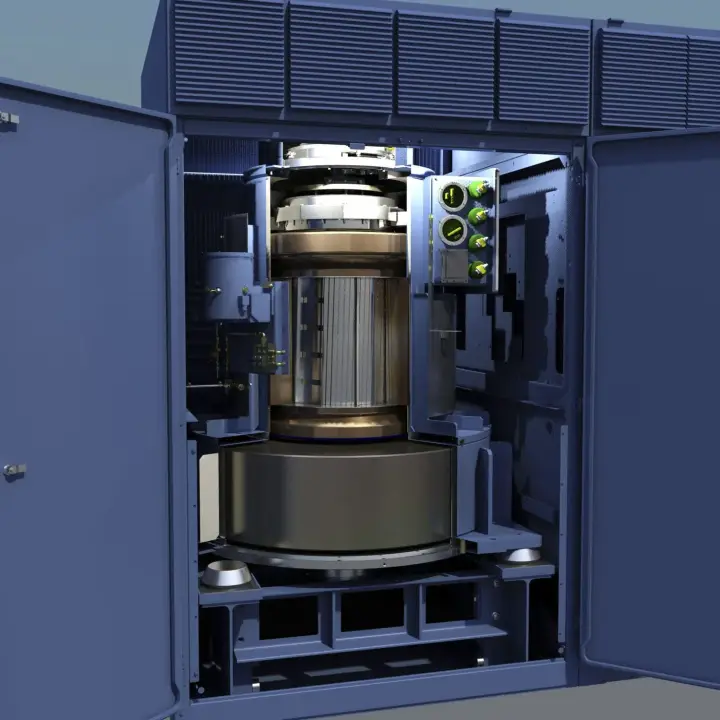
Piller's kinetic energy store, a direct replacement for a battery string rather than a UPS in its own right
This model is part of SecondWatt’s ups system research catalogue. Specifications and price observations are included where supported by sources. Equipment availability and commercial terms require confirmation.
Piller POWERBRIDGE dossier: kinetic energy storage at 60 MJ and above 3 MW peak, why it is not a UPS, host CPM specs, and a used-unit inspection checklist.
POWERBRIDGE is not a UPS. Piller's own copy describes POWERBRIDGE units as configurable singly or in parallel with a variety of Piller UPS units, and the same pairing model appears three separate times in Piller's catalogue: storage on the UNIBLOCK UBT+ is an option between batteries or flywheel, the CPM names the POWERBRIDGE PB6+ as its storage element, and the UB-V Series is offered in battery and kinetic energy storage versions.
Functionally it is the direct replacement for a VRLA or lithium string. It has no rectifier, no inverter, no static bypass and no load-side output of its own, so it should be compared against battery cabinets rather than against UPS systems. A POWERBRIDGE separated from its host UPS is a component and should be priced as one.
The published specifications are storage specifications: up to 60 MJ or more per unit in the PB60+ designation, peak power above 3 MW, and 1 MW of electrical power for over 60 seconds. Construction is a vertically mounted flywheel and generator using magnetic bearing technology, with bearings greased automatically from a reservoir, a design life above 20 years, up to 90% floor space saved against batteries, no air conditioning required, and no environmental disposal concerns.
Why it matters
POWERBRIDGE is priced and traded as stored energy, not as a UPS, and that governs the transaction. It has no rectifier, no inverter, no static bypass and no load-side output of its own, so a unit bought without its host system is a component that still needs a Piller UPS or Critical Power Module around it. Confirm which Piller UPS generation a used unit was commissioned against before treating it as a drop-in replacement for a battery string.
Who buys it
Owners of Piller UPS systems specifying kinetic storage instead of a battery plant, and data center designers who want deterministic stored energy with no disposal liability and no battery room. Because the product only ships paired to a host UPS, secondary supply is structurally thin: units reach the market as part of a whole-system decommission, not as standalone assets.
Role in the data center
Battery-replacement energy store on a Piller UPS bus, sized for short high-power ride-through with no battery room, no disposal stream and no dedicated cooling. Piller states that air conditioning is not required, that up to 90% of the floor space a battery plant would take is saved, and that a unit holds 1 MW for over 60 seconds.
Key specifications
| Product class | Kinetic energy store paired to a host UPS |
|---|---|
| Energy capacity | up to 60 or more per unit (PB60+) MJ |
| Peak power | above 3 MW |
| Ride-through | 1 MW for over 60 seconds |
| Construction | Vertically mounted flywheel and generator, magnetic bearing technology |
| Bearing maintenance | Greased automatically from a reservoir |
| Design life | above 20 years |
| Footprint saving against batteries | up to 90 % |
| Host CPM module rating | 300/360 kW scalable to 2,400/2,880 kW |
| Host CPM storage element | POWERBRIDGE PB6+ |
| Host CPM efficiency | above 96 at 25% load (IEC 62040-3), up to 98.5, near 99 in VFD % |
| Host CPM short-circuit withstand | 100 kA |
| First deployment | 1990s, as the world's largest kinetic energy store for battery replacement |
Technical summary
Product class: kinetic energy store, paired to a host UPS; not a standalone UPS. Energy capacity: up to 60 MJ or more per unit (PB60+ designation). Peak power: above 3 MW. Ride-through: 1 MW of electrical power for over 60 seconds. Construction: vertically mounted flywheel and generator using magnetic bearing technology. Bearing maintenance: bearings greased automatically from a reservoir. Design life: above 20 years. Footprint: up to 90% saved compared with batteries; air conditioning not required. Host example: CPM at 300/360 kW modules scalable to 2,400/2,880 kW using the PB6+. CPM efficiency: above 96% at 25% load per IEC 62040-3, up to 98.5%, approaching 99% in VFD mode.
Major variations
Two designations are published, PB6+ and PB60+, differing in stored energy up to 60 MJ or more per unit. The PB6+ is the element named inside Piller's Critical Power Module, which runs 300 or 360 kW modules scalable to 2,400 or 2,880 kW. The UNIBLOCK UBT+ and the UB-V Series can each be specified with either battery or kinetic storage, so POWERBRIDGE appears as the flywheel option on those platforms rather than as a separate machine. Piller publishes no dedicated POWERBRIDGE product page or brochure as of August 2026; the product is documented on the storage-options page and inside the CPM literature.
Configurations and options
POWERBRIDGE is ordered as the energy store inside a Piller system rather than as a machine on its own, so the configuration decisions are which host it is matched to and how many units run in parallel to reach the required power and time combination. Two designations are published, PB6+ and PB60+, differing in stored energy up to 60 MJ or more per unit, and the PB6+ is the element named inside Piller's Critical Power Module at 300 or 360 kW modules scalable to 2,400 or 2,880 kW. The UNIBLOCK UBT+ and the UB-V Series can each be specified with either battery or kinetic storage, which is where the flywheel appears as a line item. Piller carries no dedicated POWERBRIDGE product page and no POWERBRIDGE brochure in its product or download sitemaps as of September 2026, so ratings and options come from the host system quotation.
Compatibility and dependencies
The unit has no rectifier, no inverter, no static bypass and no load-side output of its own. It is the direct replacement for a VRLA or lithium string and must be matched to a host Piller UPS and its control generation. A unit separated from the machine it was commissioned against is a component with an integration cost, not a drop-in. Construction is a vertically mounted flywheel and generator on magnetic bearing technology with bearings greased automatically from a reservoir, so it carries a lubrication regime a battery cabinet does not, needs no air conditioning, and saves up to 90% of the floor area batteries need. Piller publishes no dimensions or weight for the unit as of September 2026, so floor loading and rigging path are established per machine. On the CPM host the declarations are 100 kA short-circuit withstand, dual input and IEC 62040-3, with UL 1778 on the UL build only.
Pricing and availability
Trend: rising Lead time, used or refurbished: No used or refurbished unit listed as of August 2026. Warranty, used: 1-year typical from refurbishment dealers.
Lifecycle and maintenance
Piller rates POWERBRIDGE above 20 years of design life with no stored-energy replacement, and its after-sales organisation performs preventative maintenance to extend UPS system life to at least 20 years, holding stocked parts at service centres across more than 40 countries. The bearing regime is a hybrid and it is the item that carries a consumable: Piller describes magnetic bearing technology alongside bearings greased automatically from a reservoir, so an unattended reservoir on a stored or decommissioned unit is a real risk that a fully levitated design does not carry. Piller publishes no MTBF figure, no rotational speed, no rotor mass and no vacuum arrangement, so run hours and discharge-cycle count have to be requested rather than inferred from the design life.
Thermal and emissions profile
Flywheel and rotary UPS produce no combustion emissions and carry no battery at all, which removes the category's largest environmental liability: no lead-acid recycling stream, no lithium fire code, and what Piller describes as no environmental disposal concerns at end of life. The second-order saving is cooling. Batteries need a controlled room at 25 degrees C or lower to reach rated life, while VYCON states the VDC needs no cooling and Piller states air conditioning is not required for POWERBRIDGE. Active Power rates CleanSource HD to 104 degrees F (40 degrees C) at 96.5% efficiency on half load and up to 98% at full load, so the parasitic cooling load a battery room imposes never appears.
Common failure points
- Grease reservoir and auto-lube system — Bearings greased automatically from a reservoir run dry when a unit sits unserviced
- Vertical rotor bearing set — The flywheel and generator are vertically mounted, so the bearing set is loaded axially
- Host UPS controls generation — A unit separated from its original UPS and control generation is a high-integration risk
- Vacuum arrangement — Piller does not publish whether the housing is evacuated, so pump and seal condition cannot be assumed from the design life
- Stored-energy verification — PB6+ and PB60+ differ in stored energy and Piller publishes no per-designation MJ table
Inspection checklist
Check the grease reservoir level and the auto-lube service history first; Piller greases the bearings automatically from a reservoir and an unserviced one on a stored unit is the primary risk. Confirm no rotor drop or rub event and no extended standstill in a humid environment, because the flywheel and generator are vertically mounted and the bearing set is loaded axially. Establish which Piller UPS or CPM generation the unit was commissioned against, and price a controls retrofit if it has been separated from that host. Ask Piller in writing whether the housing is evacuated, since no vacuum arrangement is published. Request run hours and discharge-cycle count rather than accepting the published design life above 20 years. Verify the designation, PB6+ or PB60+, against the stored energy the seller claims.
Procurement channels
Direct from Piller as part of a UPS system order. There is no independent dealer channel and no standalone product page: Piller has folded POWERBRIDGE into its storage-options page and into the CPM product, and Piller publishes no POWERBRIDGE brochure as of August 2026.
Regional notes
Sold globally through Piller's own subsidiaries and service centres, with US coverage through the Piller and Active Power organisation in Austin, Texas. Piller publishes no regional variants, no regional rating table and no regional certification statement for this product; the host Critical Power Module cites IEC 62040-3 for efficiency, EMC class C3 to IEC 62040-2, FCC Part 15J, and UL 1778 on the UL version only.