ABB DPA 250 S4 modular UPS
Manufacturer: ABB
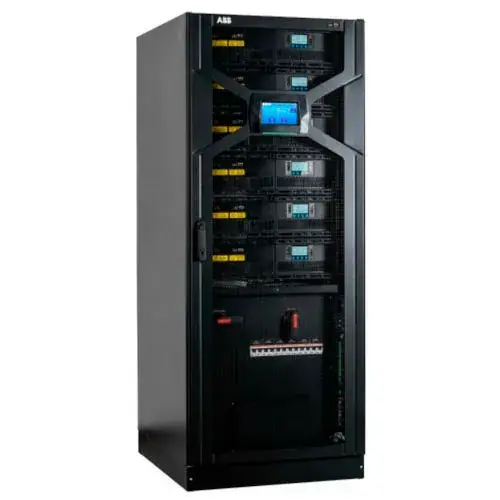
ABB's decentralized-architecture modular UPS built from 50 kW online-swappable modules, scalable to 1,500 kW
This model is part of SecondWatt’s ups system research catalogue. Specifications and price observations are included where supported by sources. Equipment availability and commercial terms require confirmation.
ABB DPA 250 S4 dossier: 50 kW online-swappable modules, 250 kW N+1 in a 300 kW frame, 97.6% efficiency, inspection checklist and secondary-market findings.
The DPA 250 S4 is ABB's decentralized parallel architecture UPS in the 250 kW class, built from six online-swappable 50 kW modules that each carry their own rectifier, inverter, DC converter and static bypass. The designation understates the hardware: the frame physically holds 300 kW and the 250 kW figure is its N+1 rating. Five frames parallel to 1,500 kW across 30 modules, and ABB quotes a module swap in under 10 minutes. Efficiency reaches 97.6% per module and 97.4% at system level in double conversion, with 99% in eco mode.
The DPA technology reached ABB through its acquisition of Newave Energy in Switzerland, and modules still carry Swiss country of origin. What matters commercially for a North American buyer is that this is an IEC 400 V product: ABB Electrification's US shelf lists MegaFlex UL, TLE and DPA 60/120/300-500 UL, and not the DPA 250 S4. No UL 1778 listing is published for the model.
As of 18 August 2026 no used, refurbished or surplus DPA 250 S4 system is listed by eBay, Critical Parts Warehouse, Critical Power Warehouse, CI Group, Gruber Power Services or Machinio. The line launched around 2017 and 2018, so the installed base has not reached decommissioning age, and the ABB DPA hardware that does change hands second-hand is modules rather than frames.
Why it matters
Module-level architecture changes what a used transaction even looks like: consumables and spares scale with module count rather than cabinet count, so a 1,500 kW system carries 30 module-level fan and capacitor sets. It is also why the only published ABB DPA secondary prices are for modules rather than frames. In this family the 50 kW module, not the cabinet, is the tradeable unit.
Who buys it
European, Middle Eastern and Asian data center operators and colocation builders specifying modular UPS in the 250 kW to 1.5 MW band, plus the ABB service channel stocking 50 kW modules against the installed fleet. North American buyers cannot purchase this model and should be routed to the DPA 300-500 UL or MegaFlex UL products instead, which carry UL 1778 listings.
Role in the data center
Primary UPS for IEC-market data halls in the 250 kW to 1.5 MW band, sitting between the transformer or switchgear and the critical distribution bus. It is configured N+1 inside a single 300 kW frame and paralleled across up to five frames for larger blocks, with the battery plant external at 480-600 VDC rather than inside the cabinet.
Key specifications
| Module rating | 50 kW |
|---|---|
| Frame capacity | 300 installed / 250 rated N+1 kW |
| Maximum system | 1,500 (5 frames, 30 modules) kW |
| Output power factor | 1.0 |
| Double conversion efficiency, technical data page | up to 97.6 module, 97.4 system % |
| Eco mode efficiency | 99 % |
| IEC 62040-3 class | VFI-SS-111 |
| Frame dimensions | 795 x 1978 x 943 mm |
| Module dimensions | 175 x 706 x 825 (66 kg) mm |
| Battery bus | 480-600 VDC |
| Module swap time | under 10 minutes |
| North America availability | Not listed; US range is DPA 60/120/300-500 UL and MegaFlex UL |
| Double conversion efficiency, TDS Rev-C | 96.9 at 100% load, 97.3 at 75%, 97.4 at 50% % |
| Short-circuit withstand | 10 kA for 1.5 s |
| Battery chemistries | VRLA, VLA open cells, NiCd, lithium-ion; decentralized charger per module |
Technical summary
Module rating: 50 kW at unity output power factor. Frame: 300 kW installed (6 x 50 kW); 250 kW rated N+1. Max system: 1,500 kW across 5 frames and 30 modules. Input/output: 220/380, 230/400, 240/415 V AC; 50/60 Hz selectable. Efficiency: up to 97.6% module and 97.4% system, double conversion. Eco mode: 99%. Topology: transformerless, three-level IGBT, online-swappable modules. Frame size: 795 x 1978 x 943 mm; 345-667 kg populated. Battery: VRLA, VLA, NiCd or lithium-ion at 480-600 VDC, charger per module. Standards: IEC/EN 62040-1, 62040-2 class C3, 62040-3 VFI-SS-111.
Major variations
One frame size, populated with one to six online-swappable 50 kW modules: 300 kW installed, 250 kW rated N+1, and up to five frames or 30 modules paralleled to 1,500 kW. The current ABB catalogue line item is DPA 250 S4 IEC 400V and the circulating technical data sheet is document 4NWD004067 Rev-C, issued 21 January 2019. The North American siblings are DPA 60 UL, DPA 120 UL and DPA 300-500 UL, which are separate 208 V products rather than voltage variants of this frame. MegaFlex DPA sits above the line from 250 kW upward on 250 kW modules, and ABB has announced no successor in this rating band.
Configurations and options
Populated module count is the largest single price variable and the first nameplate check: the frame physically accepts six 50 kW modules for 300 kW installed, and the 250 kW in the model name is the N+1 rating, so a frame can arrive holding anywhere from one to six modules. The order choices that move price and schedule are the parallel build, up to five frames and 30 modules to 1,500 kW; output voltage and frequency selection across 220/380, 230/400 and 240/415 V at 50 or 60 Hz; and the external battery chemistry, which is VRLA, VLA open cells, NiCd or lithium-ion on a 480-600 VDC bus. Stema Engineering quoted 2-4 weeks at 100-300 kW against 6-8 weeks at 650-1,500 kW in August 2026, so frame and module count drive delivery as well as cost.
Compatibility and dependencies
The frame sits on a 220/380 to 240/415 V three-phase supply and returns the same voltage set at 50 or 60 Hz. Each 50 kW module carries its own rectifier, inverter, DC converter and static bypass, so bypass is distributed inside the frame rather than bought as a separate cabinet, and an external maintenance bypass is still a separate line item. Batteries are external on a 480-600 VDC bus with a charger in every module: a VRLA plant runs 40-50 twelve-volt blocks per string, while the lithium arrangement ABB documents is Samsung SDI at 17 modules and 136 cells, which brings its own management system. Plan for 795 x 1978 x 943 mm at 345-667 kg populated, IP20, 10 kA for 1.5 s withstand at the input, 0-40 deg C operation with 20-25 deg C preferred, and 66 kg modules swapped from the front.
Pricing and availability
Trend: rising Lead time, new: 2-4 weeks at 100-300 kW and 6-8 weeks at 650-1,500 kW per Stema Engineering, quoted August 2026. Lead time, used or refurbished: No used or refurbished unit listed as of August 2026. Warranty, used: 1-year typical from refurbishment dealers.
Lifecycle and maintenance
Modular frames outlive their modules: cabinet, bus and static bypass run 15 years or more while the hot-swap power modules carry the fans and DC capacitors that wear, so the question is module hours and module count rather than cabinet age. A 1,500 kW ABB DPA system holds 30 module-level fan and capacitor sets. Eaton rates DC bus capacitors at 7 years of continuous duty and up to 10 in favourable conditions, and Vertiv field data gives 6 years for capacitors and 5-6 years or 40,000-50,000 hours for fans. Batteries turn over far faster, at 3-5 years for sealed VRLA and 12-15 for flooded cells, and spent lead-acid leaves as regulated waste through compliant recycling rather than resale. Eaton's 93PM service life extension program rebuilds the power train inside the existing shell in about 24 hours and resets another 10 years.
Thermal and emissions profile
UPS systems produce no combustion emissions, so the regulatory profile is battery handling, efficiency reporting and fire code. VRLA cells are regulated lead-acid waste at end of life and route through compliant recycling rather than resale, which is why asset recovery firms treat cabinet and cells as two separate economies. ENERGY STAR version 2.0 sets the efficiency benchmark, requiring VFI units above 10,000 W to meet 0.0058 x ln(P) + 0.886 and every AC-output unit to hold at least 90% power factor at full load, measured as a load-weighted average at 25, 50, 75 and 100% load. Efficiency is itself the emissions lever, since each point of double-conversion loss is continuous waste heat the cooling plant has to reject.
Common failure points
- Power module population — A frame sold on nameplate ships with fewer modules than the rating implies
- Module fans and capacitors — Consumables sit inside each module, so wear scales with module count not cabinet count
- Battery strings — VRLA capacity fades below 80% of nameplate and takes the ride-through with it
- Missing filler plates — Open slots break the cooling path and signal careless handling
- Live Swap entitlement — A frame without the Live Swap label must be bypassed for any module work
- Controls obsolescence — Controller and display boards reach end of life ahead of the power train
Inspection checklist
Module count: count populated slots against the frame rating; Eaton lists a 4 kVA 9PXM power module at 4,377 USD. Filler plates: Schneider's manual requires a module or filler plate in every slot on a 50 kW module bay. Module consumables: fans and capacitors live inside each module; a 1,500 kW DPA system carries 30 such sets. Live Swap label: verify the physical label; a Galaxy VS or VL without it must be bypassed, at 200 mm standoff. Module part numbers: confirm interchange; Schneider GVPM50KD is 50 kW at 400/480 V and 25 kW at 208 V. Battery age: sealed VRLA turns over at 3-5 years per Eaton lifecycle guidance; assume a full string past that. Battery capacity: reject any string below 80% of nameplate capacity under IEEE 1188 practice. Battery impedance: treat ohmic readings more than 20% above the commissioning baseline as an investigation trigger under IEEE 1188 field practice, then confirm against the battery manufacturer limit for the chemistry before condemning a cell.
Procurement channels
New units come through ABB and its IEC channel partners only. Stema Engineering publishes 2-4 week availability at 100-300 kW, 4-5 weeks at 350-600 kW and 6-8 weeks at 650-1,500 kW against a call-for-price quote. No North American refurbishment dealer stocks the model: Gruber Power Services names APC, Eaton, Liebert, MGE, Best Power, Tripp Lite and Xtreme on its refurbished brand list and no ABB at all. Where ABB DPA hardware does change hands second-hand it is at module level rather than frame level.
Regional notes
IEC 400 V product sold outside North America. ABB Electrification's US catalogue does not list it, and no UL 1778 listing is published, so a US listing for this exact designation should be treated as a grey import or a mislabeled DPA UL variant.