
An LM2500 offer can describe an engine assembly, a turbine-generator package or equipment within an existing power plant. Before comparing specifications or prices, establish which of those purchases is actually on the table.
The useful questions are connected: Which engine variant is installed? What equipment comes with it? Where is the quoted electrical output measured? What remains to be supplied before the package can serve your project?
This guide follows the LM2500 from its gas path to electrical generation, explains how to read output ratings and provides a checklist for reviewing an offer. For equipment sourcing, visit SecondWatt’s GE LM2500 page.
Key Takeaways
- The gas generator and free power turbine perform different jobs and use mechanically separate shafts.
- Identify the engine variant, generator and package scope together.
- Keep frequency, configuration and operating conditions beside every output rating.
- A brochure’s net-output figure does not automatically establish power delivered at your site.
- Connect the equipment records, performance assessment and quotation before committing to a purchase.
Watch: LM2500 explained#
Follow the energy through the engine, see where shaft power becomes electricity and learn why the purchase boundary matters. The illustrated episode runs approximately six minutes and seventeen seconds, including its closing screen. All equipment artwork is conceptual.
The episode covers the gas path, generator connection, model designation, offer boundary, rating conditions and the three records to connect before evaluating a purchase.
How does an LM2500 produce electrical power?#
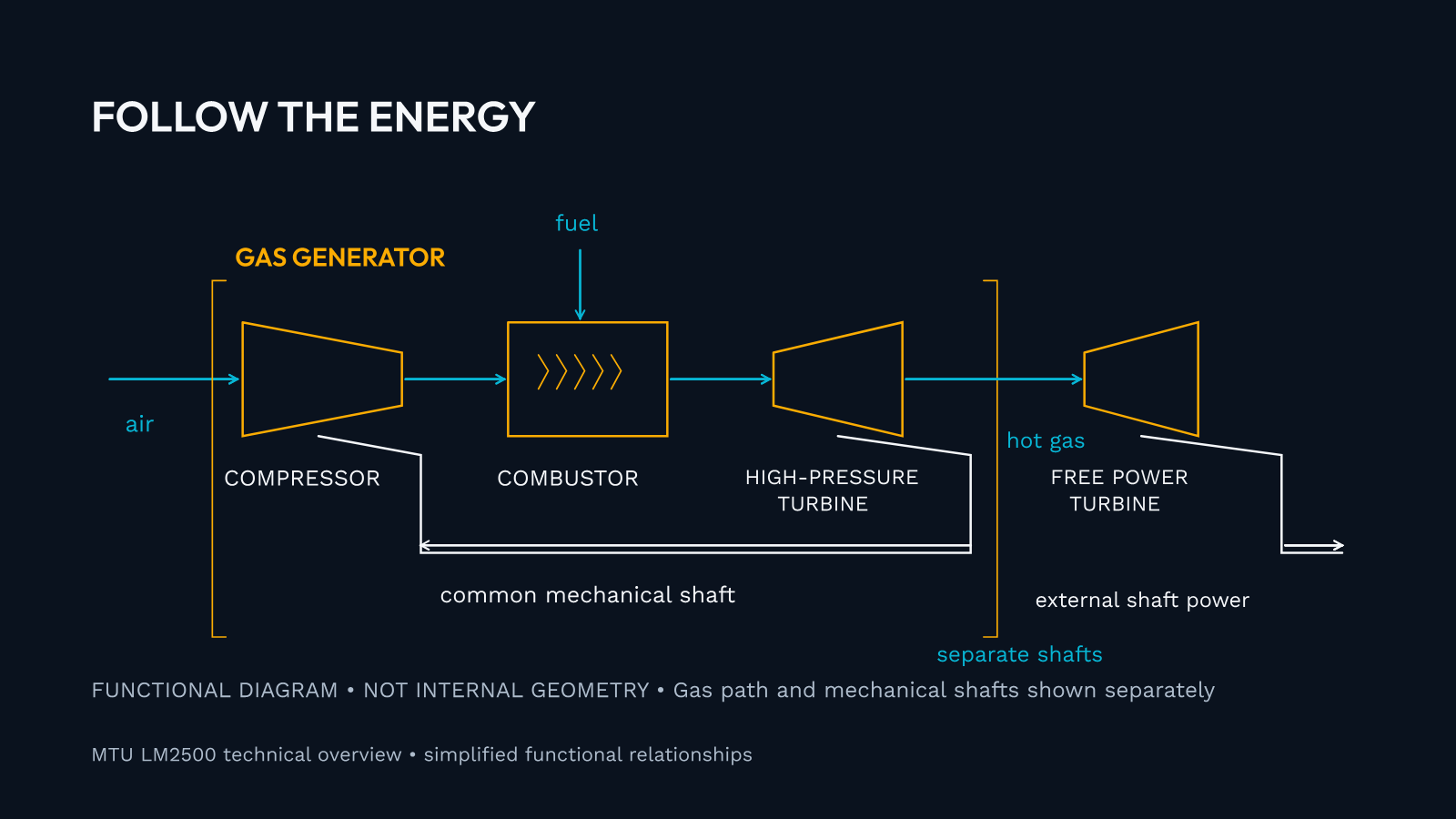
CONCEPT ILLUSTRATION — functional relationships, not an internal-geometry drawing. The gas path and mechanical shafts are shown separately.
Air enters the compressor, fuel burns in the combustor and the resulting hot gas passes through the high-pressure turbine that drives the compressor. Together, those components form the gas generator. A separate free power turbine extracts useful shaft power from the gas stream. The gas generator and free power turbine are connected through gas flow rather than one continuous mechanical shaft. MTU’s LM2500 technical overview describes this arrangement.
In a generating installation, a drive train transfers shaft power to an electrical generator. The actual couplings, any gearing and electrical arrangement depend on the supplied package. An illustration explains the relationship; equipment drawings establish the arrangement you would purchase.
This distinction helps prevent a basic scope mistake. An engine-level offer may be suitable for a buyer with compatible equipment already installed. A project starting from a new site also needs the generator, supporting systems and site interfaces. The engine’s identity alone does not establish that these are included.
Separate the LM2500 family, variant and package#
The family name identifies a starting point for research. The complete designation and configuration records establish which equipment the seller is describing.
MTU distinguishes the LM2500, LM2500+ and LM2500+G4 within its family overview. GE Vernova’s LM2500 and LM2500XPRESS product information describes its generating offerings, including the modular XPRESS package. A variant suffix and a package name are different pieces of identification.
Record the designation as documented. Then identify the power turbine, generator, package supplier, combustion configuration and installed modifications. If an advertisement shortens the name, ask the seller to expand it using the candidate’s records.
| Identity | Evidence to request | Question it answers |
|---|---|---|
| Engine variant | Nameplate and configuration records | Which engine is being offered? |
| Power turbine and drive | Assembly records and drive drawings | How is useful shaft power delivered? |
| Generator | Nameplate, data sheet and available test records | What electrical machine accompanies the engine? |
| Generating package | Equipment schedule and package drawings | Which systems belong to the offer? |
| Installed options | Completed modification records | Which enhancements are already present? |
Keep this record attached to the quotation. If a generator is substituted or an upgrade is proposed, review the effect on the technical assessment and commercial scope. Equipment as offered today and equipment after additional work are separate cases.
For public marketing, agree which identifiers may be disclosed and follow applicable listing requirements. Private diligence still needs sufficient traceability to connect photographs, inspections and maintenance records to the equipment under review.
LM2500 specifications: read each output with its conditions#
There is no single electrical-output number that accurately describes every LM2500 offer. Application, variant, generating package, frequency and measurement boundary all matter.
The table below reproduces selected simple-cycle net-output references from GE Vernova’s September 2025 LM2500XPRESS factsheet, GEA35746. These are named package references, not verified ratings for unidentified used equipment.
| LM2500XPRESS configuration in the factsheet | 50 Hz net output | 60 Hz net output |
|---|---|---|
| +G4 DLE UPT | 34.5 MW | 34.4 MW |
| +G5 DLE UPT, 25 ppm NOx label | 36.3 MW | 36.8 MW |
| +G5 DLE UPT, 15 ppm NOx label | 33.9 MW | 34.5 MW |
Rating basis: ISO conditions and natural gas; inlet and exhaust losses included; balance-of-plant equipment excluded. The source states that actual performance varies with project, fuel and ambient conditions. The NOx labels identify the source’s configurations and are not a site emissions-compliance determination. GE Vernova LM2500XPRESS factsheet
The video uses the +G4 DLE UPT, 50 Hz reference from this table. Keep that configuration and the rating basis attached to the example whenever it is used in a purchasing discussion.
If another document gives a different output, compare its heading, revision, frequency and footnotes before deciding that either figure is wrong. Ask which reference applies to the offered configuration. Do not average conflicting figures or substitute the highest available rating for the unit being evaluated.
Shaft power, generator output and site-net power#
Power figures can use the same unit while describing different things. Mechanical shaft power is not interchangeable with electricity delivered at a project’s connection point.
The quotation should explain the boundary at which output is stated. Ask for a single-line diagram and an auxiliary-load schedule when needed to make that boundary clear.
| Output description | What must be defined | Buyer’s follow-up |
|---|---|---|
| Shaft power | Mechanical output and reference conditions | Which generator and drive equipment are included? |
| Generator-terminal output | Electrical output at the generator terminals | Which loads and downstream losses remain outside this figure? |
| Package-net output | Included package loads and losses | Which site systems are excluded? |
| Site-net output | Agreed delivery point and operating conditions | Is the result estimated, tested or guaranteed? |
An OEM reference that excludes balance-of-plant equipment can be useful, provided its boundary stays visible. The project assessment must then address the excluded equipment and the loads or losses between that reference and the required delivery point. Avoid subtracting a load twice when two documents use different terminology for the same boundary.
Converting megawatts to kilowatts is straightforward: multiply by 1,000. Converting a shaft-power reference into site-net electrical output requires information about the actual equipment and operating case. It is not a unit conversion.
Use the site-net output and derating guide for the wider assessment. When comparing different equipment families, retain the same boundary across the LM2500, LM6000 and SGT-800 comparison.
What should an LM2500 generating package include?#
The word “complete” needs an equipment schedule behind it. Put each component inside or outside the sale boundary, then assign responsibility for supplying, installing and verifying the remaining interfaces.
Two offers can legitimately include different equipment. One buyer may already own compatible supporting systems, while another needs a much broader package. The task is to match the offer to the receiving project.
| Package area | Evidence to request |
|---|---|
| Turbine-generator train | Identified assemblies, couplings and arrangement drawings |
| Inlet and exhaust | Included components, interface drawings and performance assumptions |
| Fuel equipment | Included conditioning equipment and required supply conditions |
| Starting and auxiliaries | Supplied equipment, required external services and their sources |
| Controls and protection | Hardware, configuration records and software-access arrangements |
| Loose equipment and spares | Itemized inventory tied to the offered package |
| Installation and shipment | Shipping splits, connection points and removal responsibilities |
Installed equipment may rely on systems shared with the original plant. Ask which transfer with the sale and which remain behind. A photograph of an enclosure cannot resolve those questions.
For example, imagine a hypothetical offer listing an engine, generator and control cabinets while leaving starting equipment unspecified. That omission does not prove the starting equipment is excluded. It identifies a question that must be resolved before treating the package scope or budget as complete.
The relocation and commissioning guide explains how equipment boundaries become project responsibilities. Keep the component list connected to the installation plan throughout procurement.
Check frequency, voltage and the operating arrangement#
A family’s availability in different electrical configurations does not establish the compatibility of a particular used package. Review the generator, drive arrangement, controls and protection against the receiving system.
Provide the site frequency, voltage and intended operating mode. Ask for a response based on the actual candidate. If modifications are needed, identify who will engineer, supply and test them before including their effect in the assumed performance or price.
The 50 Hz and 60 Hz compatibility guide provides the wider review. A frequency label is one field in that assessment, not a complete compatibility finding.
Where islanded operation, black start or response to a load change matters, request an assessment of that operating requirement. A static megawatt total does not establish the system’s dynamic response. Use the black-start and load-acceptance guide to frame those questions.
Request performance for your actual site#
A useful site brief describes the operating case that governs the purchase. Include ambient conditions, elevation or pressure basis, fuel composition and delivery conditions, duty, demand profile and electrical delivery point.
Ambient conditions and loading affect gas-turbine performance. The EPA’s combustion-turbine technology chapter provides background on those effects. Its historical examples are not correction factors for the used package you are considering.
For a phased project, submit the initial and completed load profiles together. Ask how the proposed arrangement would operate in each phase and under the project’s specified unavailable-unit case. A candidate’s suitability at peak demand does not answer every question about its initial operating duty.
Request fuel input on a stated heating-value basis at the same operating points as the output estimate. Do not infer volumetric gas demand from the LM2500 name alone. The gas turbine fuel requirements guide provides the supply and interface questions to resolve with the equipment supplier.
Identify any equipment needed to support the proposed result, including modifications or additional site systems. Carry those items into the scope, budget and schedule. A performance case that assumes unpriced equipment is not yet aligned with the commercial offer.
Separate an engineering estimate from a contractual guarantee. If performance is part of acceptance, agree the procedure, measurement boundary and conditions. ASME’s performance-test-code overview provides context for formal testing; it does not establish that a candidate has passed a test.
Connect the equipment records, performance and quotation#
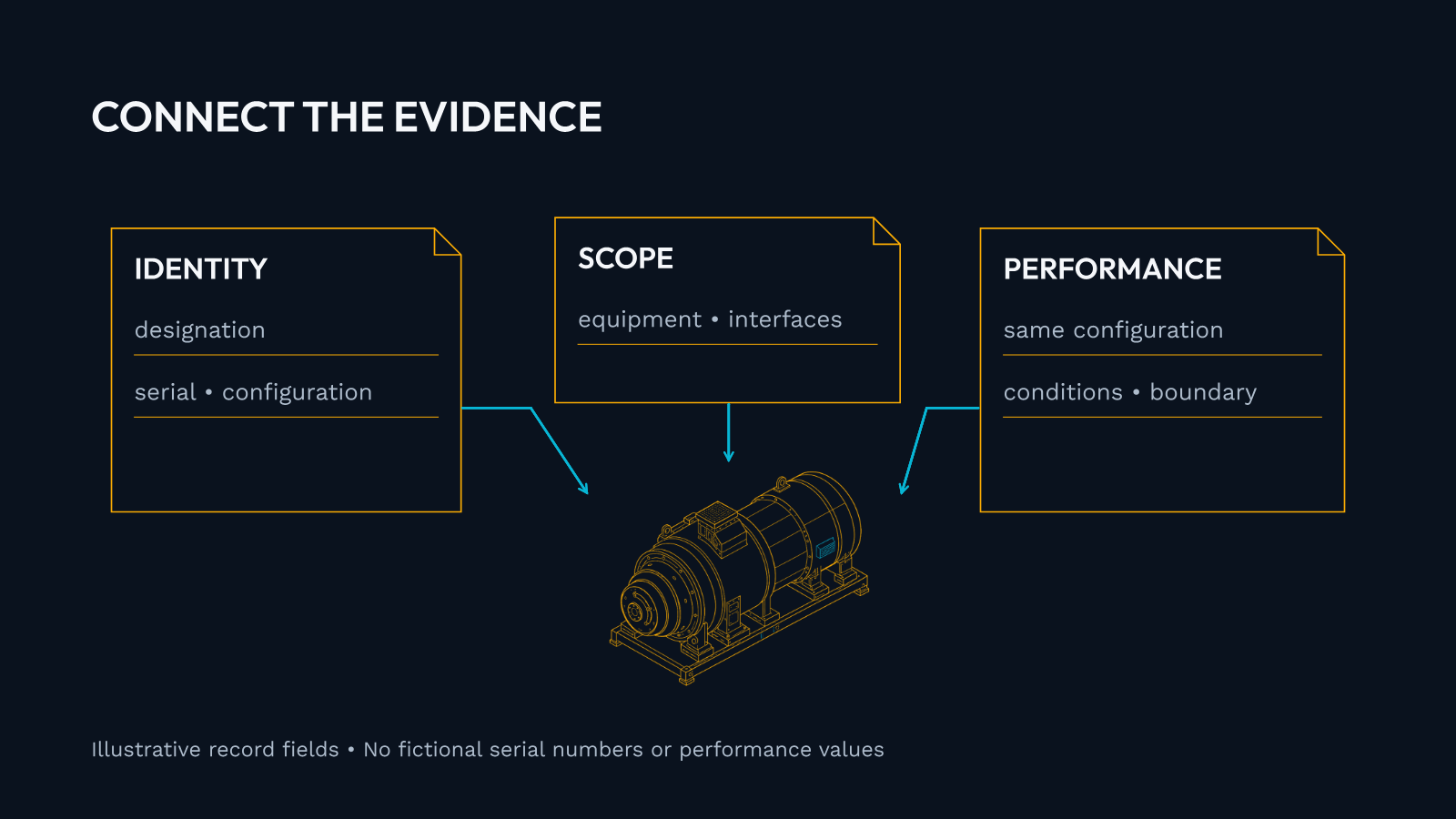
CONCEPT ILLUSTRATION — record categories for the same equipment; no actual serial number, offer or performance guarantee is represented.
The three records should tell one consistent story: what the equipment is, what the seller includes and the basis for the performance being discussed.
Consider a hypothetical offer headed “LM2500+G4, complete package.” Its attachment contains a current brochure, while the equipment schedule identifies an older generator and describes upgrades as available. That does not establish a defect. It leaves a purchasing question: which installed configuration is priced, and what work is needed to reach the performance under discussion?
Resolve the mismatch in a controlled comparison record:
| Record | Connection to establish |
|---|---|
| Equipment identity | Matches the specific engine, generator and package offered |
| Installed modifications | Supported by completion records, separate from proposed work |
| Performance reference | Names the applicable configuration and preserves rating conditions |
| Site assessment | Uses the receiving-site conditions and required delivery boundary |
| Quotation | Includes the equipment and work assumed in the assessment |
When the supplier revises a quotation, check whether it changes a spare, test, component or refurbishment activity. A revised price can reflect a revised scope. Retain the equipment-schedule revision and the technical consequence of the change.
For example, if a site assessment assumes an inlet arrangement that the final quotation excludes, reconcile the two documents before relying on the output estimate. Keep unresolved questions visible, with an owner and the evidence needed to close them.
Manuals, maintenance and inspection evidence#
A public LM2500 brochure helps identify a product family. The manuals, service information and records applicable to the actual equipment support its condition review and operating requirements.
Request a document register showing title, revision, issuer, equipment reference and availability. Include operating history, maintenance work, installed modifications, storage or preservation records and inspection reports where available. A missing record is an evidence gap; it proves neither that work happened nor that it did not.
Ask a qualified inspecting specialist to define the inspection scope and report what was examined, what was inaccessible and which findings remain unresolved. A family name on a report or a set of undated photographs is not sufficient equipment traceability.
Terms such as “overhauled” and “zero hours” need a defined basis. Establish which assemblies received work, who performed it and what the hours refer to. Where refurbishment is proposed, distinguish the present condition from the condition promised at acceptance.
Use the remaining-life and overhaul guide to develop the condition questions. Do not turn a general service interval into an automatic remaining-life conclusion for an unidentified engine.
Buyer checklist: before comparing LM2500 offers#
Use this checklist to organize an evidence request. It is not an OEM inspection procedure or confirmation that any unit meets your requirements.
- Confirm the full designation and traceable identity of the offered equipment.
- Identify the power turbine, generator, drive arrangement, frequency and voltage.
- Reconcile included components, exclusions and shared systems against drawings.
- Separate installed modifications from proposed upgrades or repairs.
- Label the output boundary, operating conditions and evidence basis.
- Request performance for the receiving site and required operating cases.
- Review available operating, maintenance, storage and inspection records.
- Identify missing documents and unresolved technical questions.
- Connect the quotation to the same equipment and work scope used in the assessment.
- Agree the evidence required for shipment, handover and acceptance.
How specifications affect LM2500 price comparisons#
An engine assembly and a generating package can have very different purchase scopes. Compare quotations only after identifying what transfers and what remains for the buyer to supply.
Keep equipment price separate from inspection, repairs, removal, transport, missing systems, installation and commissioning. Record the currency, quotation date, per-unit or lot basis and delivery responsibilities. An unresolved cost should remain visible rather than silently becoming zero.
The used gas turbine cost guide explains this distinction. This specifications article does not establish a verified LM2500 market-price range.
For delivery terms, identify the selected rule and named place precisely. ICC’s Incoterms overview explains their role in allocating delivery obligations, costs and risks. The wider purchase agreement still needs its own treatment of ownership, warranty and acceptance.
Frequently asked questions#
What is the power output of an LM2500?#
It depends on the variant, application, generating package, frequency and stated conditions. The table in this guide gives named XPRESS electrical-package references. Determine a used candidate’s suitability from its own configuration records and the required site-performance assessment.
Does an LM2500 offer include a generator?#
Only the sale scope can establish that. Request the generator identity, equipment schedule and exclusions. An engine-only offer should not be treated as a complete generating system.
Are LM2500 and LM2500XPRESS interchangeable names?#
No. The family name and the named package identify different things. Confirm the engine variant and the actual generating package rather than assigning XPRESS capabilities to every LM2500 offer.
Why do two LM2500 specification sheets show different megawatts?#
They may describe different configurations, frequencies, conditions or measurement boundaries. Preserve the table headings and footnotes, then determine which document applies to the offered equipment.
Can I use a marine shaft rating as electrical output?#
No. Mechanical power and net electrical power are different boundaries. Generator conversion, package loads and any additional site losses must be addressed for the actual installation.
Can a public manual establish the condition of a used LM2500?#
No. A reference document cannot prove a particular unit’s maintenance history, installed modifications or present condition. Obtain applicable documentation and candidate-specific evidence.
Does equipment availability establish an operating date?#
No. Release, shipment, site preparation, integration and acceptance are separate milestones. The mobile gas turbine bridge-power guide explains the wider operating requirement.
Discuss your LM2500 requirement#
Send the project location, required power at the delivery point, frequency, fuel information, operating duty and target service date. Identify mandatory configuration requirements and whether alternatives are acceptable. If you already have an offer, include the equipment schedule and the questions still open.
Review GE LM2500 equipment sourcing, explore the wider gas turbine catalogue, or contact SecondWatt to discuss the requirement. Equipment availability, scope and commercial terms must be established for the specific opportunity.
Sources and further reading#
- MTU: LM2500 — gas-generator architecture and family identification.
- GE Vernova: LM2500 and LM2500XPRESS — manufacturer product context.
- GE Vernova: LM2500XPRESS factsheet GEA35746, September 2025 — the named electrical-output references and their conditions.
- US EPA: Catalog of CHP Technologies, Section 3 — combustion-turbine performance principles; historical costs and example correction factors are not used here.
- ASME: Performance Test Codes — public overview of formal performance-test frameworks.
- ICC: Incoterms 2020 — delivery-rule context, separate from a complete purchase agreement.