
The useful comparison between LM2500, LM6000 and SGT-800 starts with a common site requirement. Identify the exact configuration, align the output boundary and operating conditions, then test whether the complete arrangement meets the duty. A table of brochure megawatts alone cannot do that work.
Key Takeaways
- Family names do not establish identical architectures, scope or performance boundaries.
- Match conditions before comparing output or efficiency.
- Unit arrangement and shared dependencies matter alongside unit size.
Begin with equipment identity#
The video illustrates different functional shaft arrangements, rather than using one generic turbine cutaway for all three families. The LM2500 has a separate free power turbine; the LM6000 uses a two-shaft arrangement; the SGT-800 is an industrial single-shaft design. Use the primary references below for the architecture, then obtain the offered machine's actual configuration documents.
Those distinctions help you understand equipment and maintenance scope. They do not establish a universal winner. Variant, combustor, installed options, condition and package design remain part of the comparison.
Put every output at the same boundary#
Gross generator output, package-net output and net export at a site's connection point can describe different quantities. A correct figure at one boundary can still be the wrong figure for your comparison.
Ask suppliers to identify included loads and losses. Then reconcile the path to your agreed connection point without deducting an auxiliary load twice. Preserve the source's gross or net label rather than rewriting it to make columns appear comparable.
| Comparison field | Required common basis |
|---|---|
| Output | Defined measurement point and included loads |
| Ambient case | Same temperature and elevation assumptions |
| Fuel and efficiency | Consistent fuel basis and energy convention |
| Installed options | Explicit cooling, SPRINT and other relevant equipment |
| Cycle | Separate simple-cycle output from any steam-cycle addition |
| Evidence | Same candidate configuration across scope and performance records |
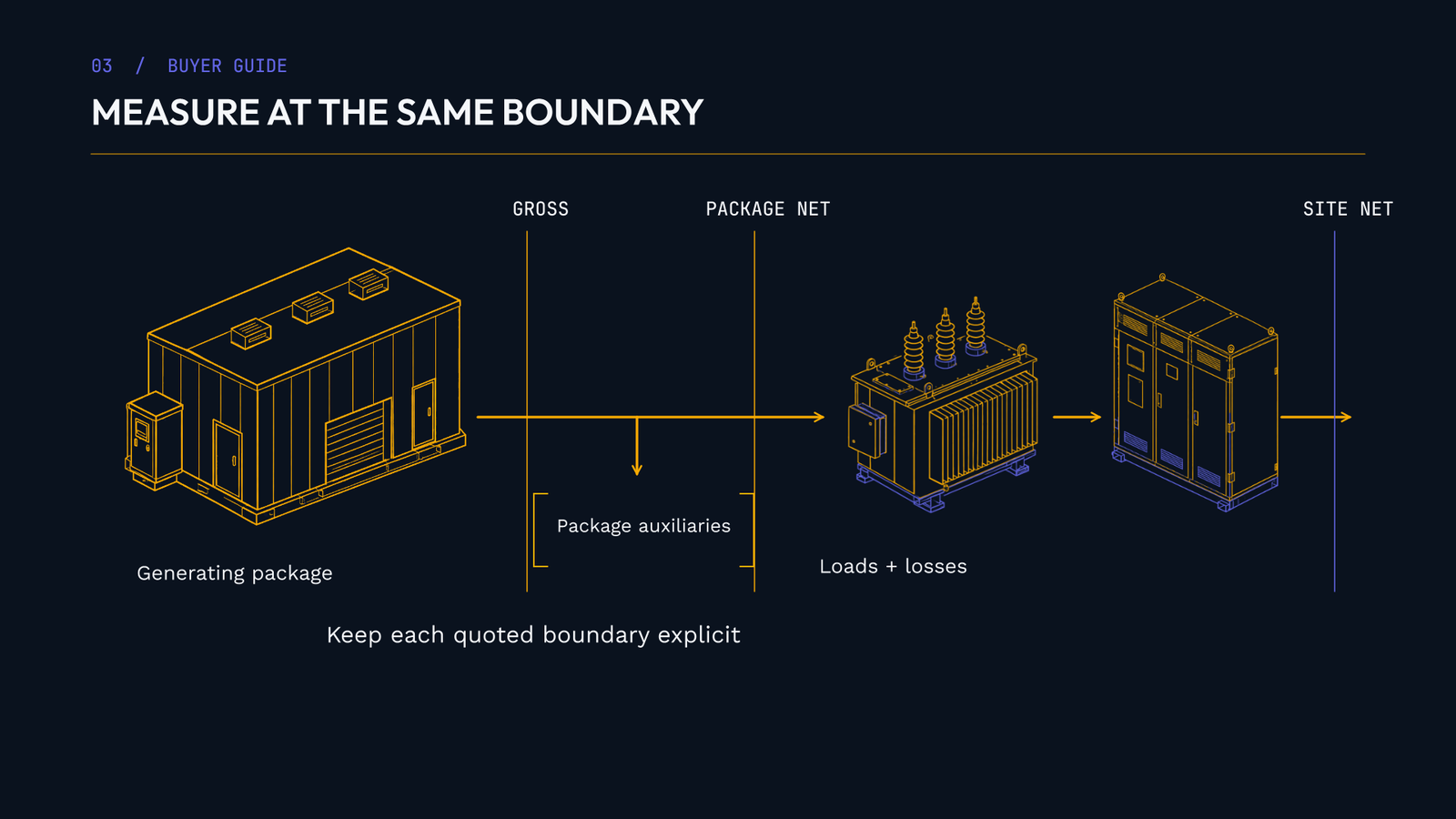
Keep each quoted boundary explicit and reconcile loads and losses once.
Test the arrangement, not only the total#
Consider a hypothetical 60 MW load. These are invented capacity-screen inputs, not ratings for the three named turbine families.
| Arrangement | Installed site capacity | With one unit unavailable |
|---|---|---|
| Three units at 30 MW each | 90 MW | 60 MW |
| Two units at 50 MW each | 100 MW | 50 MW |
The second arrangement has more installed capacity but fails this particular one-unit-out screen. That result is arithmetic, not a reliability guarantee. Common fuel supply, electrical dependencies, maintenance, transient behavior and load requirements still need separate analysis.
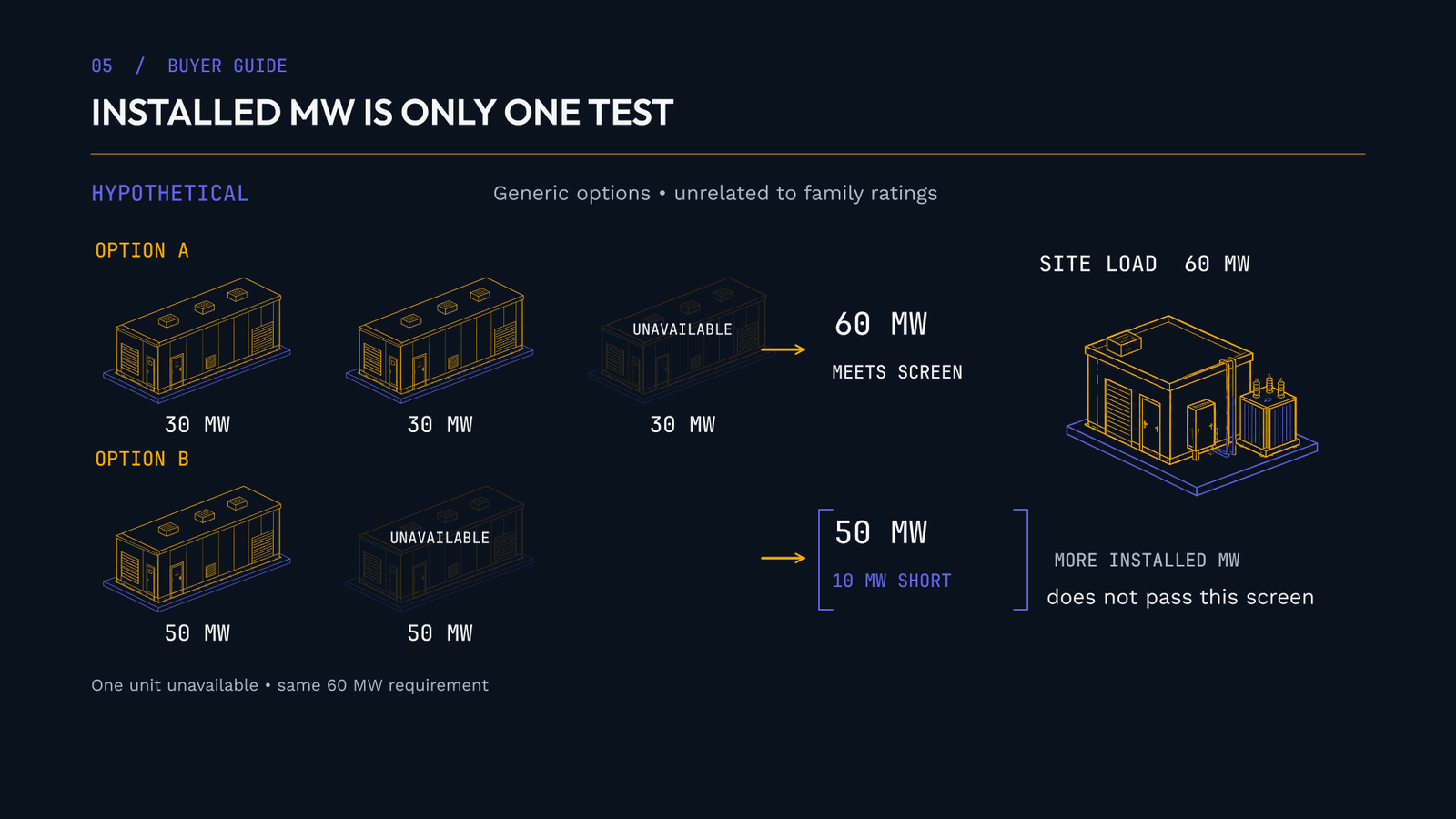
Hypothetical capacity arithmetic, unrelated to family ratings. This is not a reliability guarantee.
Compare what makes the power available#
List fuel conditions, water dependencies, connection equipment and controls alongside the performance case. If isolated operation is required, establish that duty through the appropriate design and evidence. Fast starting, starting from a dead system and carrying a changing isolated load are different capabilities.
Also separate shipping, installation and accepted-operation dates. An earlier equipment arrival does not automatically establish earlier usable power. The mobile gas-turbine guide follows those dependencies.
What should the comparison deliver?#
Use a table that states the common requirement, each candidate's supported case and the evidence still missing. Give unresolved interfaces an owner. Avoid filling blank cells with assumed capability.
Connect the result to quotation scope and condition evidence before treating it as a procurement conclusion. The aim is a documented choice for a defined duty, not a family ranking detached from the site.
Turn the shortlist into a common comparison record#
Begin with the receiving project rather than a preferred brochure. Write down the required load, operating duty, frequency, intended electrical delivery point and site conditions. Then ask every supplier to respond to that same brief. If an offer uses a different condition or boundary, retain the original value and mark the difference instead of silently treating it as comparable.
This process separates missing information from unfavorable information. An unresolved auxiliary-load boundary is an evidence gap. A documented output below the required case is a different finding. They should not receive the same notation in the comparison. Keep a responsible party and next action beside each gap so the shortlist can improve as evidence arrives.
For architecture, use the manufacturers' descriptions: MTU's LM2500 overview, MTU's LM6000 overview, and Siemens Energy's SGT-800 page. Those references establish useful family-level distinctions. They do not establish the condition, scope or site performance of a particular used offer.
Keep the unavailable-unit screen in perspective#
The video's hypothetical example isolates one question: how much capacity remains when one unit is unavailable? Three units at an assumed 30 MW each retain 60 MW after one is removed. Two units at an assumed 50 MW each retain 50 MW. Against the same assumed 60 MW load, the first arrangement passes that arithmetic screen and the second does not.
Those invented unit outputs are not ratings assigned to the named turbine families. The screen also does not establish a reliability level. Shared fuel, electrical equipment, controls, maintenance and the behavior of the load can change how the whole system performs. Keep those questions outside the simple arithmetic until the relevant design and evidence are available.
Fields to normalize before ranking#
| Comparison field | Common basis to establish |
|---|---|
| Equipment identity | Exact variant, options and package |
| Output | Same operating conditions and delivery boundary |
| Fuel performance | Same fuel and energy convention |
| Plant arrangement | Same cycle and disclosed additional equipment |
| Unavailable case | Defined unit or dependency unavailable |
| Condition | Identified records and remaining work |
| Commercial scope | Same completion outcome and exclusions |
| Schedule | Defined usable-power milestone and prerequisites |
Buyer checklist#
Use these questions alongside the full video when reviewing an actual candidate. They are an evidence-request framework, not confirmation that any offered equipment meets the requirements.
- Identify each exact variant, combustion arrangement, options and package scope.
- Normalize output to the same site boundary, conditions, frequency and fuel basis.
- Compare the same cycle arrangement and fuel-energy convention.
- Check normal and unavailable-unit capacity against the load without claiming a reliability guarantee.
- Reconcile utilities, condition, acceptance criteria and usable-power schedule.
FAQ#
Which family is best for a data-center project?#
This comparison does not establish a universal winner. The answer depends on the exact configurations, site duty, condition, dependencies and complete scope supported by the offers.
Can gross and net ratings be compared directly?#
They require a common boundary and a consistent treatment of loads and losses. Keep the original source definitions, then identify what must change to compare the same delivery point.
Does passing the one-unit-out example prove reliability?#
No. The example checks remaining capacity under stated assumptions. It does not evaluate every shared dependency, operating event or aspect of load continuity.
Prepare an equipment enquiry that can be evaluated#
Provide the project location, required electrical output and frequency, intended operating duty and target service date. Identify the candidate equipment if one is already under review, and attach the records or scope information you are authorized to share. State which questions remain unresolved rather than presenting assumptions as established facts.
Use the SecondWatt gas-turbine catalogue to continue model research and find the relevant enquiry route. An enquiry communicates requirements; it does not establish stock, a price, a delivery commitment or a guaranteed match. Keep the review record attached to the specific candidate as the discussion develops.
Sources and further reading#
- LM2500 — MTU Aero Engines. Architecture evidence; numerical rows are not used as electrical package ratings.
- LM2500 & LM2500XPRESS Gas Turbines — GE Vernova. A current named reference configuration, not a used-unit or site-output guarantee.
- LM6000 Aeroderivative Gas Turbine — GE Vernova. No universal water-flow, water-quality threshold or SPRINT availability commitment is stated in the material used.
- LM6000 — MTU Aero Engines. Architecture only. The website's abbreviated output table is not used to infer site performance or a SPRINT increment.
- Catalog of CHP Technologies, Section 3: Combustion Turbines — US EPA. Historical CHP context. No historic dollar amounts, generic gearbox rule or universal derating percentages are adopted.
- CHP Project Development Handbook — US EPA; hosted by US Department of Energy. General process evidence, not current pricing, a current legal rule or a turbine-specific schedule.
- SGT-800 Industrial Gas Turbine — Siemens Energy. No unqualified comparison with GE net ratings; no universal overhaul interval or compliance promise is adopted.
- Aeroderivative Gas Turbine Services & Support — GE Vernova. Supports the distinction between exchanged assets and broader history; no promotional outage duration or service promise adopted.
- Islanded Grid and Microgrid Solutions — GE Vernova. Not proof that a specific candidate supports black start or any data-center availability classification.