Vertiv Liebert STS2, ST/SR/SX series, 100-1850 A
Manufacturer: Vertiv
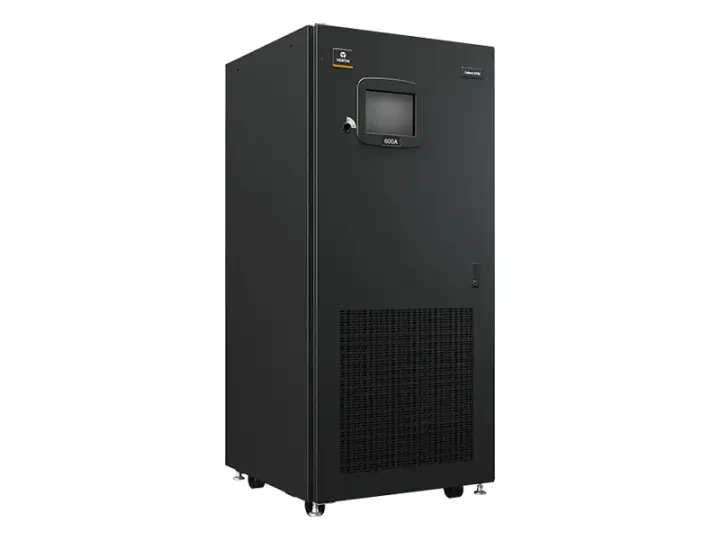
Vertiv's Liebert STS2 static transfer switch across three chassis series, 100 to 1850 amps
This model is part of SecondWatt’s static transfer switche research catalogue. Specifications and price observations are included where supported by sources. Equipment availability and commercial terms require confirmation.
Vertiv Liebert STS2 static transfer switch dossier: ST/SR/SX chassis specs, UL 1008S certification detail, transfer times, and used-market pricing analysis.
The Vertiv Liebert STS2 is a 3-phase, solid-state automatic transfer switch sold across three chassis series: ST (100-1000 A), SR (400 and 600 A only), and SX (1200-1850 A). A separate integrated product, the STS2-PDU, combines it with a fixed panelboard/transformer build; Vertiv's catalog now marks it discontinued.
Vertiv's documentation is internally inconsistent on certification, not silent on it. The 1250-1800 A four-pole, international-voltage-only guide spec (SL-20604) genuinely omits UL and seismic language, but the 100-1000 A ST spec (SL-20610), the 1200-1850 A SX spec (SL-20603), and Vertiv's own brochure all state UL 1008S, UL 891, and an optional IBC 2018 seismic floor-anchor kit. A buyer who pulls only SL-20604 will not see certifications that genuinely exist elsewhere on this platform.
Three transfer-time figures apply to three situations: under a quarter cycle for automatic/emergency transfer, under an eighth of a cycle for a manual transfer deliberately delayed until sources are phase-synchronized, and under one line cycle for the SX chassis's optimized manual mode. The SR series at 400/600 A is UL listed at 65 kA SCCR and is Vertiv's designated replacement path for first-generation Liebert STS1 units.
Warranty (12 months from startup or 18 from ship, whichever first) is Vertiv-wide boilerplate, not STS2-specific; Eaton uses the same wording. Two genuine secondary-market prices are on record, a 250 A used unit at 1,650 USD and a 400 A unit at 3,500 USD.
Why it matters
STS2-PDU's discontinued status and its fixed 208 V output, panelboard, and breaker build narrow its resale pool sharply against the still-active, distribution-agnostic standalone STS2, which can feed any downstream PDU a buyer already owns. Certification and warranty claims should be weighed against the specific chassis document and Vertiv's boilerplate warranty structure, not assumed from brand reputation alone.
Who buys it
Data center and colocation operators running dual-bus A/B UPS output arbitration are the core buyer, per Vertiv's own stated STS2 positioning. A second buyer type holds a first-generation Liebert STS1 installation and is sourcing the SR series specifically as Vertiv's documented replacement path, reusing existing STS1 ancillary accessories rather than re-engineering the site.
Role in the data center
Upstream of single-corded IT loads at the PDU or rack-row level, arbitrating automatically between two live A/B UPS output sources within a quarter cycle so a single-power-supply server does not see either source's loss.
Key specifications
| Current rating, ST series | 100, 250, 400, 600, 800, 1000 A |
|---|---|
| Current rating, SX series | 1200, 1250, 1400, 1600, 1800, 1850 A |
| Current rating, SR series | 400, 600 A |
| Voltage, ST/SX (NA-inclusive chassis) | 200/208/220/240/380/400/415/480/575/600, 3-phase VAC |
| Voltage, SR series | 208 or 480 VAC |
| Pole configuration | 4-pole double-throw (1250-1800A chassis) or 3-pole (1200-1850A chassis) poles |
| Short-circuit current rating, 800-1000A frame at 380-480V | 65 kA symmetrical |
| Short-circuit current rating, SX chassis at 380-480V | 100 kA symmetrical |
| Automatic (emergency) transfer time | less than 1/4 cycle |
| Manual (synchronized) transfer time | less than 1/8 cycle |
| Manual (optimized) transfer time, SX chassis | less than 1 line cycle |
| Warranty | 12 months from startup or 18 months from ship date, whichever occurs first |
| Cabinet dimensions, 1250-1800A 4P chassis | 26 W x 36 D x 81.6 H (88.0 H with top hat) in |
| Cabinet weight, SR series (unpacked) | 1200 lb |
| Standards listing, ST series | UL 1008, UL 1008S, CSA, ANSI, IEEE, ISO 9001, NEC, NEMA, NFPA 70 |
| Optional seismic compliance | IBC 2018 seismic floor anchor kit, optional accessory |
Technical summary
Amperage, ST series: 100/250/400/600/800/1000 A. Amperage, SR series: 400/600 A. Amperage, SX series: 1200/1250/1400/1600/1800/1850 A. Voltage, ST/SX (NA-inclusive chassis): 200-600 V, 3-phase, 50/60 Hz. Transfer time: under 1/4 cycle automatic, under 1/8 cycle manual synchronized, under 1 line cycle SX optimized. Short-circuit current rating: 25-125 kA symmetrical, varies by voltage/amperage class. Standards, ST/SX/SR: UL 1008S, UL 891, CSA C22.2 No. 178.1. Seismic: optional IBC 2018 floor anchor kit, ST series. Warranty: 12 months from startup or 18 months from ship, whichever occurs first. STS2-PDU: discontinued, fixed 208V output, integrated panelboard/breaker/transformer. Controls: microprocessor HMI, color touchscreen LCD, CANbus, RS-232 firmware upgrade port.
Major variations
Three standalone chassis series carry the STS2 name: ST (100-1000A, the widest voltage range including North American taps), SR (400A and 600A only, footprint-reduced, Vertiv's designated STS1 replacement path), and SX (1200-1850A, offered in both a 3-pole chassis covering North American and international voltage and a 4-pole chassis offering international voltage only). None of Vertiv's documents defines what the series letters stand for. A separate integrated product, STS2-PDU, combines switching with a fixed panelboard/breaker/transformer build at 250-800A and is now discontinued.
Configurations and options
3-pole or 4-pole double-throw configurations are both offered depending on chassis (SX series). An optional IBC 2018 seismic floor-anchor kit is available on the ST series as a separately ordered accessory, not a standard inclusion. Remote monitoring is available via either the IntelliSlot 485 Web Card ADPT (documented for ST/SX) or the newer Unity communications card (documented for SR), and firmware is field-upgradable via an internal RS-232 port without deenergizing the load.
Compatibility and dependencies
The SR series (400A/600A) is compatible with existing Liebert STS1 ancillary accessories per an independent reseller page, supporting its position as a direct STS1 replacement. Vertiv's own documents do not confirm whether the newer Unity communications card can be retrofitted into an older ST/SX chassis card slot originally documented with the IntelliSlot 485 Web Card ADPT; this should be confirmed directly with Vertiv rather than assumed.
Pricing and availability
Comparable secondary-market band: 4.16–14.75 $ per ampere. Trend: stable Warranty, new: 12 months from startup or 18 months from ship date, whichever occurs first. Vertiv publishes the same structure in its general Limited Warranty for Three-Phase and DC Power Products (SL-04750), so it is a category-wide term rather than an STS2-specific commitment..
Lifecycle and maintenance
Vertiv's STS2 guide specifications state a warranty of 12 months from initial startup or 18 months from ship date, whichever occurs first. This is not an STS2-specific commitment: the identical structure appears in Vertiv's general Limited Warranty for Three-Phase and DC Power Products (SL-04750), which covers Vertiv's broader AC power product category, not this model alone, confirming this term is boilerplate rather than a bespoke guarantee. HMI firmware is field-upgradable via an internal RS-232 port without deenergizing the load, per Vertiv's own guide specification. The STS2-PDU integrated variant is now marked discontinued on Vertiv's current catalog; the standalone ST/SR/SX chassis carry no such marking as of August 2026.
Thermal and emissions profile
A static transfer switch has no refrigerant and no combustion process, so GWP accounting and EPA refrigerant-management rules do not apply to the Liebert STS2 or to any variant across its ST, SR, or SX chassis lines. No SF6 or other insulating gas appears in any Vertiv document for this model. The equipment's environmental footprint is limited to semiconductor and control-board end-of-life recovery, copper bus work, and the switching losses inherent to any SCR-based device, though Vertiv does not publish an STS2-specific efficiency percentage.
Common failure points
- SCR/thyristor pairs — Failure to open cleanly, creating risk of momentary cross-connection between the two live sources
- Gate driver boards — SCR misfire, erratic or failed transfer under load
- Cooling fans — Elevated cabinet temperature, nuisance thermal alarms
- Control power transformers/capacitors — Erratic HMI behavior, false alarms, intermittent logic-power dropout
- HMI touchscreen/color LCD — Unresponsive touch input, blank or frozen display
- Seismic floor anchor kit (where ordered) — Missing or improperly torqued anchors relative to the IBC 2018 specification
- Communications/network card — Loss of remote SNMP/web monitoring while the switch itself continues operating normally
Inspection checklist
HMI firmware/software revision: confirm the current release level via the RS-232 diagnostic port before energizing, and get the field-upgrade history from the seller. Event log: pull the full 512-alarm event log and both 2x64-frame history logs via the HMI before purchase, and cross-check against the seller's stated service history. SCR gate driver boards: inspect every gate driver board for discoloration or capacitor bulging, since thermal cycling is the documented root cause on a platform marketed for 20+ year solid-state design life. Cooling fans: verify all cabinet cooling fans spin freely and are free of debris, since clogging is a named STS failure mode across the category. Short-circuit current rating nameplate: confirm the SCCR nameplate matches the voltage class in service, up to 125 kA at 208-240V and as low as 25 kA at 600V per Vertiv's own rating table.
Procurement channels
Two genuine secondary-market transactions are on record: eBay (250A used, 1,650 USD) and Surplus Record, listing a Quantum Technology Equipment unit (400A, 3,500 USD). A 600A unit (North American Switchgear Store) and an 800A unit (eBay) are listed with no transactable price. Gruber Power Services, a major refurbished-STS dealer for competing brands, carries no Liebert STS2 stock at all, and the discontinued STS2-PDU narrows the resale pool further against the still-active standalone chassis.
Regional notes
ST and SX guide specifications cover North American voltage taps (480V, 600V) alongside international taps (380/400/415V); the SL-20604 four-pole SX variant offers international voltage only, with no 480V or 600V option, which correlates with, but is not explained by Vertiv as the cause of, that document's omission of UL and seismic language.