ABB Cyberex SuperSwitch 3 and SuperSwitch 4, 100-4000 A
Manufacturer: ABB
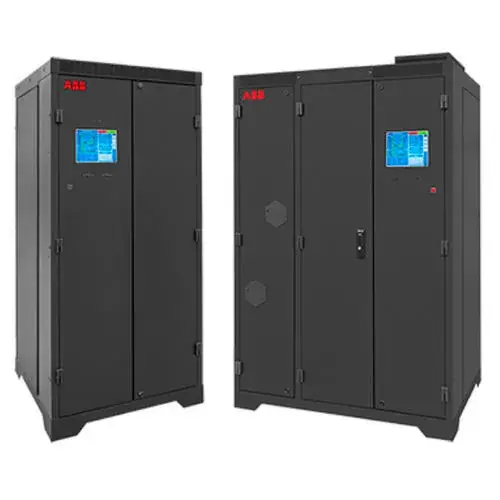
ABB's Cyberex STS line across two generations, SuperSwitch 3 legacy and SuperSwitch 4 current, 100 to 4000 A
This model is part of SecondWatt’s static transfer switche research catalogue. Specifications and price observations are included where supported by sources. Equipment availability and commercial terms require confirmation.
ABB Cyberex SuperSwitch 3 and 4 static transfer switch dossier: 100-4000A frames, dual transfer algorithms, UL 1008S listing scope, and market pricing.
Cyberex is ABB's static transfer switch brand, not Vertiv's. ABB was publishing SuperSwitch as its own product line by its release of 13 June 2018; the route by which the brand reached ABB is not established here, and no acquisition should be read into it. Vertiv's competing line is sold separately as the Liebert STS2, with no ownership link to Cyberex. Any support or warranty question about a Cyberex nameplate today is an ABB relationship, regardless of age.
The Cyberex name covers two generations, not one model. SuperSwitch 3 runs 200 to 4000 A and no longer has a current product page on ABB's site; the legacy line is still documented through distributors. SuperSwitch 4 is the current flagship, spanning at least eleven frame sizes from 100 to 4000 A, including a dedicated 100 to 250 A data sheet. SuperSwitch GT handles microgrid separation to IEEE 1547 instead, a different device class, out of scope here.
Transfer time is not one number. SuperSwitch 4 documents two named algorithms: an in-phase A9 method under 4 milliseconds, and an out-of-phase Real Time Flux Control method at 15 to 16 milliseconds, roughly a fourfold spread. ABB's own 2018 release states SuperSwitch 4 transfers 25 percent faster out-of-phase with 40 percent lower inrush than SuperSwitch 3, a generational comparison from the manufacturer, not an inference.
Both generations carry the same marketing language: a claimed 1.5 million hour MTBDE and a fault-tolerant, no-single-point-of-failure architecture. That figure repeats verbatim across both, which reads as brand-level marketing rather than a generation-specific test result, and neither is an independently audited figure.
Why it matters
Cyberex is the nameplate most likely to be mistaken for a Vertiv product, and the line most often catalogued at the wrong amperage, since its documented range runs from a 100 A data sheet up to 4000 A cabinets across two still-referenced generations. Getting the manufacturer relationship and the frame size right is the difference between a buyer who can reach ABB for support and one who cannot, and between a fair per-amp price and a mispriced listing.
Who buys it
Data centers, hospitals, manufacturing sites and semiconductor fabs running dual-corded UPS output arbitration, per ABB's own published SuperSwitch 4 applications list. A buyer evaluating a used Cyberex nameplate is really buying into ABB's post-2018 support relationship rather than a standalone Cyberex company, so confirming which generation and which frame size a listing actually represents matters more than the brand name alone.
Role in the data center
Upstream of single-corded IT loads at the PDU or rack-row level, arbitrating between two live A/B UPS output sources so a single-power-supply server rides through the loss of either path without rebooting.
Key specifications
| Amperage range, SuperSwitch 4 (3-pole) | 100-4000, discrete: 100/200/250/400/600/800/1000/1200/1600/2000/3000/4000 A |
|---|---|
| Amperage range, SuperSwitch 3 (3-pole) | 200-4000, discrete: 200/400/600/800/1000/1200/1600/2000/3000/4000 A |
| Voltage range | 208/380/400/415/480/600 V |
| Pole configuration | 3-pole simultaneous non-overlapping, or 4-pole break-before-make with SCR-switched neutral |
| Transfer time, in-phase (SuperSwitch 4) | under 4, patented A9 transfer method ms |
| Transfer time, out-of-phase (SuperSwitch 4) | 15-16, patented Real Time Flux Control method ms |
| Transfer time (SuperSwitch 3) | sensing 2, auto-transfer 4 or less, reacquisition 3 cycles ms / cycles |
| Short-circuit current rating, SuperSwitch 4 (100-250A frame) | 35 standard, 65 or 100 optional kAIC |
| Standards listing | ETL listed to UL 1008S; CSA C22.2 No. 178 |
| SuperSwitch 3 listing scope | ETL to UL1008S stated for 1200 A 3-pole units A |
| Reliability claim (MTBDE) | 1.5 million, identical wording across SS3 and SS4, OEM marketing figure hours |
| Efficiency | up to 99.4 at 480V, 98.7 at 208V % |
| Enclosure rating, SuperSwitch 4 (100-250A frame) | IP20, forced air cooling |
| Controls platform, SuperSwitch 4 (100-250A frame) | 6.5-inch color TFT touchscreen GUI in |
| Dimensions, SuperSwitch 4 (100-250A frame) | 24 x 36 x 78 (W x D x H) in |
| Weight, SuperSwitch 4 (100-250A frame) | 750 lbs |
Technical summary
Amperage, SuperSwitch 4 (3-pole): 100/200/250/400/600/800/1000/1200/1600/2000/3000/4000 A. Amperage, SuperSwitch 4 (4-pole): 200/400/600/800 A. Amperage, SuperSwitch 3 (3-pole): 200/400/600/800/1000/1200/1600/2000/3000/4000 A. Voltage and frequency: 208/380/400/415/480/600 V, 50/60 Hz. Transfer time, SuperSwitch 4: under 4 ms in-phase (A9), 15-16 ms out-of-phase (Real Time Flux Control). Transfer time, SuperSwitch 3: 2 ms sensing, 4 ms or less auto-transfer, 3-cycle reacquisition. Standards: ETL listed to UL 1008S (Intertek mark, not a UL-brand mark); CSA C22.2 No. 178. SuperSwitch 3 listing scope: ETL to UL1008S stated for 1200 A 3-pole units; higher frames unconfirmed. SCCR: 35 kAIC standard, 65/100 optional (SS4 100-250A frame); to 100 kAIC (larger SS4); 25-100 kA (SS3). Efficiency: up to 99.4% at 480 V, 98.7% at 208 V. Controls: 6.5in touchscreen GUI (100-250A frame) up to 10.4in (larger SS4 frames). Reliability claim: 1.5 million hour MTBDE, identical wording both generations, OEM marketing.
Major variations
Three product lines carry the Cyberex name, and only two are the two-source STS covered here. SuperSwitch 3 is the legacy generation, 200 to 4000 A, ETL-to-UL1008S listing stated only for 1200 A 3-pole units in ABB's own brochure text, with non-touch LCD controls and a physical mimic panel. SuperSwitch 4 is the current generation, 100 to 4000 A across at least eleven frame sizes including a 4-pole 200 to 800 A variant, with a touchscreen GUI controls platform and two named transfer algorithms, A9 and Real Time Flux Control, that SuperSwitch 3's documentation does not use by name. SuperSwitch GT is a related but different product: a 200 to 1200 A, 480VAC microgrid separation and reconnection switch built to IEEE 1547, not a two-live-source arbitration switch, and it is excluded from the specs, pricing and comparables here.
Configurations and options
The common floor-mount configuration is a 3-pole, simultaneous non-overlapping transfer unit at 208, 380, 400, 415, 480 or 600 V. A 4-pole variant with break-before-make, neutral-overlapped transfer and SCR-switched neutral is offered on SuperSwitch 4 at 200, 400, 600 and 800 A for separately derived systems, with no 600 V option documented for that neutral-switched build. Short-circuit withstand is ordered as well: the 100-250 A frames list 35 kAIC standard with 65 or 100 kAIC optional, and larger frames carry a 100 kAIC maximum at 480 V with lower-rating options available.
Compatibility and dependencies
A used unit stamped with an older Cyberex nameplate format, such as the DSFR-30400 designation found on the secondary market, does not match either current SuperSwitch naming convention, and ABB publishes no cross-reference identifying which generation or era the DSFR designation belongs to. A buyer should not assume parts or firmware compatibility with SuperSwitch 3 or SuperSwitch 4 from a Cyberex brand name alone.
Pricing and availability
Trend: stable
Lifecycle and maintenance
ABB claims an estimated 1.5 million hour MTBDE for both SuperSwitch 3 and SuperSwitch 4, framed around redundant fans, power supplies and load breakers. This is the OEM's own figure, not an independent lab test, and it repeats identically across both generations rather than varying by design vintage. Expect a 12-month service interval and the SCR-class failure modes common to this device category: thermal cycling, capacitor degradation, gate driver boards and fan wear. Controls support runs through ABB Electrification U.S. following the 2018 acquisition; SuperSwitch 3's removal from ABB's primary product site should be treated as a signal to confirm parts and firmware support directly before buying.
Thermal and emissions profile
A static transfer switch produces no emissions of its own. It is a solid-state semiconductor device that arbitrates between two already-live AC sources, not a combustion machine and not a refrigerant-bearing one, so stack emissions and refrigerant GWP accounting do not apply to this product class at all. No SF6 or other insulating gas is used in either Cyberex generation. The environmental footprint that does belong to the unit is end-of-life recovery of copper bus work, SCR heat sinks and a steel enclosure, and the efficiency loss the device itself contributes, published at up to 99.4 percent at 480V and 98.7 percent at 208V for SuperSwitch 4.
Common failure points
- Gate driver boards — Erratic or failed transfer, SCR conduction fault flagged on the touchscreen HMI
- DC bus and snubber capacitors — Reduced inrush suppression, transfer time drifting toward the upper end of the 15-16ms band
- Cooling fans — Elevated SCR heatsink temperature, thermal derating alarms on the HMI
- Touchscreen HMI and control board — Unresponsive menus, lost event log or waveform capture data
- Output load breakers — Failure to isolate a faulted source, or cross-tripping between the redundant breaker pair
- SCR pairs, the semiconductor conduction path — Unit fails to fully commutate off a faulted source, risking momentary cross-connection of two live sources
- Reacquisition and sensing circuit — Nuisance transfers on transient source disturbances that should not trigger a transfer
Inspection checklist
SCR heatsink thermal scan: request infrared thermography showing no hotspot above the unit's rated 40C ambient design ceiling. Redundant fan verification: confirm both cooling fans engage independently under hall-effect failure sensing, not just the primary fan. SCCR nameplate match: confirm the stamped rating of 35, 65 or 100 kAIC meets or exceeds the site's available fault current. Transfer time verification: request a test report showing in-phase transfer under 4ms and out-of-phase transfer under 15 to 16ms. Reacquisition timing: for SuperSwitch 3 units, confirm 3-cycle reacquisition performance at last test. Event log pull: download the stored event log and review for repeated unexplained transfers. Waveform capture review: pull stored waveform captures and check for inrush spikes exceeding the rated 1.2x inrush-limiting threshold.
Procurement channels
Gruber Power Services lists one refurbished SuperSwitch 4 unit; Mission Critical Facilities International and Strategic Protection Systems list SuperSwitch 4 with no public price. On eBay, a used DSFR-nameplate unit and a component-level control board are the only Cyberex items listed. GovDeals, PublicSurplus, IronPlanet and Surplus Record carry no Cyberex listings at all, so the visible market is thin: one refurbished dealer unit and one used marketplace unit.
Regional notes
North American product documentation throughout.