Eaton PDI WaveStar Static Transfer Switch, 100-2000 A
Manufacturer: Eaton
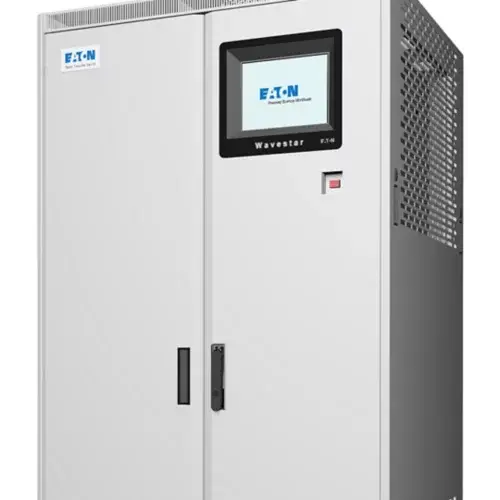
Eaton's PDI WaveStar STS with a field-selectable quarter-cycle POG or inrush-controlled VSS algorithm
This model is part of SecondWatt’s static transfer switche research catalogue. Specifications and price observations are included where supported by sources. Equipment availability and commercial terms require confirmation.
Eaton PDI WaveStar static transfer switch dossier: POG and VSS transfer algorithms, UL1008S listing, Service Life Extension Program, and per-amp pricing.
The Eaton PDI WaveStar Static Transfer Switch is a three-pole, SCR-based solid-state switch that moves a critical load between two live AC sources without mechanical contacts. The WaveStar name predates Eaton's 2020 ownership by about a year and a half. Eaton also sells a WaveStar TFA (True Front Access) enclosure, plus two older PDI nameplates: the SBR Series and a small unit Eaton brands the Matrix Telecom Static Transfer Switch, often mislabeled a Cutler-Hammer STS-100.
Eaton's own guide specification names two selectable transfer algorithms on identical hardware: POG, an automatic transfer at roughly a quarter cycle or better, and the patented Volt Second Synchronization algorithm, VSS, which slows the transfer to about a half cycle up to three quarters of a cycle while holding inrush current near one times the unit's rating. This is a field-commissioned setting, not a fixed factory spec, so two identically nameplated units can differ meaningfully in protective speed, and a buyer must ask the seller directly which mode is running rather than trust the nameplate.
Eaton assembled this family through three acquisitions: Powerware from Invensys in 2004, Pulizzi Engineering in 2007, and PDI itself in February 2020. The WaveStar name was never retired afterward, so a WaveStar nameplate is a currently serviced line, not an orphaned brand. Eaton's Service Life Extension Program covers WaveStar Legacy and TFA units with firmware, board and display replacement, adding at least ten years of service life while excluding the older SBR and LKO PDI families.
Why it matters
WaveStar is Eaton's only current floor-mount STS line, yet its own documents disagree on amperage range, and a rival brand name, Vertiv's PowerSwitch 7000, is close enough to Eaton's naming that the two get confused. Getting the variant, the commissioned transfer algorithm and the Service Life Extension Program eligibility right is the difference between a supported, ten-year-extendable asset and an orphaned legacy unit.
Who buys it
Data centers, hospitals, colocation providers and financial trading floors buying dual-source A/B power arbitration for single-corded IT and life-safety loads. A buyer evaluating a used WaveStar nameplate is really buying into Eaton's current support relationship and its Service Life Extension Program eligibility, so confirming the exact variant and the commissioned transfer algorithm matters more than the brand name alone.
Role in the data center
Upstream of single-corded IT and life-safety loads at the PDU or row level, arbitrating between two live A or B sources so a single-power-supply device rides through the loss of either path without rebooting, at whichever transfer speed the field-commissioned POG or VSS algorithm was set to deliver.
Key specifications
| Current rating, guide specification (base WaveStar) | 250, 400, 600, 800, 1000, 1200, 1600 A |
|---|---|
| Current rating, install manual and 2000A datasheet (broader attested range) | 150-2000 (3-pole) A |
| Current rating, WaveStar TFA | 250, 400, 600, 800, 1000, 1200 A |
| Voltage | 208, 400, 480, 600, three-phase, 3-wire plus ground V |
| Voltage tolerance | +/-10 % of nominal |
| Frequency and tolerance | 60 (or 50), +/-0.5 Hz |
| Pole/phase configuration | Three-pole, two-position transfer device |
| Short-circuit current rating, base 250-1600A line | 22 standard, 65 or 100 optional kAIC |
| Short-circuit current rating, 2000A extension | 65, to 600V kAIC |
| Transfer time, POG algorithm | <=1/4 cycle automatic including sense time, <=1/8 cycle manual cycle |
| Transfer time, VSS algorithm | ~1/2 to <=3/4 cycle automatic, all phase conditions, including sense time cycle |
| VSS in-rush current | typically <=1x unit rating multiple of unit rating |
| MTBF (2000A extension datasheet only) | over 2,000,000 hours |
| Controls platform | 10.4-inch color touchscreen (hot-swappable) plus Redundant Operator Interface backup; Modbus RTU, Modbus TCP/IP, SNMP v1 |
| Standards listing | ETL-listed to UL1008S, UL891, CSA22.2, IEC60947 (the 2000A datasheet states UL1008 without the S suffix) |
| Seismic certification | IBC 2010, seismic zone 4, California standard; brackets optional across all amperage classes |
Technical summary
Amperage, guide specification: 250/400/600/800/1000/1200/1600 A. Amperage, install manual and 2000A datasheet: 150-2000 A (3-pole). Voltage and frequency: 208/400/480/600 V three-phase, 60 or 50 Hz +/-0.5 Hz. Transfer time, POG algorithm: <=1/4 cycle automatic, <=1/8 cycle manual. Transfer time, VSS algorithm: ~1/2 to <=3/4 cycle automatic, inrush ~1x unit rating. SCCR: 22 kAIC standard, 65 or 100 kAIC optional; 65 kAIC to 600V on the 2000A frame. Standards: ETL to UL1008S, UL891, CSA22.2, IEC60947 (2000A sheet states UL1008, no S). Seismic: IBC 2010, seismic zone 4, California standard; brackets optional. MTBF: over 2,000,000 hours, stated only in the 2000A extension datasheet. Controls: 10.4-inch color touchscreen, hot-swappable, plus ROI backup display. Warranty: 12 months from startup or 18 months from shipment, whichever comes first.
Major variations
Five distinct product identities fall under or beside the WaveStar name, and only two are genuinely the current flagship line. The base WaveStar STS is the subject of Eaton's guide specification, and Eaton also sells a 2000 A three-pole extension and a WaveStar TFA (True Front Access) variant capped at 1200 A with a compartmentalized, front-only-service enclosure. Two older PDI nameplates remain in the same corporate family but are not WaveStar: the legacy SBR Series, rated 100 to 800 A with a flat sub-4-millisecond transfer time and no selectable algorithm, and the small telecom-rack unit Eaton's own datasheet names the Matrix Telecom Static Transfer Switch, INV-STS-100, which resellers commonly mislabel as a Cutler-Hammer STS-100 despite Eaton never using that brand name for it.
Configurations and options
The standard configuration is a three-pole, two-position transfer device at 208, 400, 480 or 600 volts three-phase. Optional short-circuit current ratings of 65 or 100 kAIC are available in place of the 22 kAIC standard rating, and optional seismic floor-mounting brackets are available across all amperage classes.
Compatibility and dependencies
Real-world transfer performance depends on a field-commissioned setting, not a fixed hardware spec: the same physical WaveStar unit can be configured for POG, an automatic transfer in roughly a quarter cycle or better, or for the patented VSS algorithm, which deliberately stretches the transfer to about a half cycle up to three quarters of a cycle in exchange for holding in-rush current near one times the unit's rating. Because that setting is invisible from the nameplate, a downstream load sized for fast POG-speed protection may actually be running on the slower VSS setting, or vice versa. A used-equipment buyer must ask the seller directly which algorithm is currently commissioned before assuming either transfer-time figure applies to the specific unit being purchased.
Pricing and availability
Published price range: 13.53 to 25.00 USD per amp new/open-box (100A legacy nameplate); 14.75 USD per amp used (400A DYR24-61B). Trend: stable Warranty, new: 12 months from startup or 18 months from shipment, whichever comes first, per Eaton's own guide specification. Vertiv's Liebert STS2 guide specification uses near-identical wording, while ABB's Cyberex SuperSwitch 4 warranty is a flat 18 months from shipment with no startup trigger, so this 12/18 structure is shared between at least two brands rather than an Eaton-exclusive commitment..
Lifecycle and maintenance
Eaton runs a named Service Life Extension Program, SLEP, that explicitly covers PDI WaveStar Legacy and TFA units, replacing firmware, circuit boards and the display, and extending end-of-service-life by a minimum of ten years with annual review for further extension. SLEP explicitly excludes the older PDI SBR and LKO STS families, so a PDI-nameplate unit outside WaveStar or TFA may have no current OEM upgrade path. Standard factory warranty is otherwise 12 months from startup or 18 months from shipment, whichever comes first. The 2000A extension datasheet claims MTBF over 2,000,000 hours, a figure not repeated in the base 250-1600A guide specification.
Thermal and emissions profile
A static transfer switch produces no emissions of its own. It is a solid-state semiconductor device that arbitrates between two already-live AC sources, not a combustion machine and not a refrigerant-bearing one, so stack emissions and refrigerant GWP accounting do not apply to this product class at all. Eaton's WaveStar literature documents no SF6 or other insulating gas and publishes no efficiency percentage for the unit.
Common failure points
- Gate driver board — SCR pair fails to fire cleanly, causing nuisance transfers or a failure to transfer on a genuine source sag
- SCR power semiconductor pair — Cross-conduction risk where a failed semiconductor momentarily or persistently connects both sources together
- Control logic and firmware board — Touchscreen freezes, lost Modbus or SNMP communication, or inability to reload a saved configuration
- DC-link and snubber capacitors — Reduced VSS in-rush suppression or audible buzzing from the SCR cabinet
- Cooling fans — Elevated internal cabinet temperature and thermal-derating alarms on the touchscreen
- 10.4-inch touchscreen and Redundant Operator Interface — Cracked glass, dead zones, or failure of the ROI backup to take over when the primary display faults
Inspection checklist
Confirm which amperage figure applies to this exact unit: Eaton's own guide spec (250-1600 A), install manual (150-2000 A) and 2026 sales brochure (100-1200 A grouped) do not agree. Confirm whether the unit is standard WaveStar or WaveStar TFA: TFA tops out at 1200 A with no 1600 A or 2000 A option, so a TFA nameplate reading higher warrants investigation. Verify the physical nameplate is genuinely WaveStar, not the legacy PDI SBR Series (100-800 A) or the small Matrix Telecom INV-STS-100 (100 A): only WaveStar and TFA units are Service Life Extension Program eligible. Confirm which transfer algorithm is currently commissioned, POG at up to 1/4 cycle or VSS at 1/2 to 3/4 cycle: before trusting either headline transfer-time figure.
Procurement channels
Eaton's PDI catalog page and channel partners (Altruent Systems, JanTech UPS, Mission Critical Facilities International) quote WaveStar and TFA units on request rather than at a posted price. Surplus Record lists no Eaton static transfer switches as of August 2026, only electromechanical automatic transfer switches. The only priced Eaton-family units are eBay listings of the smaller INV-STS-100 legacy nameplate and a DYR24-61B unit of unconfirmed WaveStar lineage.
Regional notes
Eaton publishes WaveStar documentation for the North American market. Eaton's guide specification explicitly states IBC 2010, seismic zone 4, California standard compliance, a certification the competing Vertiv Liebert STS2 guide specification does not mention anywhere. The seismic bracket itself is optional hardware at every amperage class, not a default inclusion, so a California installation should confirm the physical kit rather than assume it from the nameplate.