Ansaldo Energia RT30 and MT15 Reheat Steam Turbines
Manufacturer: Ansaldo Energia
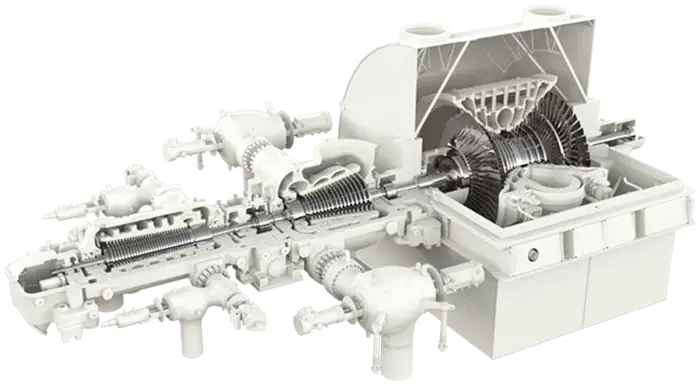
Modular reheat steam turbines from 100 to 1,000 MW for combined cycle and supercritical plants, built for 50 and 60 Hz markets.
This model is part of SecondWatt’s steam turbine research catalogue. Specifications and price observations are included where supported by sources. Equipment availability and commercial terms require confirmation.
Ansaldo Energia RT30 and MT15 reheat steam turbines: 100-1,000 MW, up to 280 bar and 620 C reheat, 50 and 60 Hz, for combined cycle and supercritical plants.
Ansaldo Energia's reheat steam turbines return partly expanded steam to the boiler or heat recovery steam generator for reheating, raising cycle efficiency. Two series are current: the MT15, a two-cylinder machine with single-flow exhaust for 100-300 MW, and the RT30, with three or more cylinders and double-flow low-pressure sections for 150-1,000 MW. Ansaldo rates the MT15 for steam up to 170 bar and 600 C with 585 C reheat, and the RT30 up to 280 bar and 600 C with 620 C reheat, covering supercritical and ultra-supercritical conditions. The range runs from two to five cylinders.
Both use 3D reaction blading machined from bar stock, welded rotors, a single-bearing design and, on the RT30, shrink rings on the high-pressure inner casing for cycling. In single-shaft combined cycles a Synchro-Self-Shifting clutch lets the gas and steam turbines run independently. Ansaldo builds every model from pre-engineered modules for both 50 and 60 Hz markets, and assembles all but the large low-pressure sections in its workshop.
Ansaldo reports more than 70 reheat reaction steam turbines (15 GW) built to ABB technology, within about 700 steam turbines and nearly 100 GW overall.
Why it matters
The steam turbine sets the bottoming-cycle output: in Ansaldo's GT36 1+1 rating the steam side adds about 237 MW to an 800 MW block (calculated). Ansaldo's reheat series cover 100-1,000 MW at steam conditions up to 280 bar and 620 C reheat, and unlike most Ansaldo gas turbines they are offered for 60 Hz as well as 50 Hz grids. Assessment: that lets a 60 Hz buyer pair an Ansaldo steam turbine with another maker's gas turbine.
Who buys it
Utilities and independent producers building combined-cycle plants behind F- and H-class gas turbines, such as Ansaldo's GT26, GT36 and AE94.3A blocks, and owners of fossil steam plants at supercritical or ultra-supercritical conditions. Ansaldo also lists cogeneration and solar plants, and the RT30 within a 100-800 MW range for small modular reactors.
Role in the data center
Ansaldo publishes no steam turbine data-center project as of November 2026. Assessment: a reheat unit forms the steam half of a large combined-cycle plant supplying a campus through the grid or a captive connection, adding roughly a third more output from the gas turbines' exhaust heat.
Key specifications
| RT30 power range | 150-1,000 MW |
|---|---|
| MT15 power range | 100-300 MW |
| RT30 main steam pressure, up to | 280 bar |
| RT30 main / reheat steam temperature, up to | 600 / 620 C |
| MT15 main steam pressure, up to | 170 bar |
| MT15 main / reheat steam temperature, up to | 600 / 585 C |
| RT30 configuration | three or more cylinders, double-flow LP section(s) |
| MT15 configuration | two cylinders, single-flow exhaust |
| Reheat family cylinder range | 2-5 cylinders |
| Frequency markets | 50 and 60 Hz |
| Blading | 3D reaction blades from bar stock, integral covers |
| Rotor and bearings | welded rotor, single-bearing design |
| HP inner casing | shrink rings for cycling capability |
| Single-shaft coupling | Synchro-Self-Shifting clutch |
| Small modular reactor range (RT30 with MT10/MT20) | 100-800 MW |
| Reheat reaction units built (ABB technology) | more than 70 units, 15 GW |
| Ansaldo steam turbine fleet (2023 brochure) | about 700 units, nearly 100 GW |
Technical summary
Ansaldo lists the MT15 at 100-300 MW, steam up to 170 bar and 600 C with 585 C reheat, two cylinders and single-flow exhaust; and the RT30 at 150-1,000 MW, up to 280 bar and 600 C with 620 C reheat, three or more cylinders and double-flow low-pressure sections. Exhaust is axial or downward for single flow and side or downward for double flow. Ansaldo does not publish last-stage blade lengths or turbine speed for these series as of November 2026.
Major variations
Current series are the MT15 (two cylinders, single-flow exhaust) and the RT30 (three or more cylinders, double-flow LP), across a family of two to five cylinders. Ansaldo also offers RT30 and the non-reheat MT10 and MT20 within a 100-800 MW range for small modular reactors. Older Ansaldo units in service follow GE impulse or Westinghouse reaction technology, and Ansaldo still services them.
Configurations and options
Options include single-shaft arrangement with a Synchro-Self-Shifting clutch or multi-shaft layout, axial, side or downward exhaust, the number of low-pressure flows, and the matching generator. Ansaldo pairs its turbines with air-cooled, hydrogen-cooled or water and hydrogen-cooled turbogenerators. Service agreements, remote monitoring and Ansaldo-made spare blades and welded rotors are offered.
Compatibility and dependencies
A reheat turbine needs a boiler or heat recovery steam generator with a reheat section, a condenser (which forms part of the LP exhaust casing on large units) and a cooling system. Steam conditions must match the series limits. Assessment: frequency is set by the generator speed, so specify 50 or 60 Hz at order; large LP sections ship disassembled and are assembled on site.
Price evidence
Price on request. Configuration, scope and dated evidence are confirmed separately for each request.
What drives the price
Assessment: series and rating, steam conditions, number of cylinders and LP flows, generator and condenser scope, hours and starts since the last major inspection, and the state of blades, casings and rotor drive price.
Lifecycle and maintenance
Ansaldo defines minor, medium and major inspections: medium covers bearings, stop and control valves, last-stage blades and endoscopic checks; major opens all casings. It publishes no hours or starts for these intervals as of November 2026. Ansaldo offers long-term service agreements, remote monitoring, phased-array checks of free-standing last-stage blades, life assessment of casings and rotors, and manufacture of new blades and welded rotors.
Common failure points
- Last-stage blades — Assessment: water-droplet erosion and corrosion fatigue in wet LP stages, worse at low load
- HP and IP casings — Assessment: thermal-fatigue cracking at inlet areas under frequent starts
- Rotor — Assessment: life consumed by creep and cycling; welded rotors need life assessment
- Stop, control and reheat valves — Assessment: solid-particle erosion of seats and stems
- Idle or stored units — Assessment: corrosion during layup without dehumidification
RT30 or MT15: match the series to the plant
- The MT15 is a two-cylinder unit for 100-300 MW at up to 170 bar; the RT30 has three or more cylinders for 150-1,000 MW at up to 280 bar. Check the heat balance and steam conditions of the plant against the series limits.
Frequency and generator
- Ansaldo builds its steam turbines for both 50 and 60 Hz markets, unlike most of its gas turbines. Confirm the generator and its speed, and whether a single-shaft clutch is part of the scope.
Inspection position
- Ansaldo defines minor, medium and major inspections: medium covers bearings, stop and control valves, last-stage blades and endoscopic checks; major opens all casings. It publishes no hours or starts for these intervals as of November 2026. Ask for the last major inspection report and the hours and starts since.
Compare offers on
- Series and rating — RT30 or MT15, guaranteed output and heat balance.
- Scope — Turbine only, or with generator, condenser, clutch and controls.
- Inspection position — Hours and starts since the last major inspection.
- Condition records — Last-stage blades, casings, rotor and valves.
Seller checklist
- Nameplate, heat balance and steam conditions
- Operating hours and starts
- Medium and major inspection reports
- Last-stage blade NDT results
- Casing and rotor NDT and life assessment
- Valve and vibration records
- Generator test results
What sets the value
Value rests on documents that tie the unit to its rating and condition: nameplate and heat balance, inspection reports, last-stage blade checks, casing and rotor NDT, vibration records, generator test results and the service history with Ansaldo or others.
Are Ansaldo reheat steam turbines available for 60 Hz?
Yes. Ansaldo states that each steam turbine model is built from pre-engineered modules for applications in both 50 and 60 Hz markets.
What sizes do Ansaldo reheat steam turbines cover?
The MT15 covers 100-300 MW with two cylinders, and the RT30 covers 150-1,000 MW with three or more cylinders and double-flow low-pressure sections.
What steam conditions can they handle?
Ansaldo rates the MT15 for up to 170 bar and 600 C with 585 C reheat, and the RT30 for up to 280 bar and 600 C with 620 C reheat.
Inspection checklist
Confirm the series (RT30 or MT15), rating, steam conditions, frequency and serial numbers. Obtain operating hours, starts and the dates and reports of the last medium and major inspections. Request last-stage blade inspection results, casing and rotor NDT, valve condition records, vibration trends and the condition of the generator.
Procurement channels
New units come from Ansaldo Energia, alone or within combined-cycle power islands and EPC contracts. Ansaldo publishes no list price. Used large Ansaldo reheat turbines are sold with complete plants rather than as stand-alone units.
Regional notes
Ansaldo states its modular steam turbines serve both 50 and 60 Hz markets. Steam turbines are not combustion equipment, so plant emissions rules apply to the boiler or gas turbine, not to the turbine.