Ansaldo Energia GT-Series Geothermal Steam Turbines
Manufacturer: Ansaldo Energia
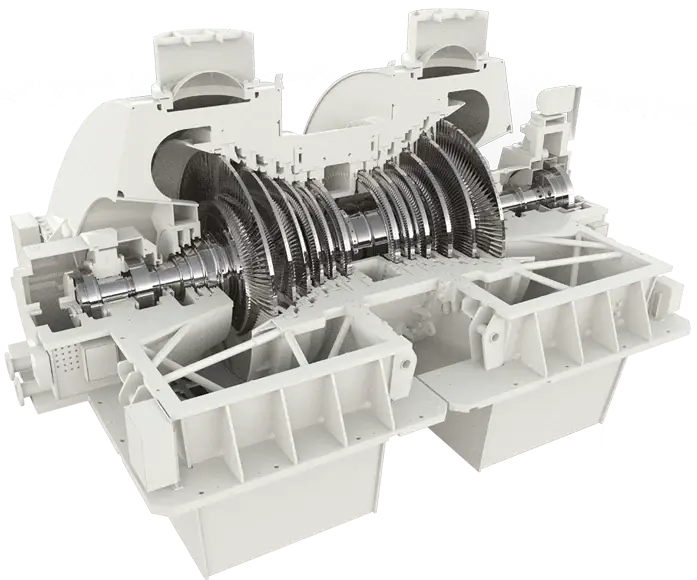
Impulse-design geothermal steam turbines of 15-150 MW with corrosion-resistant blading, from the maker of the 1911 Larderello units.
This model is part of SecondWatt’s steam turbine research catalogue. Specifications and price observations are included where supported by sources. Equipment availability and commercial terms require confirmation.
Ansaldo Energia GT-series geothermal steam turbines: 15-150 MW impulse design, up to 20 bar, 20-31 in last-stage blades, 50 and 60 Hz, retrofits.
Ansaldo Energia's geothermal steam turbines, which it calls the GT series, run on low-pressure steam from geothermal wells. They are unrelated to Ansaldo's GT26 and GT36 gas turbines. Ansaldo states its first geothermal turbine-generators went into operation at Larderello, Italy, in 1911. The current portfolio uses impulse technology, from one cylinder in single-flow configuration to two cylinders in double-flow configuration, with downward, upward, axial or lateral exhaust to suit the plant layout.
Ansaldo's 2023 brochure gives steam up to 20 bar and about 10 C superheat, butterfly admission valves, last-stage blades from 20 to 31 inches, and special rotor and blade materials against salt deposits and acid attack. Its web table lists 15-100 MW, while its 2023 brochures list 15-150 MW. Ansaldo offers both 50 and 60 Hz builds and pairs the turbines with air-cooled generators suited to humid, hydrogen sulfide-laden sites.
Ansaldo's 2023 service brochure reports more than 30 geothermal units totalling 1 GW. Recent work has centred on retrofits in Italy and a 30 MW rehabilitation in Indonesia completed in 2017.
Why it matters
Geothermal steam carries moisture, dissolved salts and acids that attack blades and casings, so material choice and a maker's field experience decide availability. Ansaldo offers corrosion-resistant rotor and blade materials, a choice of last-stage blades from 20 to 31 inches and retrofit designs; one Italian retrofit raised output from 46 MW to 59 MW with a stainless-steel-lined casing.
Who buys it
Geothermal plant owners and developers in volcanic regions building new flash-steam units or replacing ageing turbines; utilities upgrading older Ansaldo or other-make geothermal turbines through drop-in retrofits that reuse foundations; and EPC contractors bidding geothermal projects in 50 or 60 Hz markets.
Role in the data center
Ansaldo publishes no geothermal data-center project as of November 2026. Assessment: geothermal reaches data centers through grid power purchase agreements with geothermal plants, where these turbines generate baseload power with no fuel.
Key specifications
| Power range (web table) | 15-100 MW |
|---|---|
| Power range (October 2023 brochure) | 15-150 MW |
| Inlet steam pressure, up to | 20 bar |
| Inlet superheat, up to | 10 C |
| Configuration | one cylinder single-flow to two cylinders double-flow |
| Last-stage blade options | 20-31 in |
| Exhaust options | downward, upward, axial or lateral |
| Blading | impulse technology |
| Admission valves | butterfly type |
| Frequency markets | 50 and 60 Hz |
| First Ansaldo geothermal units in operation | 1911 (Larderello) year |
| Geothermal fleet (March 2023 service brochure) | more than 30 units, 1 GW |
| Italian retrofit output, before / after (dual admission) | 46 / 59 MW |
| Indonesian geothermal rehabilitation | 30 MW |
| Ansaldo geothermal output installed in Indonesia (2016) | 270 MW |
Technical summary
Ansaldo rates the GT series at 15-100 MW on its web table and 15-150 MW in its 2023 brochures, for steam up to 20 bar and about 10 C superheat. Configurations run from one cylinder single-flow to two cylinders double-flow, with downward, upward, axial or lateral exhaust, butterfly admission valves and last-stage blades of 20-31 inches. Rotor and blades use special materials against salt deposits and acid attack. It is offered for 50 and 60 Hz.
Major variations
The current GT series uses impulse blading in single- or double-flow arrangements, with last-stage blade length and exhaust direction chosen for each field. Ansaldo's retrofit offers include drop-in replacement turbines, dual-admission conversions and new casings with stainless-steel inner surfaces. Older Ansaldo geothermal units from the 1980s are now being replaced by third-generation 20 MW units.
Configurations and options
Options include single- or double-flow, the exhaust direction (downward, upward, axial or lateral), last-stage blade length, single or dual admission, and the air-cooled generator, which Ansaldo states suits geothermal sites. Ansaldo also offers EPC and retrofit scopes, including drop-in turbines that reuse existing foundations, and service agreements.
Compatibility and dependencies
The turbine needs steam within about 20 bar and 10 C superheat, a condenser and gas extraction for non-condensable gases, and cooling. Steam chemistry decides material choice: Larderello-field tests found acid chlorides causing pitting, crevice corrosion and stress corrosion cracking at the dew point. Assessment: frequency is set by the generator, so specify 50 or 60 Hz at order.
Price evidence
Price on request. Configuration, scope and dated evidence are confirmed separately for each request.
What drives the price
Assessment: rating, steam conditions, last-stage blade size, materials for the field's chemistry, single- or double-flow design, generator scope, and for retrofits the reuse of foundations and existing equipment drive price.
Lifecycle and maintenance
Ansaldo defines minor, medium and major inspections: medium covers bearings, stop and control valves, last-stage blades and endoscopic checks; major opens all casings. It publishes no hours or starts for these intervals as of November 2026. Ansaldo positions retrofits as an alternative to new build for aggressive fluids, using new casings, longer last-stage blades and new controls; one Indonesian rehabilitation took 12 months.
Common failure points
- Wet-stage blades — Acid-chloride dew-point corrosion causing pitting, crevice corrosion and stress corrosion cracking (Larderello-field tests)
- Nozzles and blading — Assessment: scale deposits narrow flow areas and cut output
- Casing inner surfaces — Corrosion of carbon-steel casings in aggressive fluids; Ansaldo used stainless-lined casings in a retrofit
- Last-stage blades — Assessment: droplet erosion in wet low-pressure stages
- Generator — Assessment: humidity and hydrogen sulfide attack windings
GT-series geothermal turbines are not GT26 or GT36 gas turbines
- Ansaldo names its geothermal steam turbine series GT, the same letters it uses for its GT26 and GT36 gas turbines. Make sure quotes and listings refer to the geothermal steam turbine.
Match materials to the field chemistry
- Geothermal steam carries salts and acids. Ansaldo uses special rotor and blade materials and offers stainless-lined casings; ask which materials are proposed for the measured chloride, hydrogen sulfide and non-condensable gas levels.
Retrofit or new
- Ansaldo offers drop-in replacement turbines and retrofits that reuse foundations, such as an Italian unit raised from 46 MW to 59 MW. Compare a retrofit with a new unit on output, schedule and remaining plant life.
Compare offers on
- Rating and steam conditions — Guaranteed output at the field's pressure, superheat and gas content.
- Materials — Blade, rotor and casing materials for the field chemistry.
- Scope — Turbine, generator, condenser, gas extraction and controls, or retrofit scope.
- Schedule — Delivery and outage duration for new or retrofit work.
Seller checklist
- Nameplate, rating and design steam conditions
- Steam chemistry history
- Blade and casing inspection results
- Material certificates
- Operating hours and outage history
- Generator insulation tests
What sets the value
Value rests on steam chemistry records, blade and casing inspection results, material certificates, operating history, generator tests and retrofit documentation. State the field conditions the unit was designed for.
When did Ansaldo start building geothermal turbines?
Ansaldo states its first geothermal turbine-generator units went into operation at Larderello, Italy, in 1911, at what is considered the first geothermal power plant in the world.
What sizes do Ansaldo geothermal turbines cover?
Ansaldo's web table lists 15-100 MW, and its 2023 brochures list 15-150 MW, for steam up to 20 bar and about 10 C superheat, with last-stage blades of 20-31 inches.
Are Ansaldo geothermal turbines available for 60 Hz?
Yes. Ansaldo states its steam turbine models are built for applications in both 50 and 60 Hz markets.
Inspection checklist
Confirm the rating, last-stage blade length, steam conditions, frequency and serial numbers. Obtain operating hours and inspection reports. Request blade NDT and pitting surveys, casing wall-thickness and corrosion maps, steam chemistry history (chlorides, hydrogen sulfide, non-condensable gases), scale and wash records, and generator insulation tests.
Procurement channels
New turbines and retrofits come from Ansaldo Energia, as stand-alone supply, EPC packages or retrofits. Ansaldo publishes no list price, and no used Ansaldo geothermal turbine carried a public asking price in November 2026.
Regional notes
Ansaldo offers 50 and 60 Hz builds. Public references are in Italy and Indonesia, where Ansaldo reported 270 MW of geothermal turbines in 2016. Steam turbines are not combustion equipment; geothermal plant emissions concern non-condensable gases handled by the plant.