Eaton PDI Wall Mount RPP
Manufacturer: Eaton
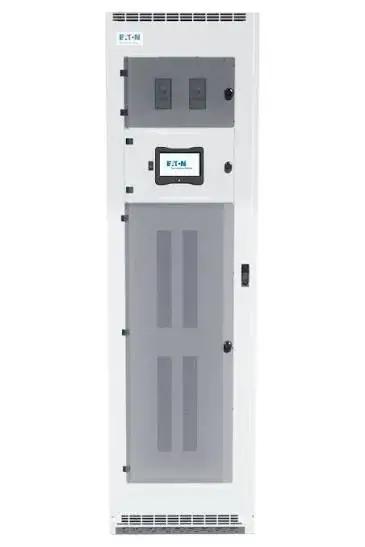
Eaton's narrowest PDI remote power panel: a 9 x 26 in wall-mount footprint carrying 225 A or 400 A across 36 to 84 poles
This model is part of SecondWatt’s remote power panel research catalogue. Specifications and price observations are included where supported by sources. Equipment availability and commercial terms require confirmation.
PDI Wall Mount RPP: 36 to 84 poles at 225 or 400 A in a 9 by 26 in footprint, the 22 to 65 kAIC family SCCR spread, breaker sourcing and used pricing.
The PDI Wall Mount RPP is the narrow-depth entry in Eaton's PDI remote power panel family: a transformer-less wall enclosure that takes an already-utilization-voltage feed from a UPS, switchboard or busway and splits it into monitored branch circuits. Eaton's catalog gives it a 9 x 26 in footprint, 225 A or 400 A mains, 36 to 84 poles, and 208, 400, 415 or 480 V at 60 Hz. Branch metering comes from PDI's WaveStar monitoring system, native Modbus RTU, with Modbus TCP/IP and SNMP on Eaton's retrofit display.
The narrow-depth product has carried two names in two eras. A 2017 PDI dealer brochure lists it as "RPP ServerLine Profile" at 225 A and 400 A; Eaton's current catalog sells the same niche as the PDI Wall Mount RPP. PDI order codes follow the pattern RPP-0#-#-###-D#, confirmed on RPP-01-0-441-D2 and RPP-02-1-441-D4 units, and as of August 2026 no Eaton or PDI catalog page, guide specification or dealer brochure uses an SL or RPP-SL designation. "Slim" appears only as dealer shorthand in the secondary market, applied to APC's Galaxy RPP as readily as to PDI's.
It is also a different platform from Eaton's house-brand Remote Power Panel, whose order codes carry an FXA suffix (RPP02FXA, RPP04FXA1214, up to 168 poles, UL 60950 and CSA 60950). Eaton's catalog marks that line discontinued and names the PDI PowerPak, Wall Mount and Modular Compact products as its replacements; the two lineages share no numbering convention and their parts do not interchange.
Standards detail varies by document. The 2017 Modular Compact guide specification names UL 60950, UL 891 and CSA 22.2 as certified and UL 67, UL 50 and UL 489 as compliance only, while the current PowerPak and Wall Mount catalog pages state "ETL Listed to UL and CSA standards" without naming a number. Published SCCR across the family spans 22 kAIC on 225 A secondary breakers to 65 kAIC at 240 VAC on Modular Compact mains, so the rating comes off the nameplate, not the family name.
Why it matters
The 9 x 26 in wall-mount footprint is the reason to specify this over the PowerPak: it recovers floor tiles in a hall where the PowerPak's 24 x 24 in base cannot be justified, at the same 225 A or 400 A mains and the same 36 to 84 poles. The trade is published documentation. Eaton names no whole-panel SCCR and no seismic standard on the Wall Mount catalog page, while IEM publishes UL 891 and UL 67 by number and cites ICC-ES AC156 and IBC-2021 for its competing RPP, so the fault-current rating has to be obtained in writing before the purchase order.
Who buys it
Data center and colocation operators standardizing on PDI distribution gear, and facility teams that need branch-circuit capacity in a corridor or wall cavity where a 24 in deep floor cabinet will not fit. Secondary-market buyers come to this nameplate for parts and monitoring compatibility with an installed WaveStar deployment. Electrical contractors buy it as the downstream half of a UPS-to-rack distribution scope, where pole count rather than amperage sets how many racks a single panel can serve.
Role in the data center
Remote power distribution from PDUs or UPS output to server racks, with branch circuit monitoring, in a 9 x 26 in wall-mount footprint where a floor cabinet will not fit
Key specifications
| Breaker amperage range | 225-450 (400 standard, 450 on Modular Compact) A |
|---|---|
| Pole configuration | 36, 42, 48, 72, 84 poles |
| Voltage, 60 Hz | 208, 400, 415, 480 V |
| Voltage, 50 Hz | 220-415 V |
| Electrical configuration | 3-phase, 4-wire plus ground - |
| Wall Mount RPP footprint | 9 x 26 in |
| PowerPak RPP footprint | 24 x 24 (24 x 38 option) in |
| Modular Compact RPP envelope | 23.75W x 84H x 12.68D; 12x24 footprint in |
| Modular Compact RPP weight | 225 typical / 300 max lb |
| SCCR, Modular Compact standard main breakers | 65 kAIC @ 240VAC |
| SCCR, ServerLine 225A secondary main breakers | 22 kAIC |
| UL/safety listing, Modular Compact | UL 60950 and UL 891 and CSA 22.2 certified; UL 67, UL 50, UL 489 compliance - |
| UL/safety listing, PowerPak / Wall Mount | ETL Listed to UL and CSA standards (no UL number stated) - |
| Operating temperature range | 32-104 (0-40) F (C) |
| Breaker frame brands documented | Square D (standard), GE, ABB Proline (84-pole option), Merlin Gerin (used 400A unit) - |
| Monitoring protocol | Modbus RTU native; Modbus RTU + Modbus TCP/IP + SNMP on retrofit display - |
Technical summary
Pole configurations: 36, 42, 48, 72, or 84. Main breaker amperage: 225A, 400A (450A on Modular Compact). Voltage, 60 Hz: 208V, 400V, 415V, 480V. Voltage, 50 Hz: 220-415V. SCCR range documented across the family: 22 kAIC (225A secondary breakers) to 65 kAIC @ 240VAC (Modular Compact main). Safety listings: UL 891 and CSA 22.2 certified; UL 67, UL 50, UL 489 stated as compliance (not listing). Wall Mount RPP footprint: 9x26 in. PowerPak RPP footprint: 24x24 in standard, 24x38 in option. Modular Compact RPP envelope: 23.75W x 84H x 12.68D in, 12x24 in footprint, ~225 lb typical / 300 lb max. Breaker frames documented: Square D (standard), GE, ABB Proline (84-pole option), Merlin Gerin (observed on one used 400A unit). Monitoring protocol: Modbus RTU native; Modbus RTU/TCP/IP/SNMP on Eaton's retrofit display.
Major variations
PDI's own five-item RPP lineup (2017 dealer literature) names Standard, Mission Critical, Modular Rack Mount, ServerLine Profile, and RPP/PDU-with-Transformer variants; Eaton's current catalog narrows this to three named products -- PowerPak, Wall Mount, and Modular Compact -- with Wall Mount occupying the same narrow-depth niche ServerLine Profile described in 2017. Separately, Eaton's own house-brand Remote Power Panel (FXA-suffix codes, up to 168 poles) is confirmed discontinued and replaced by these three PDI-branded products, a distinct predecessor platform rather than a live alternate name for any current PDI SKU.
Configurations and options
PDI RPP family options: BCMS monitoring, trapped key interlocking, multiple panelboard configurations, TVSS surge protection
Compatibility and dependencies
Across the PDI RPP family: compatible with Square D, GE, ABB and Merlin Gerin panelboard frames; UL 60950, UL 891 and CSA 22.2 listings with EN/IEC compliance stated in family literature
Pricing and availability
Comparable secondary-market band: 2000–5000 $ per unit. Trend: stable
Lifecycle and maintenance
Molded-case breakers in this class carry a roughly 30-year life expectancy under regular maintenance per Schneider Electric's own guidance, against a 5-7 year facility refresh cycle, so a decommissioned panel is normally mid-life rather than worn out. The binding constraint is breaker sourcing: this family has shipped with Square D, GE, ABB Proline and Merlin Gerin frames. Eaton's DCPD modernization service covers RPPs for new electronics, BCMS addition, capacity increase and proactive SPD, PCB, fan and breaker replacement, but Eaton publishes no RPP-specific eligibility criteria for its Service Life Extension Program as of August 2026, so get coverage confirmed in writing against the serial number. A used panel also arrives without a site-specific arc-flash incident-energy label, making a fresh study and re-labeling a real line item.
Thermal and emissions profile
As a branch-circuit distribution panelboard, this equipment carries no refrigerant charge and produces no combustion exhaust stream. Its environmental footprint is limited to the embodied energy of its steel enclosure, copper bus, and breakers, plus standard end-of-life electrical equipment recycling. No PDI or Eaton source as of August 2026 states an EPA program position, a GWP figure, or a take-back program specific to this equipment.
Common failure points
- Molded-case branch breakers — nuisance tripping, failure to trip on fault, or thermal discoloration at lugs
- BCMS/monitoring display electronics — blank or frozen monochrome display, lost network communication, unreadable branch-level data
- SPD/TVSS surge module — no visible fault-indicator lamp, reduced clamping performance after a surge event
- Neutral bus (200%-rated configurations) — elevated neutral-to-ground voltage, overheating at neutral lugs under harmonic-heavy IT load
- Main input lugs/bus connections — discoloration, pitting, or a torque reading below spec at the main breaker termination
- Kirk-key/trapped-key interlock mechanism (Mission Critical-tier units) — key binds, fails to release, or allows out-of-sequence operation
- Cooling fans (larger multi-panel configurations) — audible bearing noise above the 45 dBA rated baseline, or no airflow on power-up
Inspection checklist
Verify the field-applied SCCR nameplate meets or exceeds site available fault current: PDI's own documented range spans 22-65 kAIC across configurations, so the family name alone does not confirm the rating (NEC 408.6). Confirm the upstream overcurrent device rating does not exceed the panelboard's own nameplate rating: required under NEC 408.36. Request breaker manufacture date codes and check them against the roughly 30-year molded-case-breaker life expectancy: a unit already 15+ years in service has materially less remaining life than a newer unit at the same amperage. Exercise every breaker through a full OFF-ON-TRIP-RESET-ON cycle before energizing: repeat on at least a 12-month re-test cycle going forward, per Schneider Electric's own mechanical-reliability guidance.
Procurement channels
Eaton direct sales, authorized distributors including Power Solutions, EatonGuard, Pacific Power Systems
Regional notes
US market focus with UL certifications, 60 Hz operation standard, seismic compliance testing available