Anord Mardix Remote Power Panel
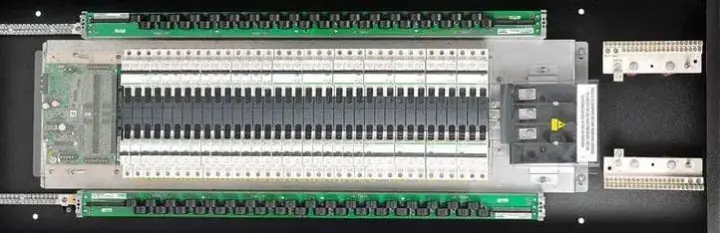
Anord Mardix's floor RPP is catalogued to 400 A, but its SCCR, UL basis, and seismic rating are unpublished
This model is part of SecondWatt’s remote power panel research catalogue. Specifications and price observations are included where supported by sources. Equipment availability and commercial terms require confirmation.
Anord Mardix Remote Power Panel specs, pricing, and code gaps: no published SCCR, an unconfirmed UL listing, and a single secondary market price of $2,500.
The Anord Mardix Remote Power Panel (RPP) is a catalogued Anord Mardix product. Anord Mardix's own site lists it as a distinct product inside its Switchgear category, alongside Static Transfer Switch, UL891 Switchgear, UL1558 Switchgear, and Power Distribution Unit. It subdivides an already-utilization-voltage feed into monitored branch circuits, up to 400A and 400V AC, with up to 84 single-pole circuits per panelboard or 168 breakers across dual panelboards.
Code-compliance documentation is thin. No Anord Mardix source states a short-circuit current rating, and no page names a UL standard directly; one reseller claims UL 508A, a control-panel standard rather than the panelboard or switchboard basis direct competitors publish. Seismic coverage is limited to optional floor stands, not a full-panel certification. The 0.5% branch-monitoring accuracy figure in Anord Mardix's literature belongs to its separate MCMS product, not a confirmed RPP spec.
Anord Mardix's July 2020 Schneider Electric partnership, covering critical data center power distribution, named DATABAR, PDUs, and Static Transfer Switch, not RPP. Flex acquired Anord Mardix for $540 million, completed December 1, 2021, describing the business around switchgear, busway, and modular power systems. Pricing is limited to one dealer observation: $2,500 for an RPP-208-000 at 208/120VAC.
Why it matters
No public source states a short-circuit current rating for this panel, so a buyer cannot verify it against NEC 408.6's field-marked SCCR requirement before purchase. Get the figure directly from Anord Mardix or a licensed engineer, and do not assume parity with the switchgear line that justified the Flex acquisition price. Direct competitors PwrQ and IEM both publish explicit SCCR figures for their RPPs; Anord Mardix does not.
Who buys it
Buyers are data center or colocation operators sourcing a compatible replacement branch-distribution panel for an existing Anord Mardix or Flex-ecosystem installation, or facility teams standardizing on Anord Mardix's switchgear and busway lines who want a matching RPP. The thin secondary market, a single $2,500 dealer observation, points to low-volume, need-specific purchases rather than broad marketplace demand.
Role in the data center
Provides local power distribution directly to server racks, located at end of server rack or on adjacent wall, used in place of overhead rack busbar to individually feed server cabinets, enables remote monitoring and control of branch circuits
Key specifications
| Current rating | Up to 400 A |
|---|---|
| Voltage (global spec) | 400 V AC |
| Voltage (dealer-observed unit) | 208/120, 60 VAC, Hz |
| Circuit capacity, single panelboard | Up to 84 single-pole circuits |
| Circuit capacity, multi-panelboard w/ BCM | Up to 168 breakers |
| Input sources per enclosure | Up to 4 sources/panelboards/main breakers |
| Enclosure ingress rating | IP31 IP class |
| Enclosure rating (reseller claim, not on OEM page) | NEMA 1 NEMA class |
| Form of separation | Form 2B (up to Form 4 Type 6) form rating |
| UL/ETL listing (reseller claim only) | ETL listed to UL 508A UL standard |
| Dimensions (global page, minimum) | 450 x 300 x 2100 mm (W x D x H) |
| Dimensions (250A/400V configuration) | 600 x 300 x 2100 mm (W x D x H) |
| Communication protocol | Modbus RTU protocol |
| Seismic provision | Optional seismic rated floor stands available accessory availability |
Technical summary
Current rating: up to 400A. Voltage: 400V AC (global spec); 208/120VAC 60Hz observed in a dealer listing. Circuit capacity: up to 84 single-pole circuits per panelboard. Multi-panelboard capacity: up to 168 breakers with optional branch circuit monitoring. Input sources: up to 4 sources, 4 panelboards, 4 main breakers per enclosure. Enclosure: IP31 per the OEM page; NEMA 1 claimed only by a third-party reseller. Form of separation: Form 2B, up to Form 4 Type 6. UL/ETL listing: unconfirmed on any Anord Mardix source; one reseller claims UL 508A only. Seismic: optional seismic-rated floor stands only, not full-panel certification. Branch monitoring accuracy: 0.5% belongs to Anord Mardix's separate MCMS line, not confirmed for the RPP.
Major variations
The RPP sits as a fifth sub-product inside Anord Mardix's Switchgear category, alongside Static Transfer Switch, UL891 Switchgear, UL1558 Switchgear, and Power Distribution Unit, a placement beside, not above, the company's flagship UL891/UL1558 switchboard lines. It is distinct from Anord Mardix's separately catalogued DataBar busway (UL 857 listed) and Distribution Panelboards (IEC-market) product lines. The company's July 15, 2020 Schneider Electric distribution partnership, announced specifically for critical data center power distribution, named DATABAR, PDUs, and Static Transfer Switch by product, not RPP, which indicates the RPP is not the flagship product in Anord Mardix's own portfolio.
Configurations and options
Main lug only, main circuit breaker, main switch configurations, top or bottom cable entry (24" cabinets bottom exit only, 38" cabinets top/bottom exit), optional Branch Circuit Monitoring, integrated IR port solutions, side and panel access options
Compatibility and dependencies
Compatible with data center PDUs, integrates with Building Management Systems (BMS) and Electrical Management Systems (EMS), works with Anord Mardix Modular Circuit Monitoring System (MCMS), supports multiple input sources for redundancy
Pricing and availability
Trend: stable Market growing at 5-6% CAGR driven by data center expansion and digital transformation, increased demand due to cloud computing and edge computing deployments
Lifecycle and maintenance
Anord Mardix publishes no service life, no overhaul interval and no RPP-specific service program on its own product pages as of August 2026. Molded-case breakers of this class carry an industry-general 30-year life expectancy under regular maintenance per Schneider Electric's own guidance, with annual exercising recommended. Anord Mardix's own RPP page names no service plan, and its 2020 Schneider Electric distribution partnership names DATABAR, PDUs, and STS, not RPP, leaving continued OEM support depth for this line unconfirmed.
Thermal and emissions profile
As a branch circuit distribution panelboard, the Anord Mardix RPP carries no refrigerant charge and produces no combustion exhaust stream; its environmental footprint is limited to the embodied energy of its steel enclosure, copper bus, and breakers, plus standard end-of-life electrical equipment recycling. No Anord Mardix source as of August 2026 states an EPA program position, a GWP figure, or a take-back program specific to the RPP. Buyers evaluating a used unit should treat scrap-value recovery through a licensed electrical recycler as the only documented disposal path.
Common failure points
- Molded-case branch breakers — nuisance tripping or failure to trip within rated curve after 15+ years in service
- Branch circuit monitoring CTs and electronics — drifted or dead current-transformer channels showing 0A or flatlined readings on live circuits
- Bus bar joints and lug connections — localized discoloration, pitting, or heat-softened insulation at splice points
- Door-in-door dead-front interlock — interlock fails to block breaker access with the outer door open, or the hinge binds after repeated cycling
- Seismic floor stand hardware where fitted — missing or unrated anchor bolts, since Anord Mardix documents the stands as an optional add-on rather than a standard-fit component
- SCCR and UL nameplate — absent, illegible, or generic nameplate carrying no panel-specific SCCR figure, which matters here because Anord Mardix publishes no SCCR for the RPP line on any of its own pages
- Discontinued or OEM parts support — inability to source matching branch breakers or BCM modules for an older-vintage unit as Anord Mardix revises its RPP line
Inspection checklist
Main and branch lug torque: verify against the torque table stamped inside the enclosure door; where no label survives, apply the standard 275-375 in-lb range for 250-400A MCCB frame lugs and record results, retorquing any lug measuring below spec. Insulation resistance (megger) test: bus-to-ground and phase-to-phase at 500VDC, minimum acceptable reading 1 megohm per standard NETA MTS-2019 Table 100.1 criteria; any reading below threshold disqualifies the panel from purchase until traced. Infrared thermal scan under load: flag any connection running more than 10 degrees C above the busbar's ambient baseline per standard NETA thermographic criteria; this is the fastest indicator of a loose or corroded joint.
Procurement channels
OEM direct via Anord Mardix (a Flex company), authorized distributors including DAXTEN, available through data center infrastructure specialists
Regional notes
US models support 208/120VAC 60Hz operation, IEC 61439 compliant versions available for international markets, designs meet both UL and IEC standards depending on region