Eaton PDI PowerPak Remote Power Panel (RPP)
Manufacturer: Eaton
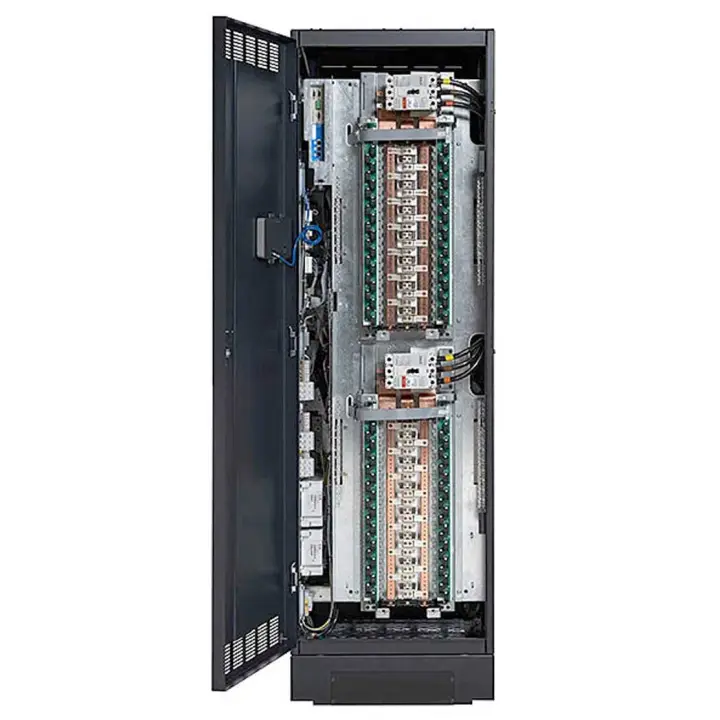
Eaton's current RPP is PDI's WaveStar PowerPak, not the RPP-A line Eaton just discontinued
This model is part of SecondWatt’s remote power panel research catalogue. Specifications and price observations are included where supported by sources. Equipment availability and commercial terms require confirmation.
Eaton PDI PowerPak Remote Power Panel specs, SCCR gaps, and pricing: 36-84 poles, UL 891, and why one 8,000 dollar listing likely is not this platform at all.
Power Xpert is Eaton's monitoring, metering, and software brand (Power Xpert Gateway, Meter, Dashboard); legacy RPP literature offers a PXGX Power Xpert Gateway card as an accessory, so a listing titled Power Xpert RPP describes an accessory card, not a separate panel product. Eaton's current RPP is the PDI-heritage WaveStar platform, in three variants -- PowerPak, Wall Mount, Modular Compact -- sharing 36-to-84-pole, 225A/400A, 208-to-480V distribution.
Eaton does not sell two competing RPP platforms today. Eaton ran two platforms -- the pre-acquisition RPP-A family on Bussmann/GHB breakers listed to UL 60950/CSA 60950, and the PDI WaveStar platform on UL 891 at 36 to 84 poles, 225/400A, 208-480V. Eaton's own catalog page marks the legacy line discontinued and end-of-life, redirecting buyers to the three PDI-branded products.
PDI and Eaton publish only a partial short-circuit rating -- 22 kAIC for the 225A secondary breakers, no whole-panel figure -- and no accuracy percentage at all for the WaveStar branch circuit monitoring system. IEM states 14/65 kAIC, Vertiv's Liebert RXV states 0.5% accuracy, and ABB's Cyberex RPP states 1% or better citing ANSI C12.1.
Pricing is limited to one ambiguous observation: an $8,000, 180A eBay listing with no PDI or WaveStar branding, more plausibly the discontinued legacy line than current PowerPak. Eaton's PDU Service Life Extension Program brochure (BR161034EN) states that modernization covers "PDUs, RPPs and STSs from PDI" with a 10-year minimum extension, but its named eligibility window covers Powerware PDUs manufactured 2010-2021; Eaton publishes no RPP-specific eligibility criteria as of August 2026.
Why it matters
No public PDI or Eaton source states a whole-panel SCCR or a WaveStar BCMS accuracy figure, so a buyer cannot verify NEC 408.6 compliance or monitoring precision without contacting Eaton directly. Eaton publishes no RPP-specific eligibility criteria for its Service Life Extension Program as of August 2026, so get model-specific coverage confirmed in writing before assuming a legacy or current unit qualifies.
Who buys it
Buyers are data center or colocation operators needing branch circuit distribution compatible with an existing WaveStar/PDI deployment, or facility teams evaluating a used Eaton-branded RPP-A unit against a new PDI PowerPak quote who need to know these are not interchangeable platforms. The single ambiguous $8,000 secondary-market observation points to low, need-specific purchase volume rather than active marketplace liquidity.
Role in the data center
Power distribution unit providing branch circuit distribution from main distribution panels to IT equipment racks, typically positioned between UPS/switchgear and rack PDUs in the power chain
Key specifications
| Pole configurations | 36, 42, 48, 72, 84 poles |
|---|---|
| Main input amperage | 225, 400 A |
| Input voltage, 60 Hz | 208, 400, 415, 480 V |
| Input voltage, 50 Hz | 220-415 V |
| Secondary/rack-distribution breaker SCCR | 22 kAIC |
| Safety listings | UL 60950, UL 891, CS 22.2, EN/IEC 60950 listing |
| Branch/panel monitor | PDI WaveStar color touch monitor platform |
| Communications | RS-485 Modbus RTU (standard); SNMP, TCP/IP (optional) protocol |
| Weight | 225-600 lbs |
| Floor-mount footprint (PowerPak) | 24x24 or 24x38 in |
| Floor-mount cabinet height | 83 in |
| Service clearance, front/rear | 36 in |
| Operating temperature range | 0-40 C |
| Operating altitude, max | 3,300 ft |
| Wall Mount RPP variant footprint | 9x26 in |
| Modular Compact RPP variant footprint | 12x24 in |
Technical summary
Pole configurations: 36, 42, 48, 72, or 84. Main input amperage: 225A or 400A. Voltage, 60 Hz: 208V, 400V, 415V, 480V. Voltage, 50 Hz: 220-415V. Safety listings: UL 60950, UL 891, CS 22.2, EN/IEC 60950. Monitor: PDI WaveStar color touch monitor. Communications: RS-485 Modbus RTU standard; SNMP or TCP/IP optional. Weight: 225-600 lbs depending on configuration. Floor-mount footprint (PowerPak): 24x24 or 24x38 in. Wall Mount RPP footprint: 9x26 in. Modular Compact RPP footprint: 12x24 in.
Major variations
Eaton ran two distinct platforms: the pre-acquisition Eaton Remote Power Panel, an RPP-A family on Bussmann and GHB breakers listed to UL 60950 and CSA 60950, and the PDI-heritage WaveStar platform covering PowerPak, Wall Mount, and Modular Compact RPPs on UL 891 at 36 to 84 poles, 225 and 400A, 208 to 480V. Eaton's own current catalog page marks the legacy line discontinued and end-of-life and redirects buyers to the three PDI-branded products. A buyer comparing an Eaton RPP quote against a PDI PowerPak quote is comparing a discontinued line against its replacement, not two live options. Within the current WaveStar platform, the three variants share the same 225A/400A, 36-to-84-pole electrical core but differ in enclosure: PowerPak is the floor-standing cabinet with the widest configuration range (24x24 or 24x38 in footprint), Wall Mount is the space-constrained option (9x26 in),
Configurations and options
Energy Management System (EMS) with remote monitoring, PXGX PDP communication card, shunt trip breakers, 80% or 100% rated breakers, Cutler-Hammer or Square D panelboards, branch circuit monitoring to 90A
Compatibility and dependencies
Compatible with upstream UPS systems and PDUs, downstream rack PDUs, supports Modbus RTU/TCP, SNMP protocols, NEC 2008 compliant wiring, isolated ground connections available
Pricing and availability
Trend: stable Upward trend driven by data center demand surge and component costs, RPP market grew from ~$1.1B to $1.6B globally 2023-2026
Lifecycle and maintenance
Molded-case breakers in this class carry an industry-general 30-year life expectancy under regular maintenance. Eaton's PDU Service Life Extension Program brochure states modernization covers "PDUs, RPPs and STSs from PDI," offering a 10-year minimum extension with display, logic-board, and BCMS-board replacement plus recalibration. Eaton publishes no RPP-specific eligibility criteria in that brochure or on its DCPD modernization services page as of August 2026, so get coverage stated in writing against the specific serial number before pricing a refurbishment.
Thermal and emissions profile
As a branch circuit distribution panelboard, the PDI PowerPak RPP carries no refrigerant charge and produces no combustion exhaust stream; its environmental footprint is limited to the embodied energy of its steel enclosure, copper bus, and breakers, plus standard end-of-life electrical equipment recycling. Eaton and PDI publish no EPA program position, GWP figure, or take-back program specific to the RPP as of August 2026. The WaveStar BCMS supports load-profiling and energy accounting that can inform a facility's own carbon accounting, but this is a data-reporting feature, not an emissions position Eaton itself publishes for the panel.
Common failure points
- WaveStar display / BCMS PCB — WaveStar display blank or frozen
- Branch circuit breaker — Branch breaker fails to trip or resets erratically
- BCMS current/voltage sensing — BCMS reports current/voltage readings that drift from a calibrated meter
- Communications card (RS-485/SNMP/TCP-IP) — Card drops off the network intermittently
- Bus bar / lug connections — Connection runs hot under load
- Key interlock mechanism — Mechanism binds or fails to actuate
- Enclosure door gasket / seismic anchoring — Gasket degraded or anchor points missing
Inspection checklist
Confirm nameplate SCCR against the site's actual available fault current before energizing: PDI publishes only 22 kAIC for 225A secondary breakers, no whole-panel figure, so this must be verified per NEC 408.6, not assumed. Request the specific pole configuration: 36, 42, 48, 72, or 84: and confirm it matches the buyer's rack count, since pole count, not amperage, sets branch-circuit capacity. Verify which branch protection is fitted at the 225A or 400A main rating: Bussmann fused switches or Eaton GHB/Square D/GE breakers: since parts and replacement lead time differ by path. Pull the WaveStar BCMS firmware and board revision and get written confirmation of Service Life Extension Program eligibility: Eaton's own program brochure states a 10-year minimum extension but names no RPP-specific eligibility criteria.
Procurement channels
Eaton direct sales, authorized distributors (EatonGuard.com, EMR CPR), system integrators for turnkey data center projects
Regional notes
US market uses UL standards with 208V/60Hz common, EU market uses IEC standards with 400V/50Hz typical, APAC varies by country