Vertiv Liebert CRV
Manufacturer: Vertiv
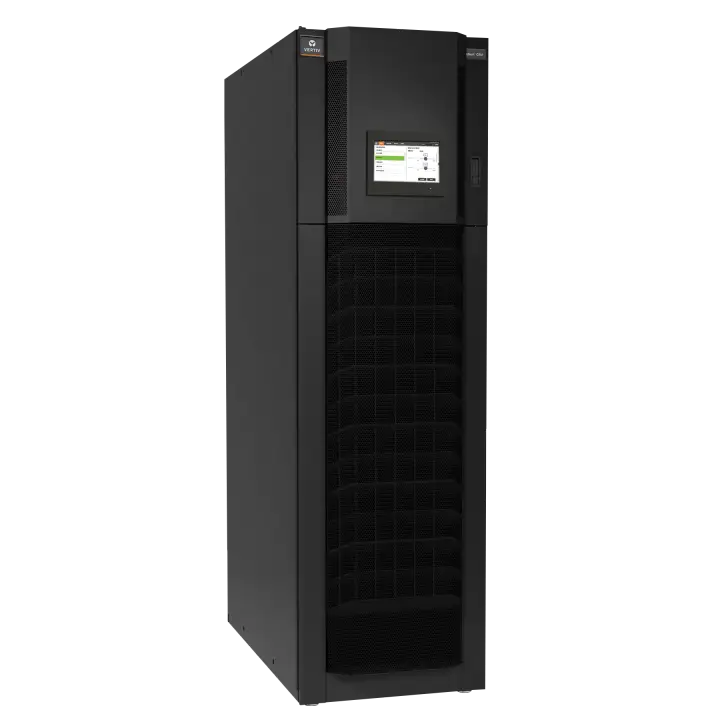
In-row DX and chilled-water cooling for server rows, 19-50 kW, R-410A with no R-22 history
This model is part of SecondWatt’s crac / crah research catalogue. Specifications and price observations are included where supported by sources. Equipment availability and commercial terms require confirmation.
Room and in-row air cooling runs out of headroom as rack density rises; above roughly 40 kW per cabinet the load is picked up by liquid cooling, usually retrofitted into halls that keep their CRAC units for the remaining air-cooled rows. The catalogue entries closest to that decision are GRC ICEtank Immersion Cooling and Vertiv Liebert XDU Coolant Distribution Unit.
Vertiv Liebert CRV in-row cooling specs, R-410A refrigerant details, the CoolPhase Row successor, and used equipment pricing for data center buyers.
Liebert CRV is Vertiv's row-based, in-row precision cooling line, not a perimeter downflow or upflow CRAC - it slots into a server row between two IT racks rather than standing at the room perimeter. North American models span three cooling mediums: DX air-cooled and water/glycol-cooled units at 19-35 kW (5.4-9.95 tons), and chilled-water units with no compressor at 32-50 kW (9.1-14.2 tons). All DX variants run a digital scroll compressor with 20-100% modulation.
Every DX CRV document Vertiv publishes, from a December 2009 manual through the August 2023 design catalogue, specifies R-410A, and no R-22 generation appears in any of them. That is a real difference from older perimeter Liebert units such as a 1998-vintage UH245A and a 2004-vintage VH219W, both nameplated R-22. A used CRV does not carry the reclaimed-refrigerant sourcing problem a similarly aged perimeter Liebert can carry.
Vertiv has already announced a compliant successor: CoolPhase Row, shipping as CRD30 and CRD40 on R-32 at 675 GWP, announced October 2, 2025 and naming legacy CRV as the product it replaces. The EPA's January 1, 2027 GWP-700 limit restricts new manufacture, not continued use, so a used R-410A CRV remains fully legal to run past that date.
Capacity, containment dependency, and proximity to the served racks separate CRV from a perimeter unit, so it cannot be priced against a perimeter DS, VH, or UH unit on nominal tonnage alone. AHRI Datacom 1360 certification applies, though Vertiv publishes no EER, NSenCOP or SCOP figure for any CRV model.
Why it matters
Every CRV document Vertiv publishes, from a December 2009 manual to the August 2023 design catalogue, specifies R-410A, so a used CRV carries none of the R-22 history that 1998 and 2004-vintage perimeter Liebert units do. Vertiv has already named CRV as the legacy line CoolPhase Row (R-32) replaces, so a buyer planning a long capital hold should weigh parts and factory-support planning against that roadmap shift, even though a used R-410A CRV remains fully legal to run past January 1, 2027.
Who buys it
Data center and colocation operators retrofitting hot or cold aisle containment onto existing server rows, buyers standing up rack-dense or GPU-pod cooling that needs capacity close to the load rather than at the room perimeter, and facilities adding supplemental spot cooling to an already-cooled raised-floor room. A buyer choosing between the DX and chilled-water CRV variants should already have condenser or chilled-water-loop infrastructure decided before comparing unit price.
Role in the data center
Row-based supplemental or targeted cooling paired with hot or cold aisle containment, sized to the racks it sits beside rather than to an entire room, and not a standalone room-perimeter cooling source. It sits between two IT racks in the row itself, close-coupled to rack-dense or GPU-pod loads that a perimeter unit cannot reach efficiently.
Key specifications
| Capacity range (DX, air/water-glycol) | 19-35 kW |
|---|---|
| Capacity range (chilled water) | 32-50 kW |
| Refrigerant (DX variants) | R-410A - |
| Refrigerant GWP (R-410A, AR5 100-yr) | 2,088 GWP |
| Compressor type | Scroll-type, digital scroll, variable capacity 20-100% - |
| Cabinet dimensions (H x W x D) | 2000 x 300/600 x 1100-1250 mm |
| Dry unit weight, CR035RA | 805 (365) lb (kg) |
| Dry unit weight, CR019 | 507 (230) lb (kg) |
| Electrical supply (600 mm units) | 208-230V/3ph/60Hz or 460V/3ph/60Hz V/phase/Hz |
| Short-circuit current rating (SCCR) | 65,000 (most models) A |
| Standards listing | CSA C22.2 No. 236 / UL 1995 (Heating and Cooling Equipment); AHRI Standard 1360 certified - |
| Operating temperature envelope | 75-110 (23.9-43.3) deg F ( deg C) |
| Operating humidity envelope | 15-60 % RH |
| Refrigerant charge, base indoor unit (CR035RA) | 10 (4.5) lb (kg) |
| Sound pressure, 100% fan (CR050RC / CR032RC) | 72 / 86.2 dB(A) |
| Control platform | Liebert iCOM, 9 in. color touchscreen - |
Technical summary
DX capacity: 19-35 kW (5.4-9.95 tons), air-cooled or water/glycol-cooled. Chilled-water capacity: 32-50 kW (9.1-14.2 tons), no compressor. Refrigerant: R-410A (GWP 2,088), all DX variants, no R-22 generation documented. Compressor: digital scroll, 20-100% capacity modulation, 3,500 rpm at 60 Hz. Cabinet: 300 mm or 600 mm wide, 2,000 mm tall, 1,100-1,250 mm deep. Weight: 507 lb (230 kg) CR019 to 805 lb (365 kg) CR035. Electrical: 208-230V or 460V, 3-phase, 60 Hz. Control platform: Liebert iCOM, 9 in. color touchscreen. Standards: CSA C22.2 No. 236 / UL 1995; AHRI Datacom 1360 certified. Operating envelope: 75-110 deg F (23.9-43.3 deg C), 15-60% RH.
Major variations
CRV ships in three cooling-medium variants under one nameplate family: DX air-cooled (model prefix CR0xxRA), DX water/glycol-cooled (CR0xxRW), and chilled-water with no compressor (CR0xxRC). North American documentation from 2009 through the current August 2023 design catalogue consistently uses plain 'CRV' with CR0xx model numbers; a separately branded international 'CRV+' variant exists in Vertiv's EMEA/APAC literature with different model codes and EU-market electrical and dimensional conventions, and Vertiv does not apply the 'CRV+' branding to the North American line in any of its NA documentation. Vertiv's currently marketed row-based successor is CoolPhase Row (CRD30/CRD40), not 'CRV2' or 'CRV+' - a separate product built on R-32 refrigerant, announced October 2, 2025, and explicitly named as CRV's replacement.
Configurations and options
Cabinet width is 300 mm or 600 mm, and cooling medium is DX air-cooled (CR0xxRA), DX water/glycol-cooled (CR0xxRW) or chilled water (CR0xxRC). Electrical service on North American units is 208-230 V or 460 V, three-phase, 60 Hz. Control is Liebert iCOM with a 9 in. color touchscreen and up to 20 rack temperature sensors, speaking Modbus and SNMP. A humidifier and reheat subsystem is an option rather than standard fit, so confirm on the specific part number whether it was ever installed: many secondary-market units have it bypassed or removed rather than repaired.
Compatibility and dependencies
CRV is an in-row unit, not a perimeter one, and that changes what its nameplate numbers mean. Capacity, aisle-containment dependency, and proximity to the served racks all separate it from a perimeter CRAC: a perimeter unit discharges into a raised floor or overhead duct and cools an entire room, while CRV sits between two racks in a hot-aisle/cold-aisle row and cools only the racks flanking it, generally depending on aisle containment to hit its rated capacity. Published North American capacity ranges are DX at 19-35 kW (5.4-9.95 tons) and chilled water at 32-50 kW (9.1-14.2 tons); a CRV at these figures cannot be priced against a perimeter DS, VH, or UH unit of similar nominal tonnage without accounting for that structural difference.
Pricing and availability
Comparable secondary-market band: 75–700 $ per ton. Trend: stable Lead time, new: Vertiv states no lead time in days or weeks; its own CRV product and specification pages publish no manufacturing lead time.. Warranty, new: One Year Limited Warranty Against Defects in Material and Workmanship, per Vertiv's own CRV product page.. Warranty, used: The four priced eBay listings carry a 'seller refurbished' condition label with no stated warranty period..
Lifecycle and maintenance
Vertiv publishes no figure for CRV service life, compressor MTBF or EC fan life in operating hours. Vertiv's own product page states a one-year limited warranty against defects in material and workmanship on new units. CRV shipped on the Liebert iCOM control platform natively from its earliest published documentation in 2009, and it does not appear on Vertiv's own list of legacy platforms eligible for iCOM retrofit, which covers DS, CW, DSE, PDX/PCW, and Mini-Mate. It never needed the control-upgrade path those perimeter units require, so a used CRV does not carry that control-obsolescence risk.
Thermal and emissions profile
CRV runs R-410A on every DX variant, GWP 2,088, and no R-22 generation appears in any document from a December 2009 manual through the August 2023 design catalogue. That contrasts with older perimeter Liebert units such as a 1998-vintage UH245A and a 2004-vintage VH219W, both R-22 nameplated, so a used CRV does not carry the reclaimed-refrigerant sourcing problem a used perimeter Liebert of similar age can carry. The chilled-water CR0xxRC variants carry no compressor at all; their exposure sits upstream at whatever chiller plant serves them. The Jan 1, 2027 GWP-700 limit restricts new manufacture, not continued use, and Vertiv has already named CoolPhase Row (CRD30/CRD40, R-32, 675 GWP) as CRV's successor, announced October 2, 2025.
Common failure points
- Digital scroll compressor — Loss of cooling capacity, failure to stage past 20% modulation, high discharge temperature
- EC fan motor/bearing — Audible bearing noise, reduced airflow, vibration at the top of the cabinet
- iCOM control board — Blank or unresponsive 9 in. touchscreen, no communication over Modbus/SNMP, unit defaults to local-only operation
- Condensate pump — Water accumulation in drain pan, nuisance high-water alarms, drain line backing up
- Refrigerant line joints (post-relocation) — Slow refrigerant leak, subcooling drift over weeks, repeated low-charge nuisance trips
- Humidifier/reheat subsystem (where equipped) — Humidity setpoint not maintained, canister scale buildup, reheat element failure
- Digital scroll unloader/modulation valve — Compressor stages full-on/full-off instead of smooth 20-100% modulation, higher energy draw, temperature swings in the served row
Inspection checklist
Nameplate refrigerant type: confirm R-410A, not a relabeled or field-converted charge, before pricing against its 2,088 GWP. Compressor model and type: confirm digital scroll, not a swapped generic scroll, and record the serial date code. Base indoor unit refrigerant charge: verify against nameplate: 5 lb (2.7 kg) CR019RA, 7 lb (3.2 kg) CR020RA, 10 lb (4.5 kg) CR035RA: a mismatch indicates prior field service or a leak repair. Subcooling reading at current ambient: target range runs from 22 deg F (12.0 deg C) at 0 deg F ambient down to 0 deg F at 125 deg F ambient per the OEM table: a reading well outside this band signals charge loss or a metering-device fault. Compressor oil level and type: POE ISO 32 centistoke viscosity is the OEM-specified oil for the digital scroll compressor; wrong oil type is a red flag for non-OEM service history.
Procurement channels
In-row CRV units reach the resale channel at a fraction of the volume and dealer diversity of perimeter Liebert units: Surplus Record alone carries 28 used Liebert perimeter listings against 4 priced CRV listings, all from one Phoenix, AZ eBay dealer. This is consistent with in-row units being installed in smaller quantities per room, more tightly coupled to a specific row or containment build-out, and less commonly decommissioned as a standalone salvage item than a perimeter unit pulled whole from a raised-floor room.
Regional notes
North American CRV documentation (2009-2023) consistently uses CR0xx model numbers, 208-230V/460V 3-phase electrical, and imperial/metric dual dimensions. A separately branded 'CRV+' variant in Vertiv's EMEA/APAC literature uses different model codes (CR025/CR035-style) and 380-415V 3-phase electrical, and should not be assumed parts-compatible with North American CRV stock.