Rittal LCP Rack DX / LCP Inline DX
Manufacturer: Rittal
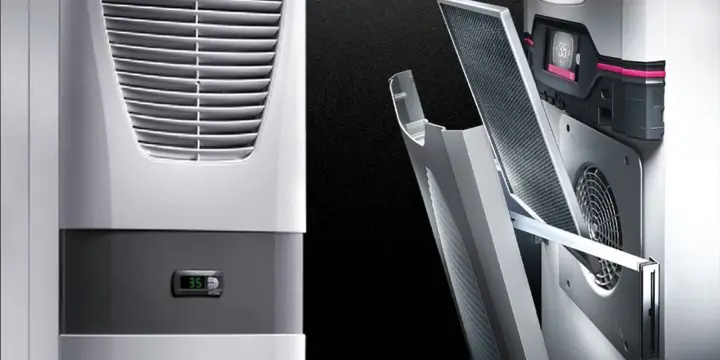
In-row DX cooler at 12 kW or 20 kW per unit, charged with R-410A at GWP 2,088 against a 700 GWP ceiling from January 2027
This model is part of SecondWatt’s crac / crah research catalogue. Specifications and price observations are included where supported by sources. Equipment availability and commercial terms require confirmation.
Room and in-row air cooling runs out of headroom as rack density rises; above roughly 40 kW per cabinet the load is picked up by liquid cooling, usually retrofitted into halls that keep their CRAC units for the remaining air-cooled rows. The catalogue entries closest to that decision are CoolIT Systems DCLC Direct Liquid Cooling and GRC ICEtank Immersion Cooling.
Rittal LCP DX in-row DX cooling specs, R410A refrigerant GWP, the January 2027 EPA deadline it faces, and used equipment pricing for data center buyers.
Rittal's Liquid Cooling Package (LCP) DX line is the manufacturer's own in-row and rack-adjacent direct-expansion cooling unit for IT equipment, sold as LCP Rack DX (dedicated to one rack footprint) and LCP Inline DX (shared across adjacent racks in a row), in two capacity tiers. The 12 kW tier runs a twin-rotary compressor across a 3-12 kW modulation range with N+1 fan redundancy; the 20 kW tier runs a scroll compressor and can be interconnected with up to 8 additional units for row-level redundancy instead. Both tiers are genuinely self-contained DX systems: an internal compressor and evaporator inside a 300mm x 2,000mm x 1,000-1,200mm chassis, with refrigerant piping running out to a remote air-cooled condenser rather than a chilled-water loop.
The refrigerant is R410A on both tiers, GWP 2,088 on EPA's own AR4-basis reference table. Because Rittal markets LCP DX explicitly as data-center and IT-room equipment, it sits inside the subsector EPA's Technology Transitions Rule names data centers, computer room air conditioning, and information technology equipment cooling, putting the January 1, 2027 GWP-700 manufacturing deadline directly on this product.
LCP DX tops out at 20 kW per unit, in-row scale, not room-perimeter scale. For a full data-hall CRAC or CRAH at 10-30-ton scale, Rittal does not manufacture its own unit at all; it sells STULZ's CyberAir 3PRO DX and CW room-cooling systems under a stated global partnership. A buyer comparing a Rittal room unit against a STULZ room unit at that scale is likely comparing the same machine sold through two catalogs.
Why it matters
The January 1, 2027 GWP-700 deadline is the commercially decisive fact: LCP DX runs R410A at GWP 2,088, roughly triple the ceiling, and no lower-GWP successor variant has been announced. Rittal has already made an equivalent transition elsewhere in its catalog (R134a to R-1234yf on a current Blue e+ IT SKU), which shows the capability exists, but nothing public commits LCP DX to the same path before the deadline binds new manufacture.
Who buys it
Edge and small-to-medium data center operators, colocation tenants adding supplemental in-row cooling to a hot row without a chiller-plant buildout, and system integrators standardizing on Rittal's enclosure ecosystem who need row-level DX capacity rather than a room-perimeter unit. Buyers evaluating room-perimeter scale under the Rittal name should confirm whether the quoted unit is this Rittal-engineered LCP DX or a Rittal-sold STULZ CyberAir 3PRO DX.
Role in the data center
LCP DX sits inside the row, cooling one rack (LCP Rack DX) or a shared span of adjacent racks (LCP Inline DX), typically as supplemental or targeted capacity for a high-density row rather than the sole cooling source for an entire hall. Its 12-20 kW per-unit range and up-to-8-unit interconnection make it suited to edge sites and small-to-medium data centers that want DX cooling without a full chiller-plant investment, not the room-perimeter role a floor-mount CRAC or CRAH plays in a large hall.
Key specifications
| Cooling capacity, 12 kW tier | 3-12 kW (modulation range) |
|---|---|
| Cooling capacity, 20 kW tier | 20 (68,242) kW (BTU/h) |
| Refrigerant | R410A - |
| Refrigerant GWP (EPA AR4-basis reference table) | 2,088 GWP |
| Compressor type, 12 kW tier | Twin rotary - |
| Compressor type, 20 kW tier | Scroll, inverter-controlled - |
| Voltage / phase / frequency (documented SKU) | 208, 1, 60 V/phase/Hz |
| Chassis dimensions (both tiers) | 300 (W) x 2,000 (H) x 1,000-1,200 (D) mm |
| Weight, 12 kW tier | 181 (399) kg (lb) |
| Weight, 20 kW tier | 201 (443) kg (lb) |
| Airflow, 12 kW tier | 2,825 (4,800) CFM (m3/h) |
| Redundancy, 12 kW Inline tier | N+1 EC fans, primary/backup control - |
| Redundancy, 20 kW tier | Interconnection of up to 8 units count |
| Condenser configuration | Remote, air-cooled; standard and high-ambient variants - |
| Fan technology | EC (electronically commutated), tool-less replacement - |
| Controls | Electronic expansion valve; integral condensate/leak management; remote monitoring - |
Technical summary
Capacity, 12 kW tier: 3-12 kW modulation range. Capacity, 20 kW tier: 20 kW (68,242 BTU/h). Refrigerant: R410A, GWP 2,088 (EPA AR4 reference table). Compressor, 12 kW tier: twin rotary. Compressor, 20 kW tier: scroll, inverter-controlled. Condenser: remote, air-cooled; standard and high-ambient variants. Chassis dimensions (both tiers): 300mm W x 2,000mm H x 1,000-1,200mm D. Weight: 181 kg (399 lb) 12 kW tier; 201 kg (443 lb) 20 kW tier. Voltage: 208V, single-phase, 60Hz (documented SKU). Airflow, 12 kW tier: 2,825 CFM (4,800 m3/h). Redundancy: N+1 fans (12 kW); interconnect up to 8 units (20 kW). GWP-700 manufacturing deadline for this subsector: January 1, 2027.
Major variations
LCP DX ships in two chassis orientations and two capacity tiers. LCP Rack DX dedicates one unit to a single rack; LCP Inline DX shares cooling across adjacent racks in a row. The 12 kW tier runs a twin-rotary compressor with N+1 fan redundancy and a primary/backup control scheme; the 20 kW tier runs a scroll compressor and supports interconnecting up to 8 units for row-level redundancy instead. The chilled-water sibling, LCP Rack CW / LCP Inline CW, shares the same 300mm x 2,000mm x 1,200mm chassis platform but replaces the compressor and refrigerant circuit with a coil fed from a building chiller plant, rated up to 30 kW per unit.
Compatibility and dependencies
LCP DX and LCP CW share an identical outer chassis footprint (300mm x 2,000mm x 1,000-1,200mm), but a DX chassis cannot simply be re-piped into a CW unit or vice versa; the compressor, evaporator, and expansion-valve hardware are specific to the DX variant and are not stated by Rittal to be field-convertible. Rittal's own site places LCP DX/CW, STULZ CyberAir, and Rittal Blue e+ under one "IT Cooling Solutions" umbrella page, which can read as one interoperable family; they are not, and a buyer should confirm which specific product a quoted "Rittal cooling unit" actually is before assuming shared parts or service support.
Pricing and availability
Comparable secondary-market band: 899.99–9642.5 $ per unit (Rittal Blue e+ enclosure cooler, not LCP DX). Trend: stable
Lifecycle and maintenance
Rittal publishes no service-life, MTBF or overhaul-interval figure for LCP DX on its product pages, the LCP DX sell sheet or the detailed data sheet as of August 2026. Rittal's documented service-relevant features are architectural rather than a stated interval: an inverter-controlled compressor with an electronic expansion valve, tool-less EC fan replacement, and an integral condensate/leak-management system for early-warning monitoring. Rittal publishes no control-platform support statement covering discontinued LCP DX part numbers, so get that confirmed in writing before buying a superseded SKU.
Thermal and emissions profile
LCP DX runs R410A, GWP 2,088 on EPA's AR4-basis reference table. Because Rittal markets LCP DX as data-center and IT-room equipment, it sits inside the subsector EPA's Technology Transitions Rule names data centers, computer room air conditioning, and IT equipment cooling, so the January 1, 2027 GWP-700 manufacturing deadline binds it directly, with no lower-GWP successor announced. Rittal's own Blue e+ enclosure coolers, by contrast, run R-513A at GWP 630 (R-1234yf at GWP 1 on the newest Blue e+ IT SKU) and are captured by no EPA subsector at all, since 40 CFR 84.54 lists no industrial-enclosure-cooling category. The same manufacturer's refrigerant risk is therefore binary: dated and real for its data-center product, essentially absent for its enclosure product.
Common failure points
- Compressor — Loss of cooling capacity, compressor short-cycling or lockout
- Electronic expansion valve — Poor superheat control, capacity below the stated 3-12kW modulation range
- Remote condenser / line set — High head pressure, reduced capacity in warm ambient conditions
- EC fan assembly — Reduced airflow below the rated 2,825 CFM (12kW tier), uneven rack-face temperatures
- Condensate and leak management system — Water intrusion near IT equipment, or a refrigerant leak going undetected until capacity loss is severe
- Multi-unit interconnection controls — A unit pulled from a redundant group fails to operate standalone, or reports errors tied to a master unit that is no longer present
- Refrigerant charge / R410A service supply — Rising recharge cost over the unit's remaining service life as the economy-wide HFC cap tightens (60% of baseline through 2028, 30% from 2029)
Inspection checklist
Confirm nameplate refrigerant matches R410A: a mismatched or aftermarket-retrofit charge changes both service cost and 2027 manufacturing-deadline relevance: GWP 2,088 per EPA's AR4 reference table. Verify compressor type against capacity tier nameplate: twin rotary on 12 kW units, scroll on 20 kW units: a mismatch signals a rebuilt or swapped compressor. Pull run-hour log from the unit's controller where available: no OEM-published service-life figure exists for this model, so run hours are the only objective condition signal. Test the electronic expansion valve's superheat control across at least 2 load points (minimum and near-maximum modulation): the 12 kW tier's stated 3-12 kW modulation range should track cleanly at both ends.
Procurement channels
New LCP DX pricing is published only through CDW, an IT reseller, rather than by Rittal or a Rittal-authorized distributor; Rittal's own US storefront quotes rather than lists. LCP DX does not appear in used inventory on eBay, Surplus Record or the directindustry.com aggregator, so a buyer working the secondary market has no comparable sales to price against and is effectively buying new.