Schneider Electric InRow RD (Uniflair InRow Direct Expansion)
Manufacturer: Schneider Electric
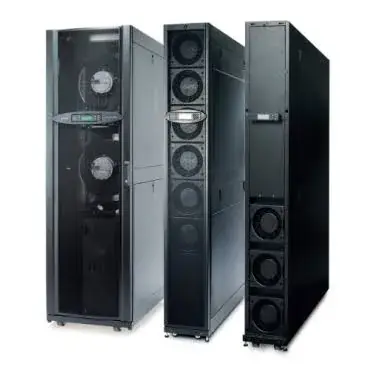
Row-mounted direct-expansion cooling spanning three refrigerant generations under one nameplate
This model is part of SecondWatt’s crac / crah research catalogue. Specifications and price observations are included where supported by sources. Equipment availability and commercial terms require confirmation.
Room and in-row air cooling runs out of headroom as rack density rises; above roughly 40 kW per cabinet the load is picked up by liquid cooling, usually retrofitted into halls that keep their CRAC units for the remaining air-cooled rows. The catalogue entries closest to that decision are ZutaCore HyperCool Two-Phase Direct-to-Chip and CoolIT Systems DCLC Direct Liquid Cooling.
Schneider Electric APC InRow RD (ACRD) direct-expansion cooling specs, refrigerant GWP transition dates, and used-market pricing for data center buyers.
Schneider Electric's InRow RD is a direct-expansion (DX) in-row cooler that slots into a 300mm or 600mm gap between server racks, sold historically under the APC brand and marketed today as Uniflair InRow Direct Expansion. The letter prefix in the model code, not the trailing number, decides whether a compressor is even present: ACRD is this DX line, ACRC is a same-numbering chilled-water sibling with no compressor at all, and ACRP is a third family that mixes DX (100/101/102) and chilled-water (500/501/502) models under one prefix.
That distinction has money attached in the resale channel. ACRC and ACRP units are routinely listed under the same "APC in-row" shorthand as ACRD, so a listing title on its own does not establish whether the unit carries a compressor, and four such listings priced between $1,500 and $3,500 are not comparable sales for an ACRD unit at all.
The line spans three refrigerant generations under one nameplate family: R-407C on the older ACRD500/501/502 reciprocating platform, R-410A across the bulk of the resale population (ACRD100/101/200/201/301/600/601/602), and R-32 only on the current ACRD101S and ACRD101P. Schneider's own transition schedule closes new R-410A orders on May 31, 2026 and requires installation by December 31, 2026 - one day ahead of the EPA's January 1, 2027 GWP-700 deadline for computer-room air conditioning.
A compliant low-GWP successor exists only at 11 kW and below, on ACRD101S and ACRD101P. Schneider publishes no R-32 SKU at the 30 kW or 42 kW capacity classes as of August 2026, leaving buyers who need larger DX capacity without a documented replacement part number.
Why it matters
The model code determines refrigerant exposure and EPA compliance timing: three DX generations (R-407C, R-410A, R-32) carry different GWP profiles and different windows for legal new installation. Misreading the ACR-prefix as interchangeable risks buying a chilled-water ACRC or mixed-medium ACRP unit by mistake, or budgeting service refrigerant against the wrong regulatory clock entirely.
Who buys it
Data center and colocation operators retrofitting hot-aisle/cold-aisle rows with supplemental spot cooling, edge and telecom site operators needing cabinet-level DX cooling, and used-equipment buyers sourcing decommissioned ACRD units for row-based capacity augmentation in raised-floor or slab environments already running aisle containment.
Role in the data center
Supplemental row-based DX cooling deployed inside a hot-aisle/cold-aisle containment scheme to add localized high-density capacity, not a room-level primary cooling replacement. It sits in the row between racks in a 300 mm or 600 mm gap, close-coupled to the load it serves, and rejects heat to an outdoor condensing unit or a building fluid loop rather than to room air handled at the perimeter.
Key specifications
| Capacity, 300mm legacy chassis | Up to 10 kW |
|---|---|
| Capacity, 600mm legacy chassis | Up to 42 kW |
| Capacity, current-gen R32 (ACRD101S/P) | 0.5-11.0 kW |
| Refrigerant, 300/600mm legacy | R410A - |
| Refrigerant, 500-series | R407C - |
| Refrigerant, current-gen | R32 - |
| Refrigerant GWP, R410A | 2088 GWP (CO2-eq) |
| Refrigerant GWP, R32 | 675 GWP (CO2-eq) |
| Equipment refrigerant charge, 300mm | 1.6 (3.5) kg (lb) |
| Voltage/phase, ACRD600 | 200-240 / 3 V / phase |
| Weight, 600mm chassis (unpackaged) | 367-413 (808-911) kg (lb) |
| Dimensions, chassis (H x D) | 1991 x 1070 mm |
| Minimum service clearance | 900 front/rear, 760 side mm |
| Electrical, MCA/MOP (ACRD600P) | 78.6 / 110 A |
| Compressor drive range, 500-series | 30-85 Hz |
| Efficiency, current-gen | 3.0 SCOP |
Technical summary
Capacity, 300mm legacy chassis: up to 10 kW. Capacity, 600mm legacy chassis: up to 42 kW. Capacity, current-gen R32 (ACRD101S/P): 0.5-11.0 kW. Refrigerant: R-410A (300/600mm legacy), R-407C (500-series), R-32 (current-gen). Refrigerant GWP: R-410A 2,088 / R-407C 1,774 / R-32 675. Equipment refrigerant charge: 1.6 kg (3.5 lb), 300mm chassis. Voltage: 200-240V / 3-phase (ACRD600 class). Weight: 367-413 kg (808-911 lb), 600mm chassis. Minimum service clearance: 900mm front/rear, 760mm side. Efficiency, current-gen: SCOP 3.0. Standards: CE / UL (current-gen).
Major variations
Three refrigerant/compressor generations share the ACRD prefix: R-407C reciprocating-compressor units (ACRD500/501/502), R-410A scroll-compressor units (ACRD100/101/200/201/301/600/601/602 and P-suffix humidified variants), and the current R-32 platform (ACRD101S/101P). The letter prefix, not the number, decides cooling medium across the wider family: ACRD is direct-expansion, ACRC (InRow RC) is chilled water with no compressor at all, and ACRP (InRow RP) mixes DX (100/101/102) and chilled-water (500/501/502) models under one prefix - the reason two ACRC chilled-water units and two ACRP units routinely appear in the resale channel under the same "APC in-row" shorthand as genuine ACRD stock. Engineering lineage traces to APC's InfraStruxure architecture, launched in 2003, four years before Schneider Electric completed its 2007 acquisition of APC.
Configurations and options
Base and humidified/reheat variants share a chassis but not the hardware: the P-suffix SKUs (600P, 601P, 602P, 101P) carry the humidifier and reheat module and the base SKUs do not. Condenser medium is a separate choice: air-cooled units reject heat to an outdoor ACCU-series condensing unit, while the fluid-cooled ACRD200/201 chassis rejects to a building condenser-water or glycol loop, with the compressor and refrigerant circuit present either way. Chassis width is 300 mm or 600 mm, and electrical service runs from 25 A MCA / 40 A MOP on a 300 mm single-phase unit to 78.6 A / 110 A on a 600 mm three-phase humidified unit.
Compatibility and dependencies
Even the largest InRow RD chassis (ACRD600 series) tops out at up to 42 kW, roughly 12 tons - a fraction of the 12-30-ton perimeter CRAC units in the broader category, so a single in-row unit is never a tonnage-matched substitute for a perimeter unit; matching room capacity means deploying several units in an array. It is a split system requiring a matched outdoor condensing unit (e.g. ACCU100 on the R32 platform) within a 46 m (150 ft) maximum equivalent refrigerant-line length, and its short close-coupled air path is designed around hot/cold aisle containment rather than open-room delivery.
Pricing and availability
Published price range: $1,300 to $27,649 across 7 observations (used to new/reseller list). Comparable secondary-market band: 1500–3500 $ per unit. Trend: stable Lead time, new: Schneider states no lead time in days or weeks for the line; reseller stock status ranged from in-stock (Gruber Power) to temporarily out-of-stock (Connection.com) and out-of-stock (SabrePC) across the observations.. Warranty, new: One-year factory warranty covering parts, labor and travel; excludes loss of refrigerant, consumables and preventive maintenance items, per the OEM O&M manual.. Warranty, used: 30-day return window observed on both eBay used-unit listings (a marketplace return policy, not a manufacturer functional warranty)..
Lifecycle and maintenance
Schneider's own dates for ACRD301S, part of this same family, show end of commercialization October 15, 2026 and end of standard service October 15, 2036 - a ten-year support tail. New units carry a one-year factory warranty on parts, labor and travel, explicitly excluding loss of refrigerant and preventive maintenance items. Refrigerant charge runs 3.5 to 24 lb across the family, well under the 50 lb full-charge threshold that triggers EPA's mandatory leak-repair-rate rule, so that specific mandate does not bind on a single unit. Schneider publishes no compressor MTBF and no hours-based overhaul interval for the line.
Thermal and emissions profile
Three refrigerant generations exist under one nameplate family. R-407C (GWP 1,774) runs the older ACRD500/501/502 reciprocating platform; R-410A (GWP 2,088) covers the bulk of the resale population (ACRD100/101/200/201/301/600/601/602); R-32 (GWP 675) is confirmed only on the current ACRD101S and ACRD101P, the sole variant already below EPA's 700 GWP ceiling taking effect for computer-room air conditioning on January 1, 2027. Existing R-410A and R-407C units remain legal to operate, relocate and service indefinitely - only new manufacture and new installation are restricted.
Common failure points
- Compressor (reciprocating, 500-series) — Frequent short-cycling or failure to reach setpoint despite fans running normally
- Compressor (scroll, R410A 300/600mm) — High discharge-temperature alarm or locked-rotor trip on restart after a period idle
- Refrigerant circuit / brazed joints — Repeated low-charge alarms shortly after a recharge
- EC/VFD fan assembly — Airflow-proving alarm trips, or unit runs unusually loud or imbalanced
- Control board / network management card — Unit will not report into a current building management system or NMC web interface
- Condensate pump / drain pan — Water-detection alarm trips, or visible residue and scale in the drain pan
- Humidifier / reheat module (P-suffix units only) — Humidity setpoint drift or the reheat coil fails to energize on demand
Inspection checklist
Confirm nameplate refrigerant against the physical unit: legacy 300mm/600mm chassis carry R410A while the 500-series (ACRD500/501/502) carries R407C, and the model number alone does not reveal which. Pull total logged compressor and fan run-hours from the unit's own controller display: the InRow RD controller tracks run time independently per major component and a reset after a swap erases that history. Verify refrigerant charge against OEM nameplate: 1.6 kg (3.5 lb) equipment charge on the 300mm chassis, rising to 2.2-10.93 kg once a matched outdoor condenser is included. Pressure-test the circuit and hold for a documented period before rigging: an unrecorded reading at pickup leaves no baseline to prove a later leak occurred in transit rather than at the seller's dock.
Procurement channels
New and reseller-list stock moves through IT hardware resellers: Connection, SabrePC, Gruber Power Services and compsource.com all list ACRD part numbers, with new 300 mm units observed at $16,118 to $18,491 per unit. Used and decommissioned units surface on eBay, where two ACRD observations sat under $2,100. Schneider's own product pages quote rather than list.
Regional notes
Voltage variants observed (200-240V single-phase, 200-240V/460-480V/380-415V three-phase) map to US and international grid standards; every published InRow RD price as of August 2026 is a US-dollar reseller or marketplace listing; no euro-denominated channel lists the line.