Eaton Pow-R-Way III
Manufacturer: Eaton
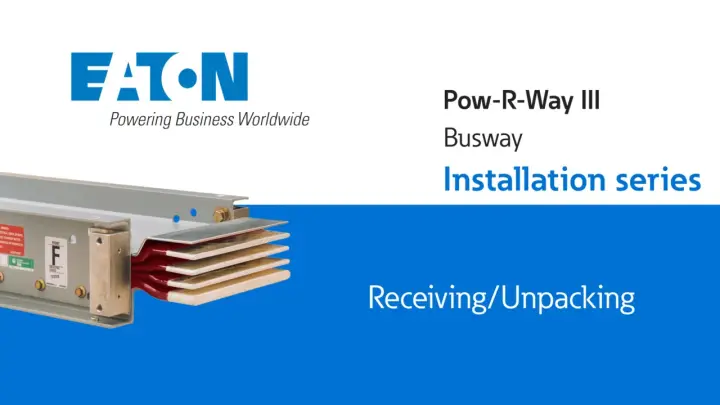
Eaton's 225-5000 A UL 857 busway; its plug-in units will not fit a Pow-R-Way or Pow-R-Way II run without a factory adapter
This model is part of SecondWatt’s busway research catalogue. Specifications and price observations are included where supported by sources. Equipment availability and commercial terms require confirmation.
Eaton Pow-R-Way III busway specs, UL and IEC short-circuit ratings, Pow-R-Way II fit issues, and used equipment pricing for data center buyers.
Eaton Pow-R-Way III is the current generation of Eaton's rigid overhead busway line, rated 225-5000A copper or 225-4000A aluminum at 600V under UL 857 and CSA C22.2 No. 27-94. It replaced Pow-R-Way II in 1997 with a two-piece aluminum housing, finger-safe IP2X plug-in openings, and higher short-circuit withstand ratings than the two generations before it.
Eaton's own aftermarket parts catalogue states plainly that plugs for vintage Cutler-Hammer bus, Pow-R-Way bus, and Pow-R-Way III bus are not interchangeable. Eaton sells a special-order factory adapter line to bridge Pow-R-Way III plug-in technology onto existing Westinghouse-era Pow-R-Way and Pow-R-Way II runs, but no catalogue number or price is published, and a buyer must contact the Greenwood, SC factory directly rather than order a listed part.
That is a weaker posture than Schneider Electric's I-Line family, where PBQ 400-600A fusible switches are a standard catalogue part factory-rated for both I-Line and I-Line II with no adapter required. Eaton's literature does not address the reverse case either: no Eaton catalogue or design guide states whether an original Pow-R-Way or Pow-R-Way II plug-in unit will seat in a Pow-R-Way III housing.
The Pow-R-Way name traces to a 1971 Westinghouse product rated 600-5000A and a narrower 1975 Pow-R-Way II rated 225A and 400A only, with the brand passing to Eaton through its 1993-94 acquisition of Westinghouse's Distribution and Control Business Unit. Under IEC 61439-6 the same physical product is separately certified to 660V with a higher current ceiling than its UL listing.
Why it matters
The interchangeability gap is the practical risk: a used Pow-R-Way II run cannot accept a current-production Pow-R-Way III plug-in off a distributor shelf, only through an unpriced, unlisted factory adapter. That materially changes the resale calculus for older Eaton and Westinghouse stock compared with Schneider's I-Line family, where cross-generation fit is a published, standard-catalogue guarantee rather than a special-order bridge.
Who buys it
Data center and mission-critical facility owners standardizing on Eaton's low-voltage distribution ecosystem; general contractors and electrical distributors sourcing decommissioned or overstock Pow-R-Way III sections for reuse; and buyers of legacy Westinghouse-era Pow-R-Way or Pow-R-Way II stock who need to confirm, before purchase, whether current plug-in units will actually fit.
Role in the data center
Eaton markets Pow-R-Way III directly for data center grey-space distribution, alongside high-rise, manufacturing, university/hospital, EV-charging-depot, and utility-substation use. Within a data hall it carries bulk power from switchgear or an RPP to load centers as feeder busway, or runs overhead with tap-off plug-in units where rack layouts need to change, the same feeder-versus-plug-in split that defines the busway category generally.
Key specifications
| Current rating, copper conductor | 225-5000 A |
|---|---|
| Current rating, aluminum conductor | 225-4000 A |
| System voltage, UL/NEC-rated | 600 V |
| System voltage, IEC-rated | 660 V |
| Short-circuit withstand range, UL (6-cycle rms symmetrical) | 85,000-200,000 A |
| Short-circuit withstand range, IEC (1-second rms symmetrical) | 25,000-120,000 A |
| Feeder busway stick length range | 16 in to 10 ft, in 1/8 in increments in / ft |
| Plug-in busway stick length range | up to 10 ft, in 24 in increments in / ft |
| Weight range, copper conductor (225A-5000A) | 14.6-79.0 lb/ft |
| Copper conductor conductivity | ~99 % IACS |
| Aluminum conductor conductivity | ~57 % IACS |
| Conductor insulation class / temperature rating | Class B / 130 C |
| IP rating range by configuration | IP2X-IP66 IP |
| Standards listing | UL 857, CSA C22.2 No. 27-94, IEC 61439-6 (DEKRA/KEMA-certified) - |
| Seismic certification | IBC + California Building Code, exceeds Zone 4 requirements - |
| Field / maintenance joint bolt torque | 55-65 (74.6-88.1) ft-lb (N-m) |
Technical summary
Current rating: 225-5000A copper, 225-4000A aluminum. Voltage: 600V UL/NEC listing; 660V under IEC 61439-6 (DEKRA/KEMA-certified). Short-circuit withstand: 85,000A UL (6-cycle) vs 35,000A IEC (1-second) at the 225-600A class. IEC current ceiling exceeds UL ceiling: 6,300A copper / 4,800A aluminum vs 5,000A / 4,000A UL. IP rating range: IP2X at plug-in openings up to IP66 for severe outdoor feeder. Seismic: certified to IBC and California Building Code, stated to exceed Zone 4 requirements. Feeder stick length: 16in to 10ft, in 1/8in increments. Plug-in stick length: 24in increments up to 10ft maximum. Joint bolt torque: 55-65 ft-lb (74.6-88.1 N-m) at every field joint. Conductor insulation: Class B epoxy, 130C rating. Cross-generation plugs: Pow-R-Way, Pow-R-Way II and Pow-R-Way III are not interchangeable.
Major variations
Original Pow-R-Way (Westinghouse, 1971): rated 600-5000A, sandwich design in feeder and plug-in, bolt-end/slot-end single-bolt connection. Pow-R-Way II (Westinghouse, 1975): a narrower line rated 225A and 400A only, single captive-bolt-per-bar design, indoor horizontal applications only. The brand passed to Eaton on August 11, 1993, when Eaton agreed to acquire Westinghouse's Distribution and Control Business Unit for $1.1 billion, merging it into Eaton's Cutler-Hammer-branded distribution operations; the U.S. Department of Justice cleared the deal, with a required divestiture to Thomas & Betts, on January 31, 1994. Pow-R-Way III launched in 1997 under Eaton, with a two-piece extruded aluminum housing, IP2X finger-safe plug-in openings, and higher short-circuit withstand ratings than either predecessor.
Configurations and options
Four physically interchangeable-without-adapters configurations at matched current and system rating: outdoor feeder (IP55), indoor feeder (IP40), indoor plug-in (IP40, IP2X at the plug-in opening itself), and indoor sprinkler-proof plug-in (IP54); a severe outdoor feeder option reaches IP66. Circuit-breaker frame designations span F-Frame (10-225A) through K-Frame (100-400A), L-Frame (300-600A), and up through MDL/N-Frame (400-800A), with fusible-switch plug-in units offered from 30-800A across multiple mounting orientations.
Compatibility and dependencies
Eaton's own aftermarket parts catalogue (CA08100014E) states plainly that plugs for vintage Cutler-Hammer bus, Pow-R-Way bus, and Pow-R-Way III bus are not interchangeable, and structures its replacement-parts tables separately by generation. A Pow-R-Way III plug-in unit does not seat directly in an original Pow-R-Way or Pow-R-Way II housing's tap opening, or vice versa. Eaton does publish a bridge: a special-order factory adapter line that lets Pow-R-Way III plug-in technology be added to existing Westinghouse-era Pow-R-Way, Pow-R-Way II, low impedance busway, current-limiting busway, and obsolete Cutler-Hammer CP2/CP3/CP4 Safetybus runs, without replacing the whole run.
Pricing and availability
Published price range: $72.30-$177.78 per linear foot (used and new-surplus 10 ft sections). Trend: stable
Lifecycle and maintenance
No OEM-published design-life figure exists for Pow-R-Way III. Eaton's installation manual (IB01701001E, effective January 2025) calls for annual maintenance inspection, including Belleville-washer compression checks and re-torquing joint bolts to 55-65 ft-lb (74.6-88.1 N-m) whenever a joint is disturbed or relocated. Eaton still sells a new replacement plug-in unit for the original 1971 Pow-R-Way line today, catalog number IPTB400 at $7,683.99 sale price and listed Normally In Stock at RSP Supply, showing parts support has stayed active for more than five decades past introduction, though that is evidence of continued parts availability, not a stated OEM design-life commitment.
Thermal and emissions profile
Pow-R-Way III uses no refrigerant and produces no emissions, so refrigerant GWP and EPA transition rules do not apply to this equipment class. The comparable cross-standard question for busway is UL versus IEC short-circuit withstand: Eaton rates the 225-600A class at 85,000A under UL 857's 6-cycle test but only 35,000A under IEC 61439-6's 1-second test on the identical physical product. That roughly 2.4-times gap reflects test duration rather than two differently built products, though Eaton's own literature does not state that reconciliation explicitly. Its IEC certification, at 660V, also carries a higher current ceiling (6,300A copper, 4,800A aluminum) than the 600V UL listing's 5,000A copper ceiling.
Common failure points
- Joint (bolted busbar connection) — Localized hot spot on thermal scan, discoloration or oxidation at the joint face
- Belleville washer/spring assembly — Washer visibly flattened or uncompressed at a joint that has seen thermal cycling
- Silver-plated contact surface (plug-in tap opening) — Base metal visible through worn plating, elevated resistance reading on test
- Epoxy insulation (Class B, 130C) on bus bars — Cracking, chalking, or brittleness on visual or flex inspection, most likely on stock predating Pow-R-Way III's 1997 introduction
- Aluminum housing (outdoor or older stock) — Staining, pitting, or corrosion at seams consistent with past water ingress
- Ground path (integral housing ground or isolated ground bus) — Continuity reading measurably above 0 ohms end-to-end
- Cross-generation plug-in mismatch — A Pow-R-Way III plug-in unit will not physically seat in an original Pow-R-Way or Pow-R-Way II housing's tap opening, or vice versa
Inspection checklist
Joint bolt torque: verify 55-65 ft-lb (74.6-88.1 N-m) at every field joint before re-energizing, per Eaton IB01701001E. Torque-indicating shear-bolt heads: confirm every bolt sheared cleanly at its factory-set torque; an unsheared head signals an under-torqued joint from original installation. Belleville washer compression: visually inspect at every joint; an uncompressed washer means clamping force has relaxed and the joint needs re-torquing. Thermal imaging scan: request the seller's most recent full-load infrared survey and compare against at least 2 prior scans of the same joints, since no single universal trip-temperature threshold is published. Silver-plated contact surfaces at every plug-in tap opening: check for wear-through to base copper or aluminum, which raises contact resistance and cannot be reversed by cleaning.
Procurement channels
New and gray-market/new-surplus stock moves through authorized-distributor-style resellers (RSP Supply, IGAM) and liquidation dealers (Freeman Liquidators, West Michigan Industrial Surplus). Used stock, including legacy Westinghouse-branded Pow-R-Way, moves through eBay sellers describing themselves as industrial surplus dealers (Upstate Breaker Wholesale, EMSCO Sales, varietyindustrialsupply) and through general surplus-equipment dealers (SPW Industrial).
Regional notes
The UL 857 / 600V product line is the North American configuration. The identical physical product is separately DEKRA/KEMA-certified to IEC 61439-6 at 660V with a higher current ceiling for international markets, and its published short-circuit withstand figures are not directly comparable between the two certifications because of differing test durations.