Siemens SENTRON 3WA air circuit breaker (current generation)
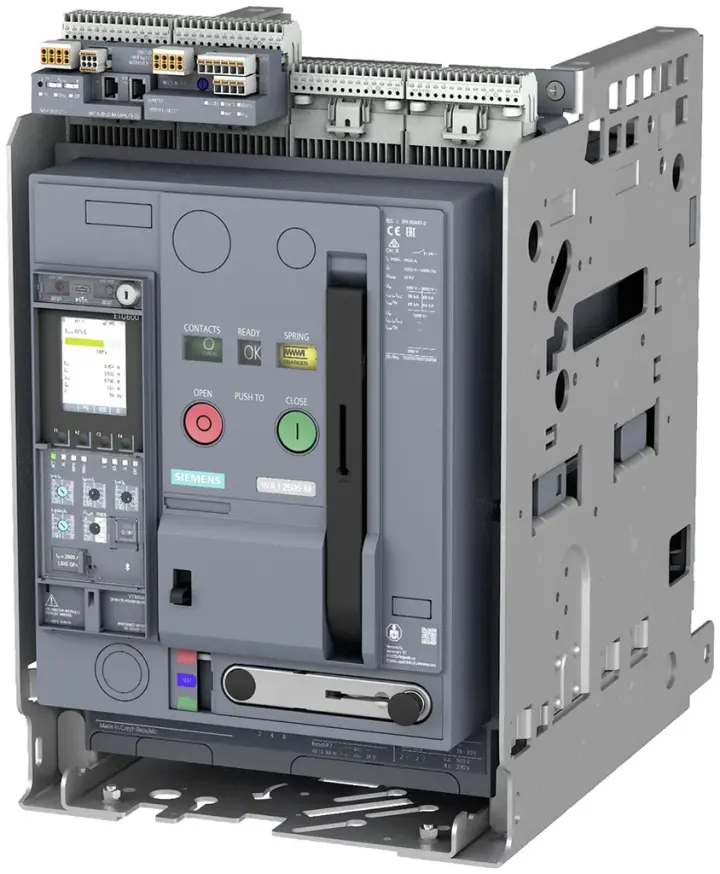
Siemens SENTRON 3WA air circuit breakers, the current 630-6,300 A generation and designated 3WL retrofit path
Siemens SENTRON 3WA air circuit breaker (current generation) is one of 41 data center switchgear tracked in the SecondWatt catalogue, each with specifications, lead times and indicative secondary-market pricing.
Siemens SENTRON 3WA dossier: current-generation air breakers 630-6,300 A to 150 kA, 3WL retrofit path, gray-market watch, inspection checklist.
Why it matters
Every OEM breaker transition creates a decade of retrofit and spares demand, and 3WL-to-3WA is the largest such transition now running: October 2026 ends 3WL production while millions of cubicles stay in service. Tracking 3WA gray-market formation from day one gives SecondWatt the pricing history competitors will lack.
Who buys it
Switchboard builders and data center electrical contractors buy 3WA new for UL 891/UL 1558 boards; 3WL owners buy 3WA retrofit kits as the phase-out lands. Used-market buyers have little to work with yet; project-surplus units will be the first tradable supply.
Role in the data center
Main and feeder ACBs in new LV switchboards and as the retrofit engine inside the 3WL installed base feeding UPS and mechanical buses.
Key specifications
| Current range | 630-6,300 A |
|---|---|
| Interrupting class | to 150 kA |
| Standards | IEC 60947-2; UL 1066/489 variants |
| Trip units | ETU600 series |
| Communications | PROFINET / Modbus TCP |
| Retrofit role | designated 3WL conversion path |
| 3WL phase-out driver | October 2026 |
| Owner correction | Siemens AG Smart Infrastructure |
Technical summary
Range: 630-6,300 A, three frame sizes Interrupting: to 150 kA class Standards: IEC 60947-2; UL 1066 / UL 489 (3WA8 variants) Trip units: ETU600 series, integrated metering Communications: PROFINET, Modbus TCP, PROFIBUS options Builds: fixed and withdrawable, 3P/4P Position: successor and retrofit path for SENTRON 3WL Retrofit kits: convert 3WA into existing 3WL cubicles Owner: Siemens AG Smart Infrastructure (Electrical Products)
Pricing and availability
Trend: up Lead time, new: Distributor quote; Siemens expanding US capacity (165M USD Carolinas). Lead time, used or refurbished: No meaningful used channel yet. Warranty, used: 1-year typical from reconditioning dealers.
Lifecycle and maintenance
LV power circuit breakers serve 30-40 years on 3-5 year maintenance cycles per ANSI/NETA MTS and NFPA 70B, with mechanism lubrication and injection testing the critical items. A deep reconditioning ecosystem (Relectric, NAS, Bay Power, Bullock) tests to NETA specifications and warrants units for 1 year. OEM trip-unit retrofit programs (Eaton PXR, ABB EntelliGuard R, Siemens 3WA retrofit) extend installed platforms past electronics obsolescence, which sustains used-breaker values.
Common failure points
- Mechanism springs and lubrication — Slow trips, trip-free on close, failure to latch on aged units
- Trip unit electronics — Nuisance trips or no-trip from aged or obsolete electronics
- Contacts and arc chutes — Overheating and interruption failure from eroded contacts or cracked chutes
- Secondary wiring — Control faults from damaged secondary disconnects and aux switches
- Provenance and counterfeits — Counterfeit or mis-labeled breakers fail catastrophically under fault
- Cassette and racking wear — Misalignment and cluster contact damage on worn cradles
Inspection checklist
Mechanism — exercise open/close 10+ cycles; verify charge/close/trip sequence without trip-free behavior Trip curve — primary injection test; NETA field data shows 22% of LV power breakers off their published curves Secondary injection — verify all 4 protection functions (LSIG) against settings; record as-found/as-left values Contact resistance — micro-ohm test each pole; investigate readings above 1.5x sister poles Insulation resistance — megger at 1,000 V per ANSI/NETA MTS acceptance tables Contact wear — inspect arcing contacts and wear indicators against the OEM replacement limit Arc chutes — remove and inspect for cracks, erosion, and metal splatter; replace damaged chutes Lubrication — verify mechanism grease condition; dried lubricant is the leading slow-trip cause on 20+ year units Racking — exercise draw-out mechanism through connect/test/disconnect; verify shutter operation Auxiliary wiring — verify secondary disconnects, charging motor voltage (24-125 V options), and aux contacts Trip unit vintage — identify electronics generation; obsolete trip units reprice the breaker toward core value Counterfeit screen — verify serial numbers with the OEM; counterfeit LV breakers documented since the 2007 CPSC recall Ratings match — confirm frame, sensor/rating plug, and interrupting rating (kA at 480 V) against the application Listing match — verify cassette/cradle compatibility and UL 1066 or UL 489 listing matches the switchgear type Records — factory test report, service history, and injection results; missing records reprice toward as-is
Procurement channels
Siemens distribution for new; Surplus Record shows unused-surplus 3WA units price-on-request; gray-channel offers exist but lack provenance. The 3WL aftermarket is the price benchmark until 3WA supply forms.